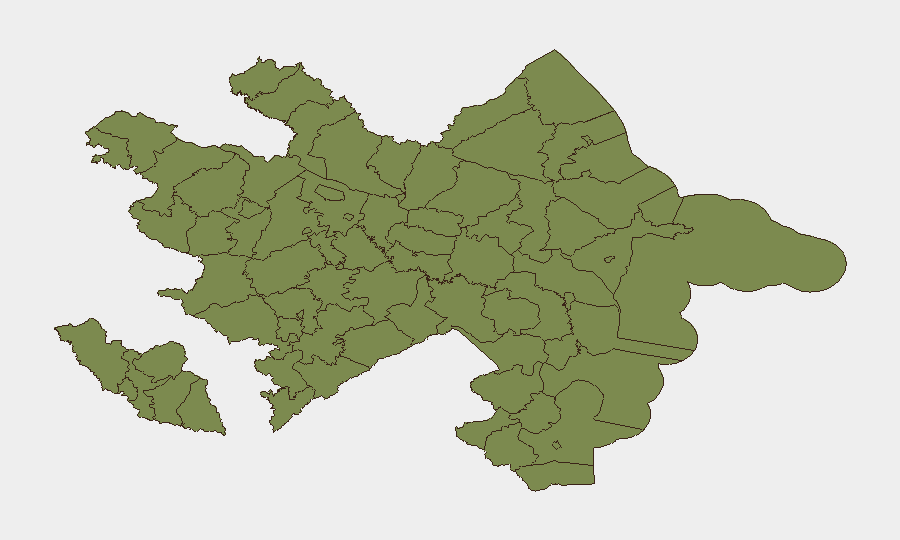
Situation Summary
Azerbaijan remains a relatively stable country by regional standards, ranked #106 globally with a composite threat score of 9. Current developments reflect governance shifts and localized incidents rather than systemic security breakdown. The main areas of concern are concentrated in Baku and border districts, with recent policy changes affecting information control and online access. No large-scale conflict, civil unrest, or organized crime activity has been reported in the past 24–48 hours.
Key Developments
- Ganja, Azerbaijan – mass food poisoning at memorial ceremony, 13 July 2026. Eight people were hospitalized after consuming homemade food at a memorial event. All were discharged in satisfactory condition; food samples remain under laboratory investigation. Authorities are treating this as a localized public-health incident with no confirmed evidence of deliberate contamination.
- Nationwide – expanded internet blocking authority without court order, 13–14 July 2026. Azerbaijan's amended Law on Information now permits state bodies to block websites administratively for content deemed insulting, defamatory, or promoting drugs, pornography, gambling, or suicide—in addition to existing emergency powers. These rules are already in effect and do not require prior judicial authorization.
- Baku – consideration of full Council of Europe withdrawal, 13 July 2026. President Ilham Aliyev signaled potential withdrawal from the Council of Europe, characterizing its demands on Azerbaijan as "absolutely unacceptable." This reflects escalating diplomatic friction over human-rights and governance standards.
- Baku – public statements on Russia–Ukraine war and U.S.–Iran tensions, 13 July 2026. President Aliyev called for immediate cessation of the Russia–Ukraine conflict and commented on the possibility of U.S.–Iran peace, positioning Azerbaijan as engaged with regional diplomatic dynamics. No domestic security incidents accompanied these statements.
- Nationwide – continued investigation into Ganja poisoning, 13–14 July 2026. Multiple local and regional news outlets are tracking the food-poisoning case; authorities are actively investigating without signs of escalation into targeted attack, civil unrest, or organized criminal involvement.
Highest-Risk Areas
Baku City dominates the risk profile with a score of 31.5—roughly 21 times higher than any other subnational area. This reflects concentration of government, business, and foreign presence, combined with sensitivity to political and diplomatic developments. Ujar District ranks second (risk 9), while all remaining districts score 1.5, indicating a steep risk gradient concentrated in the capital and select border areas. Border districts (Sadarak, Qazakh, Sharur, Tovuz, and Nakhchivan) carry baseline tensions related to historical Armenia–Azerbaijan disputes and cross-border dynamics, but current reporting shows no active escalation.
How GeoBit Would Assist
Security teams would use Intel Sweep and multi-language OSINT to monitor emerging governance changes—such as internet blocking enforcement—and their downstream effects on situational awareness and secure communications. AOI Monitoring with alerting on Baku, Ganja, and border districts would provide early warning of civil unrest, public-health crises, or cross-border incidents. Network & Actor Analysis focused on government communications and diplomatic signals would help track policy shifts, such as Council of Europe relations, that may signal broader instability.
7-Day Outlook
No major security incidents are forecast for the next seven days. Attention should remain on implementation of the new internet blocking law and its impact on operational communications and media access. Diplomatic tensions with European institutions may escalate rhetoric but are unlikely to translate into immediate domestic security threats. Border areas warrant routine monitoring for spillover effects from regional conflicts, particularly if tensions between Armenia and Azerbaijan resurface.
Highest-Risk Areas — Ranked
| # | State / Region | Risk |
|---|---|---|
| 1 | Baku City | 31.5 |
| 2 | Ujar District | 9 |
| 3 | Sadarak District | 1.5 |
| 4 | Qazakh District | 1.5 |
| 5 | Sharur District | 1.5 |
| 6 | Yevlakh District | 1.5 |
| 7 | Kangarli District | 1.5 |
| 8 | Nakhchivan Autonomous Republic | 1.5 |
| 9 | Aghstafa District | 1.5 |
| 10 | Tovuz District | 1.5 |
| 11 | Qakh District | 1.5 |
| 12 | Shaki | 1.5 |
Previous Daily Briefs
A new Azerbaijan brief is written every day — each with its own risk map and downloadable CSV. Here's the last week; use the calendar to go further back.
📅 Browse every day by calendar →
Highlighted days have a brief. Tap a day for that day's map & analysis, or “csv” for that day's dataset ($5).
Atlas — our AI intelligence desk — emails them this snapshot personally. Nothing else, no list.