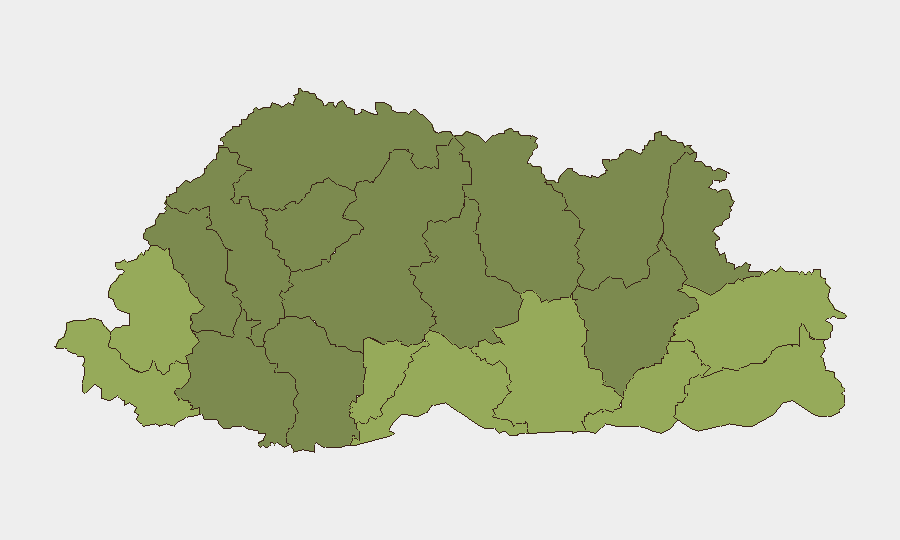
Situation Summary
Bhutan remains in a stable, low-threat security environment with no confirmed incidents, civil unrest, crime events, or infrastructure failures reported in the last 24–48 hours. The country's composite threat score of 2 places it outside the tracked global threat ranking; open-source monitoring across news, social media, and government alerts has detected no acute security developments. Border districts adjacent to India and Tibet maintain elevated background risk ratings, but these reflect structural factors rather than active incidents.
Key Developments
No discrete security, crime, unrest, or infrastructure incidents have been reported in Bhutan in the last 24–48 hours.
Open-source monitoring confirms:
- No alerts issued by Bhutan's Ministry of Health, national emergency services, or central government in the last 24–48 hours indicating acute public-safety, health, or infrastructure risk.
- Fourth Thromde local elections remain in candidate-selection and administrative phases; Bhutanese media report no protest activity, violence, or electoral disruptions tied to these preparations.
- No cross-border incidents documented involving Bhutanese territory or spillover from neighboring regional conflicts (including Myanmar) in the current 24–48 hour window.
- No verified social-media reports of crime, civil disorder, or travel disruptions in major towns or transportation routes.
Highest-Risk Areas
Samtse, Sarpang, Haa, and Pemagatshel districts register the highest composite risk scores (58, 55, 52, and 50 respectively), reflecting their geographic position along Bhutan's borders with India and Tibet/China, historical cross-border commodity movement, and limited state infrastructure density. These risk ratings are background assessments rather than indicators of active incidents; no new events in these districts have been confirmed in the 24–48 hour window. Mid-tier risk districts (Samdrup Jongkhar, Tsirang, Zhemgang) show elevated scores tied to similar border-area structural factors. Central and northern districts (Wangdue Phodrang, Gasa, Lhuntse) carry lower risk profiles, consistent with stronger state presence and distance from disputed or high-permeability borders.
How GeoBit Would Assist
Security teams with personnel or assets in Bhutan would employ AOI Monitoring & Early Warning to establish persistent watch on border districts and major population centers, with automated alerting on emerging incidents. Intel Sweep and multi-language OSINT fusion (including Bhutanese media, social platforms, and government channels) provides 24/7 coverage of security, health, and infrastructure developments; election monitoring capabilities track political stability during the Thromde process. GIS & Spatial Analysis and alternative routing tools support duty-of-care planning for staff movement, particularly in higher-risk border districts.
7-Day Outlook
No acute security threats are anticipated in the next seven days based on current trajectory and open-source indicators. Continued focus should remain on border districts and election-related developments, though neither has produced incidents in recent weeks. Regional stability in neighboring areas (India, Tibet) remains the primary exogenous risk factor; any significant cross-border disruption would be the primary trigger for escalated Bhutan-specific monitoring.
Highest-Risk Areas — Ranked
| # | State / Region | Risk |
|---|---|---|
| 1 | Samtse District | 58 |
| 2 | Sarpang District | 55 |
| 3 | Haa District | 52 |
| 4 | Pemagatshel District | 50 |
| 5 | Samdrup Jongkhar District | 48 |
| 6 | Tsirang District | 45 |
| 7 | Zhemgang District | 42 |
| 8 | Trashigang District | 40 |
| 9 | Mongar District | 38 |
| 10 | Gasa District | 35 |
| 11 | Lhuntse District | 32 |
| 12 | Wangdue Phodrang District | 30 |
Previous Daily Briefs
A new Bhutan brief is written every day — each with its own risk map and downloadable CSV. Here's the last week; use the calendar to go further back.
📅 Browse every day by calendar →
Highlighted days have a brief. Tap a day for that day's map & analysis, or “csv” for that day's dataset ($5).
Atlas — our AI intelligence desk — emails them this snapshot personally. Nothing else, no list.