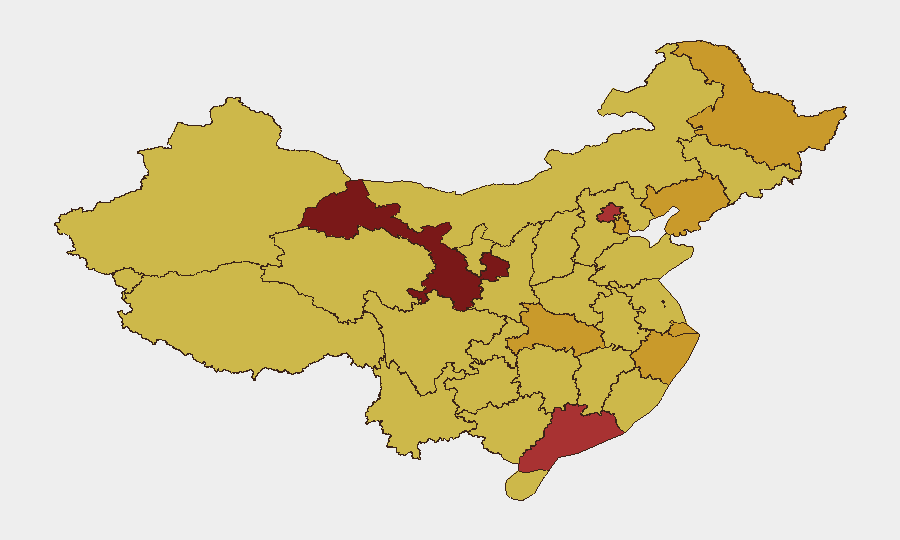
Situation Summary
China remains a composite threat level 2 globally, with 801 tracked security events reflecting heightened geopolitical tension, enforcement actions targeting foreign nationals and companies, and elevated cyber-intrusion risk. The past 48 hours have seen intensified foreign-ministry messaging on legal compliance, detention of Japanese nationals over alleged export violations, and continued PLA naval operations near Taiwan. International intelligence agencies have issued joint warnings on Chinese AI-enabled cyber capabilities, signaling near-term elevated risk to corporate IT infrastructure and sensitive intellectual property across sectors. The threat environment is dynamic and enforcement-driven rather than acute, but regulatory and security-apparatus activity is visibly accelerating.
Key Developments
- Dalian, Liaoning – 24 June 2026 – China's Foreign Ministry confirmed detention of two Japanese nationals by "Chinese competent authorities" for allegedly violating Chinese law in connection with rare-earth product exports. The ministry issued formal guidance to all foreign nationals and companies to strictly observe Chinese law, directly linking enforcement to national security authorities.[2]
- Beijing (national) – 24 June 2026 – Foreign Ministry emphasized that foreign nationals and firms operating in China "must abide by Chinese laws and regulations," explicitly tying recent detentions to state security enforcement. This signals sustained, near-term compliance risk for foreign staff and executives in strategic-materials and security-sensitive sectors.[2]
- Taiwan Strait (Fujian coast–Taiwan transit) – 23 June 2026 – PLA aircraft carrier *Fujian* conducted a north–south transit of the Taiwan Strait escorted by other naval vessels, its first such mission since April. Taiwan's Defense Ministry confirmed the movement; no direct confrontation reported, but regional maritime-navigation risk elevated.[1]
- National / Cyber domain – 24 June 2026 – Five Eyes intelligence issued a joint alert warning that rapid advances in Chinese AI frontier models (including GLM-5.x) are increasing the risk of sophisticated cyberattacks against government and corporate systems. Axios reporting links this to accelerating Chinese AI development and urgent need for strengthened corporate cyber-resilience.[3][4]
- Dalian, Liaoning – 24 June 2026 – The 17th Summer Davos (World Economic Forum Annual Meeting of the New Champions) opened with Premier Li Qiang attending. Large international forums in China typically trigger elevated security measures, movement controls, and potential short-notice travel/logistics restrictions in host cities.[2]
- National / Public-health infrastructure – 24 June 2026 – World Bank project documentation describes a "China Emerging Infectious Diseases Prevention, Preparedness and Response Project," indicating international attention to China's health-security and emergency-response infrastructure relevant to medium-term travel and outbreak-response planning.[7]
Highest-Risk Areas
Gansu (risk 100) ranks as the single highest-risk province, followed closely by Guangdong (78.8) and Beijing (78.6). The concentration of elevated risk in coastal and major-city regions—Guangdong, Shanghai, Liaoning, Zhejiang, and Tianjin—reflects both economic-espionage activity, enforcement operations in trade-sensitive zones, and proximity to international borders and strategic waterways. Gansu's outlier risk score warrants targeted intelligence inquiry into current drivers; Beijing and Shanghai's risk reflects ongoing state-security operations and foreign-national enforcement.
How GeoBit Would Assist
Intel Sweep and multi-language OSINT fusion enable real-time tracking of Foreign Ministry statements, security-authority press releases, and cross-correlated reporting on detentions and enforcement actions affecting foreign staff. Network & Actor Analysis and entity extraction pinpoint which sectors, companies, and individuals are subject to heightened enforcement focus. AOI Monitoring & Early Warning on Dalian, Beijing, Shanghai, Liaoning, and other high-risk regions can provide persistent watch on movement controls, security activities, and travel restrictions that directly impact duty-of-care and operational continuity. Cyber intelligence feeds track Chinese state-linked intrusion campaigns and AI-enabled attack vectors.
7-Day Outlook
Enforcement intensity is expected to remain elevated through the Summer Davos event (closing ~27 June), with heightened security cordons in Dalian and potential spillover restrictions in other major cities. Foreign nationals in strategic sectors (materials, energy, AI, defense supply chains) face near-term legal-compliance and detention risk; cyber-intrusion attempts against corporate networks are likely to continue or escalate. No acute civil or military escalation is currently forecast, but compliance-driven regulatory actions and PLA naval operations in the Strait will remain steady-state drivers of operational risk.
Highest-Risk Areas — Ranked
| # | State / Region | Risk |
|---|---|---|
| 1 | Gansu | 100 |
| 2 | Guangdong Province | 78.8 |
| 3 | Beijing | 78.6 |
| 4 | Shanghai | 72.4 |
| 5 | Liaoning | 72 |
| 6 | Heilongjiang | 71.9 |
| 7 | Zhejiang | 71.9 |
| 8 | Tianjin | 71.4 |
| 9 | Hubei | 71.3 |
| 10 | Tibet | 70.8 |
| 11 | Jiangsu | 70.7 |
| 12 | Guangxi | 70.5 |
Sources
Previous Daily Briefs
A new China brief is written every day — each with its own risk map and downloadable CSV. Here's the last week; use the calendar to go further back.
📅 Browse every day by calendar →
Highlighted days have a brief. Tap a day for that day's map & analysis, or “csv” for that day's dataset ($5).