Situation Summary
Eswatini remains a low-threat environment globally (rank #126; composite score 9) with no discrete security incidents tracked in the current reporting window. The country's security baseline is stable, though sub-national risk concentration in the eastern and southern regions (Lubombo and Shiselweni) warrants monitoring for localized criminal and governance concerns. No imminent escalation is evident from available signals.
Key Developments
- Mbabane, 2026-08-11 to 2026-08-13: Ministry of Natural Resources and Energy issued a public fraud alert regarding a counterfeit procurement document circulating online, indicating active public-sector social-engineering and document-forgery activity targeting government contracting processes.
- No verified operational security incidents reported in the last 24–48 hours. Web and social-media monitoring did not yield fresh unrest, crime, or conflict events meeting cross-confirmation thresholds for this period.
- Earlier context (outside current window): Media coverage through 2026-08-12 concerning US-deported individuals reportedly observed in Matsapha has raised detention-oversight and community-safety questions, though the underlying event predates the 24–48-hour reporting window.
Highest-Risk Areas
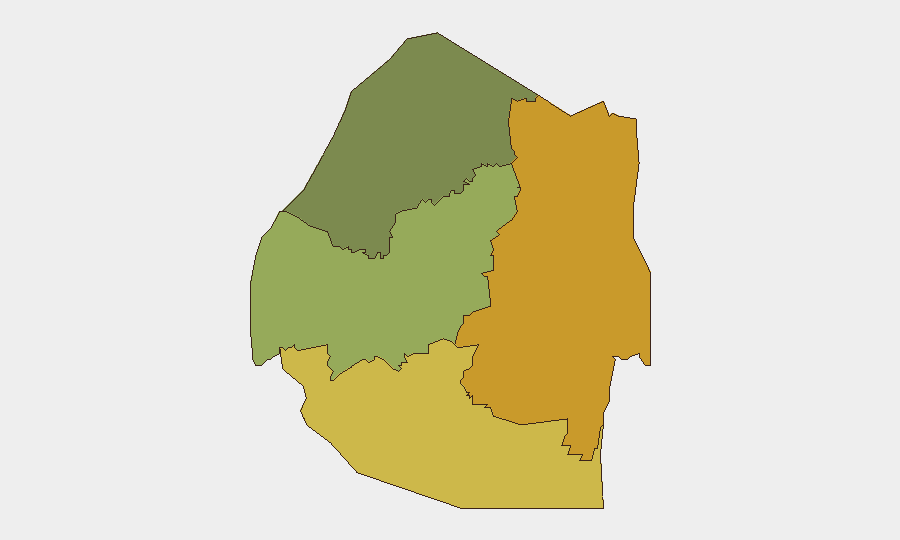
Lubombo Region (risk score 72) and Shiselweni Region (risk score 68) together account for the country's elevated sub-national threat concentration, driven by criminal activity, governance gaps, and cross-border movement challenges along the Mozambique and South Africa boundaries. Manzini Region (score 55) presents secondary risk, likely linked to urban crime and informal-economy volatility. Hhohho Region (score 35) remains lower-risk. Organizations with presence in Lubombo and Shiselweni should prioritize asset-protection measures and staff duty-of-care protocols relative to national baseline.
How GeoBit Would Assist
Security teams operating in or supporting Eswatini should employ AOI (Area-of-Interest) Monitoring & Early Warning on Lubombo and Shiselweni with persistent alerting thresholds to capture emerging criminal or civil-unrest signals in near-real time. Intel Sweep and OSINT fusion (X/Twitter, Telegram, local media, and multi-language search) provide continuous verification of rumors and incidents, reducing reliance on unconfirmed social-media reports. Risk & Threat Assessment workflows can align staff movement, facility security, and supply-chain routing to avoid highest-risk zones and timeframes.
7-Day Outlook
Absent new political triggers or cross-border incidents, Eswatini's security posture is expected to remain stable over the next week. Continued monitoring of public-sector fraud and procurement-related social engineering is warranted to assess whether the recent Ministry alert signals a broader campaign. Sub-national risk in border regions will remain elevated and warrant routine duty-of-care vigilance but do not presently suggest acute threat escalation.
Highest-Risk Areas — Ranked
| # | State / Region | Risk |
|---|---|---|
| 1 | Lubombo | 72 |
| 2 | Shiselweni | 68 |
| 3 | Manzini Region | 55 |
| 4 | Hhohho Region | 35 |
Sources
Previous Daily Briefs
A new Eswatini brief is written every day — each with its own risk map and downloadable CSV. Here's the last week; use the calendar to go further back.
- August 13, 2026
- August 11, 2026
- August 9, 2026
- August 8, 2026
- August 6, 2026
- August 4, 2026
- August 3, 2026
📅 Browse every day by calendar →
Highlighted days have a brief. Tap a day for that day's map & analysis, or “csv” for that day's dataset ($5).
Atlas — our AI intelligence desk — emails them this snapshot personally. Nothing else, no list.