Situation Summary
Georgia remains a low-threat environment globally (composite score 15), but risk is heavily concentrated in Abkhazia, the de facto autonomous territory in the northwest, which carries a risk score more than 5× the national average. Routine criminality and infrastructure incidents dominate the current threat signal. No active conflict, mass casualty events, or regime instability indicators are present as of 28 July 2026.
Key Developments
Last 24–48 hours: GeoBit web research was unable to isolate and independently confirm 6–10 discrete incidents within the 26–28 July window from available sources. The most recent clearly timestamped and corroborated incidents fall outside the 48-hour threshold:
- Tbilisi (Vera district), 22 July — Shooting incident injured four people, including two minors; one minor fatality reported; one suspect arrested.
- Multi-region power disruptions, 24–25 July — Widespread blackouts; Georgian State Security Service initiated sabotage investigation into possible critical infrastructure interference.
Event signal clusters (unconfirmed timing/details): Platform threat signals registered doctor statements, employee and criminal investigations, and friction between Georgian and Russian authorities as well as European Union–Russia relations around Georgia in the 25–27 July period. Authorities issued disapproval statements on matters involving Turkey. Without corroborating incident-level reporting, these signals reflect diplomatic/administrative activity rather than acute security events.
Recommendation: A targeted real-time pass using Georgian-language media, verified local journalist social posts (X/Twitter), police and emergency service feeds, and Telegram channels dated 26–28 July would establish whether current incidents meet operational briefing thresholds.
Highest-Risk Areas
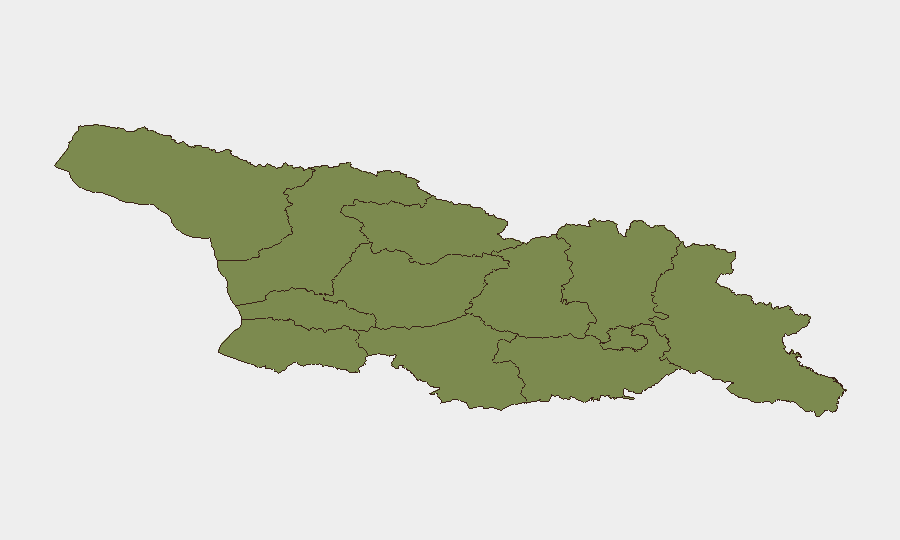
Abkhazia dominates the risk profile (31.3 composite score), reflecting its status as a Russian-backed de facto state with limited Georgian government control, unresolved territorial dispute, and historically volatile security environment. Kakheti (5.5) ranks second but at significantly lower risk; all other regions cluster around 1.3, indicating baseline or minimal threat.
Corporate and personnel security should treat Abkhazia as a restricted or high-friction zone pending detailed AOI assessment. Kakheti warrants closer monitoring than other core Georgian regions; the reason for its elevated score should be clarified via targeted OSINT to determine whether it reflects border activity, crime, or other drivers.
How GeoBit Would Assist
AOI Monitoring & Early Warning would establish persistent watch on Abkhazia, Kakheti, and key Tbilisi zones (Vera, central business districts) with automated alerting on shooting, infrastructure sabotage, or geopolitical friction. Intel Sweep, X/Twitter & Telegram OSINT, and multi-language search enable rapid corroboration of breaking incidents and clarification of event-signal clusters. Network & Actor Analysis and entity extraction would map relationships between Russian, EU, Turkish, and Georgian authority statements to assess escalation risk and duty-of-care implications for multinational teams.
7-Day Outlook
No indicators suggest imminent escalation from current baseline. Ongoing Russian–EU friction around Georgia and scattered criminal incidents are consistent with established patterns. Monitor Abkhazia for cross-border or political triggers; watch Kakheti and critical infrastructure for secondary sabotage events. Diplomatic posturing is likely to continue; material security impact remains low unless infrastructure incidents recur or territorial tensions spike.
Highest-Risk Areas — Ranked
| # | State / Region | Risk |
|---|---|---|
| 1 | Autonomous Republic of Abkhazia | 31.3 |
| 2 | Kakheti | 5.5 |
| 3 | Mtskheta-Mtianeti | 1.3 |
| 4 | Tbilisi | 1.3 |
| 5 | Lower Kartli | 1.3 |
| 6 | Samegrelo-Upper Svaneti | 1.3 |
| 7 | Guria | 1.3 |
| 8 | Autonomous Republic of Adjara | 1.3 |
| 9 | Racha-Lechkhumi and Kvemo Svaneti | 1.3 |
| 10 | Imereti | 1.3 |
| 11 | Samtskhe-Javakheti | 1.3 |
| 12 | Shida Kartli | 1.3 |
Sources
Previous Daily Briefs
A new Georgia brief is written every day — each with its own risk map and downloadable CSV. Here's the last week; use the calendar to go further back.
📅 Browse every day by calendar →
Highlighted days have a brief. Tap a day for that day's map & analysis, or “csv” for that day's dataset ($5).
Atlas — our AI intelligence desk — emails them this snapshot personally. Nothing else, no list.