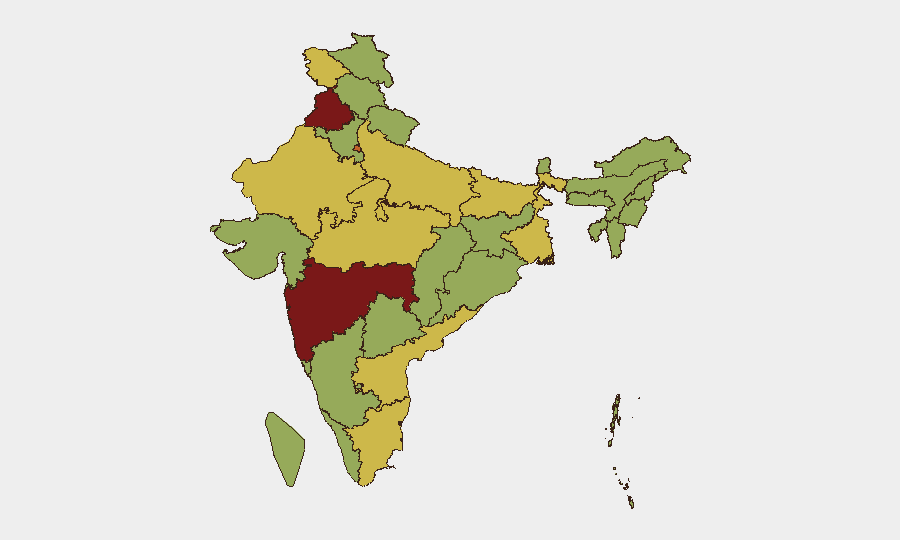
Situation Summary
India remains at moderate composite threat level (#17 globally, score 82) with 578 tracked events. Maharashtra, Punjab, and Delhi dominate the risk landscape, driven by communal tensions, criminal activity, protest movements, and institutional friction. Recent signals (July 10–12) point to elevated government investigation, police-judiciary disputes, and farmer-ministry confrontations, though no single incident has escalated to crisis level. The threat trajectory is stable but fragmented across multiple low-to-medium intensity vectors rather than a unified acute risk.
Key Developments
- Delhi-NCR region (within 48 hours): Heavy rainfall and waterlogging across Noida, Delhi, Ghaziabad, and Indirapuram triggered multiple fatalities including drownings, electrocution, and open-drain incidents; public safety and infrastructure vulnerability highlighted.
- July 12 – National political statement: Congress party issued public statement; context and substance not independently confirmed in current research, but flagged as recent signaling activity.
- July 11 – Maharashtra: State-level public statement recorded; specific content unclear from available signals, but timing coincides with broader institutional friction.
- July 11 – Government sector friction: Police-judiciary dispute (public statement vs. disapproval signals) and government-led investigation activity recorded; suggests institutional strain in law enforcement or judicial oversight.
- July 11 – Agricultural protest: Ministry rejected farmer group position; consistent with ongoing agrarian grievance patterns in high-risk states but specific demand or location not detailed in current data.
- July 11 – Unconventional violence signal: Government entity flagged in connection with reported unconventional violence; classification and jurisdiction unclear without corroboration.
- July 10 – Student activity: Public statement from student organization recorded; underlying grievance or campus location not specified.
- July 11 – Arrest activity (France/Vancouver cross-border): Arrest or detention event with potential international dimension; relevance to India-based assets or personnel requires clarification.
Highest-Risk Areas
Maharashtra (87.3), Punjab (82), and Delhi (74.6) comprise the top tier and account for institutional, communal, and criminal risk concentration. Maharashtra's elevated score reflects activity density in Mumbai and surrounding industrial/commercial zones; Punjab shows sustained communal and separatist-linked signals; Delhi centralizes political, protest, and police-judiciary friction. West Bengal, Madhya Pradesh, and Bihar (65, 64, 63.8 respectively) represent a secondary tier where criminal activity, student unrest, and governance gaps create secondary friction points. Mid-tier states (Uttar Pradesh, Rajasthan, Jammu & Kashmir, Tamil Nadu, Andhra Pradesh, Karnataka) maintain scores 59–63, suggesting distributed but manageable risk.
How GeoBit Would Assist
Security and risk teams should deploy Intel Sweep and multi-language OSINT fusion to track Maharashtra, Punjab, and Delhi protest/communal signals in real time; entity extraction and sentiment analysis on farmer-ministry and police-judiciary disputes to detect escalation triggers; and AOI monitoring with alerting on high-risk districts (Noida, Mumbai, Amritsar corridors) to flag infrastructure failures, mass gatherings, or institutional breakdowns before operational impact. Routing & network analysis supports duty-of-care route planning around monsoon-affected zones and protest hotspots.
7-Day Outlook
Near-term trajectory favors continued low-level friction—farmer grievances, communal statement cycles, and institutional disputes—without imminent acute violence or system-wide disruption. Monsoon season in Delhi-NCR and western states will sustain infrastructure and public-safety risks independent of security events. Monitoring should focus on whether police-judiciary disputes or government investigations escalate to organizational paralysis or produce cascading arrests.
Highest-Risk Areas — Ranked
| # | State / Region | Risk |
|---|---|---|
| 1 | Maharashtra | 87.3 |
| 2 | Punjab | 82 |
| 3 | Delhi | 74.6 |
| 4 | West Bengal | 65 |
| 5 | Madhya Pradesh | 64 |
| 6 | Bihar | 63.8 |
| 7 | Uttar Pradesh | 62.9 |
| 8 | Rajasthan | 62.4 |
| 9 | Jammu and Kashmir | 60.9 |
| 10 | Tamil Nadu | 60.9 |
| 11 | Andhra Pradesh | 60.2 |
| 12 | Karnataka | 59.2 |
Sources
Previous Daily Briefs
A new India brief is written every day — each with its own risk map and downloadable CSV. Here's the last week; use the calendar to go further back.
📅 Browse every day by calendar →
Highlighted days have a brief. Tap a day for that day's map & analysis, or “csv” for that day's dataset ($5).
Atlas — our AI intelligence desk — emails them this snapshot personally. Nothing else, no list.