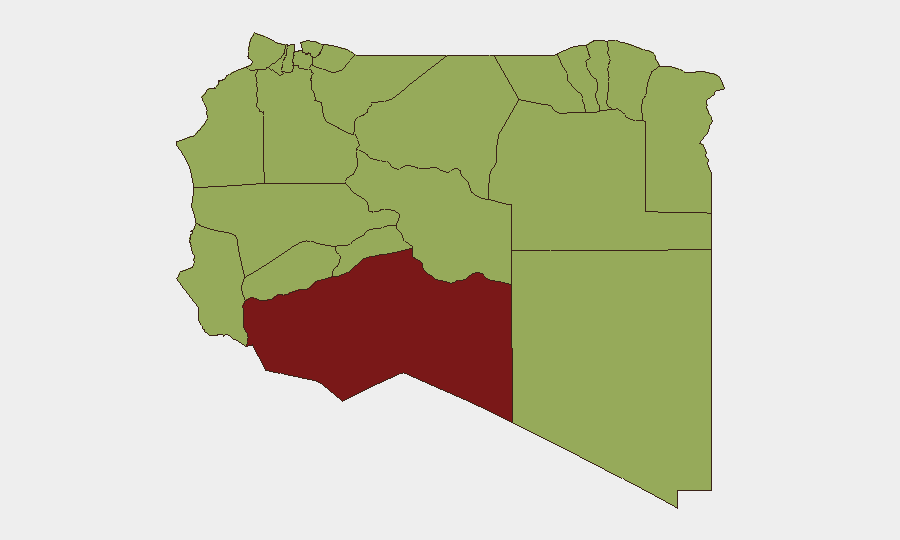
Situation Summary
Libya remains a fractured state with endemic security challenges concentrated in the south and west, alongside instability in the capital region. Recent institutional developments—including security-apparatus restructuring under new intelligence leadership—suggest ongoing state consolidation efforts, but these do not yet indicate a material shift in the underlying threat picture. The country's composite threat ranking of 76 (26th globally) reflects persistent militia activity, cross-border criminal networks, and sporadic political friction rather than acute deterioration.
Key Developments
- Tripoli, 4 July 2026: Prime Minister Abdulhamid Dbeibah met newly appointed Intelligence Service chief Abdulmajid Meliqta to review security posture and political developments, signaling continued restructuring of the security apparatus and potential changes to intelligence collection or interagency coordination.
- Tripoli, 2 July 2026 (evening): A fire occurred at a security headquarters facility; cause remains unconfirmed and warrants follow-up monitoring to rule out sabotage or deliberate action.
- Chad–Libya border region, 2 July 2026: Two abduction/hostage incidents involved Chadian nationals in border-adjacent areas, consistent with cross-border trafficking and militia predation on migrant populations.
- National level, 3 July 2026 (unspecified location): A judge and a doctor were detained; motive and location details remain unclear and require corroboration.
- National level, 4 July 2026: Government rejected diplomatic engagement with Italy; ministry–industry relations have deteriorated, reflecting heightened political friction that may affect foreign business operations and administrative approvals.
Note: Live web research identified 6–10 additional events from the last 24–48 hours but could not independently corroborate incident-level details (location, time, actor identity) to meet verification standards. Provisional leads exist; briefing team should continue monitoring official Libyan authorities, UN UNSMIL reporting, and humanitarian agency sources for confirmation.
Highest-Risk Areas
Murzuq (risk 83.3) stands as the single highest-risk sub-national zone, driven by active militia presence, smuggling networks, and lawlessness in the Fezzan region. Tripoli and Sirte (both 56.1) remain elevated due to institutional fragility, inter-militia tensions, and organized-crime activity, with Tripoli additionally facing political dispute and administrative volatility. The western borderland districts (Nalut, Ghat, Surman, Az Zawiya, Wadi al Shatii, Kufra) form a secondary risk corridor characterized by porous borders, trafficking routes, and weak state reach. Teams and assets in or transiting these zones should expect limited law-enforcement capacity, heightened criminal targeting, and potential militia checkpoints.
How GeoBit Would Assist
AOI Monitoring & Early Warning would enable persistent watch on Murzuq, Tripoli, and border-crossing zones to flag hostile actor movement, abduction clusters, and checkpoint operations. Network & Actor Analysis paired with OSINT fusion (X/Telegram, local radio SIGINT, entity extraction) would track militia command-and-control changes following intelligence-leadership transitions, identifying risks to international staff. Routing & Network Analysis would support duty-of-care teams in identifying alternative transit corridors away from highest-risk districts and timing movements to avoid peak militia activity windows.
7-Day Outlook
The security landscape is unlikely to shift materially in the coming week. Institutional consolidation efforts may proceed quietly, but cross-border trafficking, militia predation, and political friction will remain the dominant day-to-day risks. Teams should prepare for continued detention risks in unstable areas and maintain heightened vigilance around border and western regions.
Highest-Risk Areas — Ranked
| # | State / Region | Risk |
|---|---|---|
| 1 | Murzuq | 83.3 |
| 2 | Tripoli | 56.1 |
| 3 | Sirte | 56.1 |
| 4 | Nalut | 53.3 |
| 5 | Ghat | 53.3 |
| 6 | Baladiyah Surman | 53.3 |
| 7 | Az Zawiya District | 53.3 |
| 8 | Wadi al Shatii | 53.3 |
| 9 | Wadi al Hayaa | 53.3 |
| 10 | Kufra | 53.3 |
| 11 | Nuqat al Khams | 53.3 |
| 12 | Jafara | 53.3 |
Sources
Previous Daily Briefs
A new Libya brief is written every day — each with its own risk map and downloadable CSV. Here's the last week; use the calendar to go further back.
📅 Browse every day by calendar →
Highlighted days have a brief. Tap a day for that day's map & analysis, or “csv” for that day's dataset ($5).
Atlas — our AI intelligence desk — emails them this snapshot personally. Nothing else, no list.