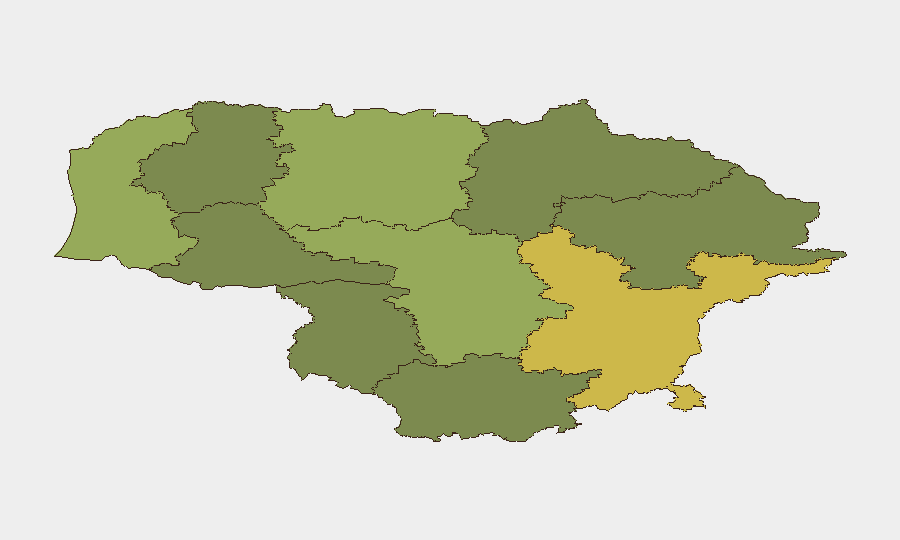
Situation Summary
Lithuania remains a low-threat country globally (rank #125, composite score 10) with no tracked major incidents in the current assessment window. However, the past 48 hours have surfaced a cluster of security-relevant developments: violent crime in Vilnius, elevated air-defence posture, presidential warnings of hybrid threats, widespread power outages, and civil unrest linked to migration tensions. The trajectory reflects heightened alertness to external (Russian) hybrid and kinetic threats alongside domestic social friction, with infrastructure resilience under near-term stress.
Key Developments
- Vilnius stabbing (violent crime), 22:38 Aug 24: A 50-year-old man found stabbed in a parked Volkswagen Caravelle on A. Kojelavičiaus gatvė; hospitalized for non-serious injuries; circumstances under investigation by police. This represents targeted urban violence in the capital's residential zone.
- NASAMS air-defence deployment, Aug 24: Lithuanian Armed Forces replaced a short-range RBS-70 system with a medium-range NASAMS surface-to-air missile system around Vilnius airspace, signaling elevated strategic posture in response to perceived airspace threats.
- Presidential warning of Russian false-flag operations, Aug 24: President Gitanas Nausėda publicly cautioned that Russia may conduct "false flag" attacks on Baltic critical infrastructure (energy, transport, communications), raising threat perception for utilities and strategic assets across Lithuania.
- Widespread power outages persist, Aug 24–25: Following a storm days earlier, over 111,000 consumers remained without electricity as of Aug 24 morning. Outages affect households and potentially disrupt transport, communications, and services in multiple regions.
- Migration-linked civil unrest in Vilnius, Aug 23 (reported Aug 24): Far-right and counter-protest groups clashed at Cathedral Square with explicit white-nationalist messaging; physical altercations reported between participants. Indicates heightened social tension and risk of recurrent demonstrations.
- NATO reconnaissance activity, Baltic Sea vicinity, Aug 24: Multiple NATO aircraft observed simultaneously over the Baltic, including airspace near Lithuania and Kaliningrad, reflecting elevated regional military activity.
- €600,000 Ukrainian support allocation, Aug 25: Lithuania committed funds to Ukrainian NGOs for child repatriation and accountability mechanisms, part of its foreign-policy posture toward Russian aggression.
Highest-Risk Areas
Vilnius County dominates Lithuania's sub-national risk profile (score 68), driven by its status as the capital, concentration of critical infrastructure, and incidents of violent crime and civil unrest within the past 48 hours. Kaunas (58) and Klaipeda (52) follow, likely reflecting industrial and port-related assets; Klaipeda's maritime exposure to Baltic tensions and energy infrastructure may amplify strategic vulnerability. Collectively, the top three counties account for the majority of tracked risk and warrant priority coverage by corporate security teams with personnel or assets in those zones.
How GeoBit Would Assist
Corporate security teams should deploy AOI Monitoring & Early Warning on Vilnius County critical infrastructure and transport hubs to detect emerging hybrid threats or civil unrest escalation. Intel Sweep and multi-language OSINT (X/Telegram, news feeds) will track both Russian disinformation campaigns (false-flag narratives) and domestic migration-related social tension in real time. Routing & Network Analysis can support duty-of-care teams in identifying alternative transport and supply-chain paths around power-outage zones and protest hotspots.
7-Day Outlook
Power restoration efforts should reduce infrastructure disruption over the next week, though pockets of outage may persist. Migration and far-right protest activity is likely to recur in Vilnius and other urban centers, particularly around public squares; organizations should monitor local civil-unrest indicators. The elevated NATO presence and air-defence posture suggest no imminent kinetic escalation but underscore sustained hybrid-threat awareness; corporate teams should maintain situational monitoring and contingency plans for critical-infrastructure disruptions or security incidents affecting staff or supply chains.
Highest-Risk Areas — Ranked
| # | State / Region | Risk |
|---|---|---|
| 1 | Vilnius County | 68 |
| 2 | Kaunas County | 58 |
| 3 | Klaipeda County | 52 |
| 4 | Siauliai County | 42 |
| 5 | Panevezys County | 38 |
| 6 | Taurage County | 35 |
| 7 | Utena County | 33 |
| 8 | Alytus County | 32 |
| 9 | Telsiai County | 28 |
| 10 | Marijampole County | 25 |
Sources
Previous Daily Briefs
A new Lithuania brief is written every day — each with its own risk map and downloadable CSV. Here's the last week; use the calendar to go further back.
- August 23, 2026
- August 21, 2026
- August 19, 2026
- August 17, 2026
- August 15, 2026
- August 13, 2026
- August 11, 2026
📅 Browse every day by calendar →
Highlighted days have a brief. Tap a day for that day's map & analysis, or “csv” for that day's dataset ($5).
Atlas — our AI intelligence desk — emails them this snapshot personally. Nothing else, no list.