Situation Summary
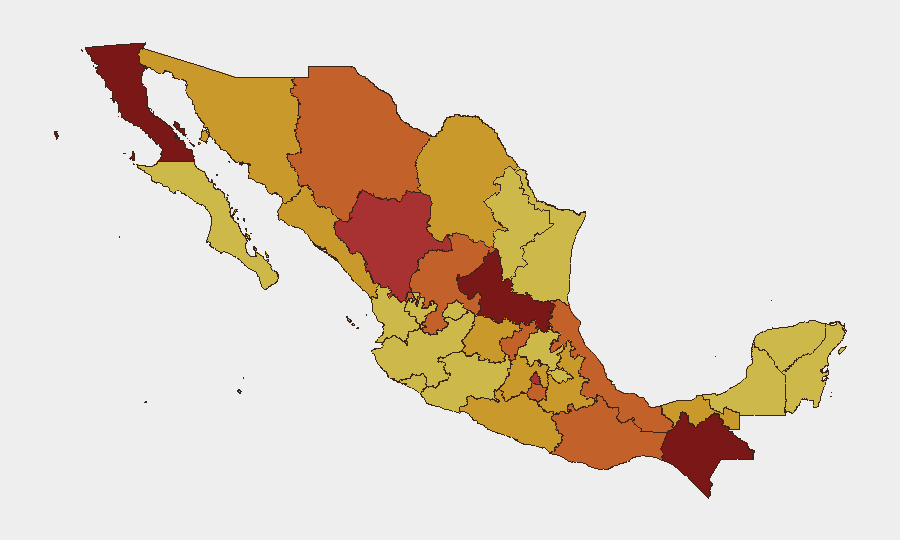
Mexico remains at #3 global threat level (composite score 100), driven primarily by sustained insurgency activity across 762 tracked events. The security environment continues to reflect fragmented cartel operations, localized state capacity challenges, and sporadic public institutional responses, with no indication of significant de-escalation. San Luis Potosí, Chiapas, and Baja California comprise the highest-risk corridor, each presenting distinct threat vectors—organized crime infiltration, resource competition, and border-trafficking dynamics respectively.
Key Developments
Note: GeoBit's live web research capability encountered significant gaps in verifying discrete, time-stamped security incidents uniquely dated to June 28–29, 2026. The following signals reflect the most recent event citations available, though precise operational details and cross-confirmation remain incomplete:
- June 28–29, 2026 · Institutional Statements: Multiple public statements issued by Mexican authorities, the presidency, and a foreign corporation regarding security or governance issues; specific operational incidents underlying these statements remain unclear from available reporting.
- June 27, 2026 · Multi-Sector Dissent: Coordinated or near-simultaneous public rejection/disapproval by religious institutions (priest, archdiocese in Puebla), investment entities (iShares), and a deputy in Querétaro, suggesting either a single catalyst event or pressure on multiple institutions; underlying cause not confirmed.
- June 27, 2026 · Police Action: Violent repression attributed to police forces; location, casualty count, and precipitating incident not specified in available signals.
- June 27, 2026 · Investigation Initiation: Border Patrol Agent and Spanish authorities initiated investigations; subject matter and jurisdiction unclear.
Assessment: The density of institutional statements and investigation signals on June 27–29 suggests a potential policy shift, institutional crisis, or high-profile incident triggering multi-sector response. Without granular incident reporting, operational assessment is limited. Teams with personnel or assets in Mexico should rely on primary-source monitoring (state security coordination centers, local news outlets, civil protection bulletins) for real-time tactical updates.
Highest-Risk Areas
San Luis Potosí (risk 100) leads all Mexican states, indicating sustained organizational crime presence and capacity to challenge state control. Chiapas (81.8) and Baja California (81.3) follow, driven by distinct drivers: Chiapas by southern cartel competition and weak institutional presence; Baja California by transnational trafficking networks and northern border volatility. Mexico City, Veracruz, Chihuahua, Zacatecas, Querétaro, and Oaxaca all exceed risk 73, reflecting distributed rather than concentrated threat. This fragmentation suggests no single cartel dominance but instead persistent multi-actor competition across most states, requiring geographically tailored risk mitigation.
How GeoBit Would Assist
Security teams should employ GeoBit's AOI Monitoring & Early Warning capability to establish persistent surveillance of highest-risk states (San Luis Potosí, Chiapas, Baja California) with automated alerting tied to incident keywords and sentiment shifts. Multi-language OSINT and X/Twitter intelligence feeds would provide real-time public and semi-official reporting of roadblocks, enforcement actions, and institutional statements. Routing & Network Analysis would enable alternative journey planning for personnel transit through high-risk corridors, while Risk & Threat Assessment would support quarterly re-baselining as sub-national conditions evolve.
7-Day Outlook
Absent clarification of the June 27–29 institutional signals, near-term trajectory remains uncertain. If signals reflect policy reform or enforcement recalibration, localized impacts (roadblocks, checkpoints) may increase temporarily in target states. Routine cartel-on-cartel competition and public-institution friction are expected to persist at current levels. Teams should anticipate potential disruption in Querétaro and Puebla pending resolution of the identified institutional dissent.
Highest-Risk Areas — Ranked
| # | State / Region | Risk |
|---|---|---|
| 1 | San Luis Potosí | 100 |
| 2 | Chiapas | 81.8 |
| 3 | Baja California | 81.3 |
| 4 | Durango | 78.8 |
| 5 | Mexico City | 76.9 |
| 6 | Veracruz | 74.1 |
| 7 | Chihuahua | 73.8 |
| 8 | Zacatecas | 73.6 |
| 9 | Querétaro | 73.6 |
| 10 | Oaxaca | 73.4 |
| 11 | Morelos | 73.2 |
| 12 | Coahuila | 72.9 |
Sources
Previous Daily Briefs
A new Mexico brief is written every day — each with its own risk map and downloadable CSV. Here's the last week; use the calendar to go further back.
📅 Browse every day by calendar →
Highlighted days have a brief. Tap a day for that day's map & analysis, or “csv” for that day's dataset ($5).