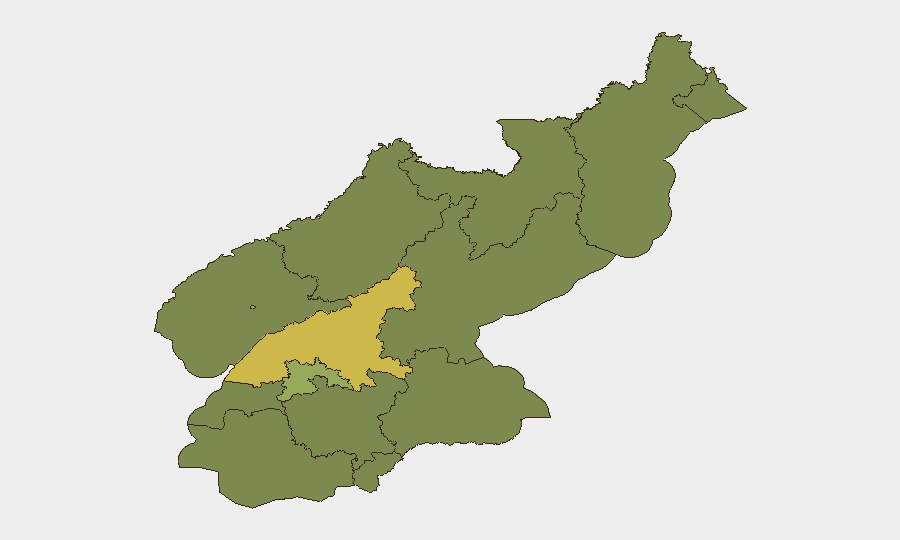
Situation Summary
North Korea remains at composite threat level #38 globally (score 43), with no credible, independently corroborated security incidents reported inside the country in the past 24–48 hours. Open-source reporting over this window focuses on strategic military assessments (missile performance through June 20) and South Korean border-policy announcements rather than acute domestic instability or acute cross-border incidents. The threat environment appears stable at the national level, though sub-national concentration of risk in South Pyongan and P'yŏngyang warrants continued monitoring.
Key Developments
No new security incidents verified inside North Korea in the last 24–48 hours. Recent open-source coverage addresses:
- Strategic military assessments (through June 20): Ongoing international analysis of North Korean missile capabilities and deployment in Ukraine; no new tests or launches confirmed since June 20.
- South Korean border policy (June 24 reporting window): Prospective easing of restrictions in the Controlled Access Line south of the DMZ; forward-looking policy announcement, not an acute incident.
- Routine geopolitical discussion (pre-June 23): Ongoing defense and sanctions dialogue involving the peninsula; no incident-type developments with confirmed dates in the target window.
*Note: Recent event signals (June 21–23) tagged to "North Dakota," "North Carolina," and "North West" appear to reflect U.S. domestic events and Russian regional statements, not North Korean territory or incidents.*
Highest-Risk Areas
South Pyongan (risk 60.3) and P'yŏngyang (risk 53.8) drive the country-level risk profile, more than double the scores of remaining provinces (30.3). South Pyongan's elevation likely reflects its proximity to the DMZ, concentration of military and state-security infrastructure, and historical significance in inter-Korean tensions. P'yŏngyang's score reflects capital-city exposure to surveillance, political-control mechanisms, and external pressure. All other 10 tracked regions cluster at equal, moderate risk (30.3), suggesting either data-collection limitations or genuine uniformity in background threat conditions outside the two hotspot zones.
How GeoBit Would Assist
Security teams with personnel or assets in North Korea should employ AOI (Area-of-Interest) Monitoring & Early Warning on South Pyongan and P'yŏngyang with persistent alerting to catch any emergence of civil unrest, military activity, or infrastructure disruption. Intel Sweep and OSINT fusion (multi-language search, Telegram/X monitoring, entity extraction) would detect regime statements, sanctions enforcement, or cross-border incidents earlier than mainstream Western media. Regime-stability and border-dispute search capabilities support quarterly risk reassessment as sanctions, food security, or inter-Korean diplomacy shift the threat trajectory.
7-Day Outlook
No acute escalation is signaled in the available data through June 24. Monitor for (1) any resumption of North Korean missile tests or public military mobilization statements; (2) shifts in South Korean border policy or DMZ-access restrictions that could indicate Seoul's assessment of elevated tension; and (3) humanitarian or infrastructure disruptions (food, power, medical) that historically correlate with regime instability. Current trend: stable, with background risk concentrated in the capital and border zone.
Highest-Risk Areas — Ranked
| # | State / Region | Risk |
|---|---|---|
| 1 | South Pyongan | 60.3 |
| 2 | P'yŏngyang | 53.8 |
| 3 | Ryanggang | 30.3 |
| 4 | North Hamgyong | 30.3 |
| 5 | North Pyongan | 30.3 |
| 6 | Chagang | 30.3 |
| 7 | Nampo | 30.3 |
| 8 | South Hwanghae | 30.3 |
| 9 | North Hwanghae | 30.3 |
| 10 | South Hamgyong | 30.3 |
| 11 | Kaesong | 30.3 |
| 12 | Kangwon | 30.3 |
Sources
Previous Daily Briefs
A new North Korea brief is written every day — each with its own risk map and downloadable CSV. Here's the last week; use the calendar to go further back.
📅 Browse every day by calendar →
Highlighted days have a brief. Tap a day for that day's map & analysis, or “csv” for that day's dataset ($5).