Situation Summary
Pakistan faces elevated political and security instability following the assassination of the Prime Minister on 2026-06-26, compounded by international diplomatic pressure (UNSC disapproval on 2026-06-25) and domestic institutional tensions (Supreme Court threats against the government). Khyber Pakhtunkhwa remains the highest-risk sub-national zone (65.1 composite score), with Islamabad Capital Territory elevated to second-highest risk (51.8), reflecting both the capital's political volatility and ongoing security operations. The convergence of leadership transition, judicial-executive conflict, and heightened police/military activity signals a period of significant uncertainty for the next 7–14 days.
Key Developments
- Islamabad, Pakistan — 2026-06-26: Prime Minister assassinated; motive and perpetrator(s) remain unclear. This is the most consequential single event in the reporting window and will dominate succession dynamics and security posture for the immediate period.
- Islamabad Capital Territory — 2026-06-25 to 2026-06-26: Multiple police and military conventional force deployments reported; Red Zone access restrictions remain in place following Iranian President Pezeshkian's visit (2026-06-24). Heightened force presence reflects both assassination response and post-visit security lockdown.
- Supreme Court, Islamabad — 2026-06-25: Court issued threats to government and rejected detainee petition, signaling institutional friction at a moment of executive weakness and leadership vacuum.
- Unconfirmed report — North Waziristan region (date unclear): Social media report claims suicide bombing killed ≥13 security personnel and injured four civilians; lacks corroborating news coverage and should be treated as unverified pending additional sources.
- International pressure — 2026-06-25: UNSC disapproval motion against Pakistan; Copenhagen public statement on 2026-06-26 indicates diplomatic isolation component coinciding with domestic crisis.
- Islamabad security restrictions — ongoing from 2026-06-24: Red Zone (federal administrative core) remains under traffic and movement restrictions; Cabinet Division directed non-essential staff to work from home; exemptions for PM Office, Foreign Ministry, Interior, and parliament.
Highest-Risk Areas
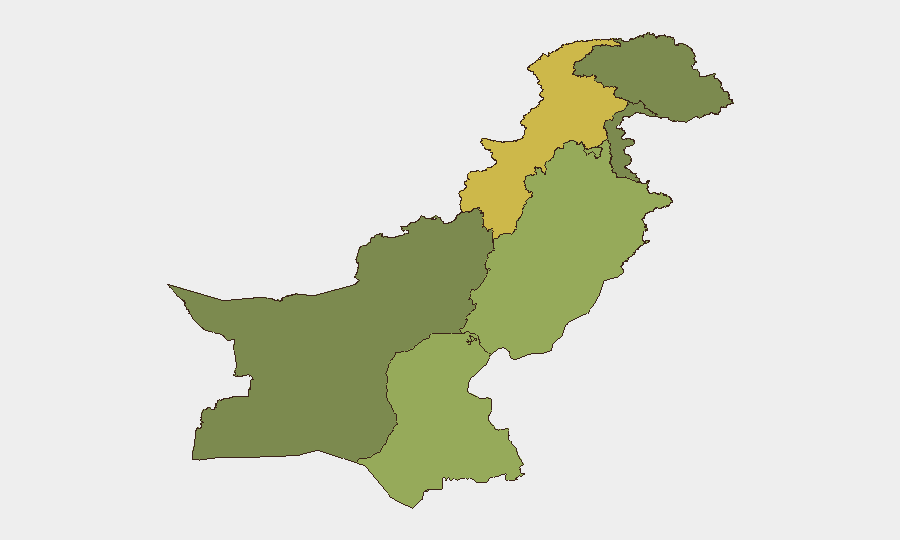
Khyber Pakhtunkhwa's dominance (65.1) reflects persistent militant activity, cross-border tensions, and limited state capacity. The sharp elevation of Islamabad Capital Territory to second place (51.8)—ahead of traditionally high-risk Sindh and Punjab—is driven by the assassination, institutional conflict, and succession uncertainty. Sindh and Punjab, each at 41.1, carry significant residual terrorism and organized-crime risks but are currently secondary to the political crisis in the capital. Balochistan (37.4) and the northern territories remain subordinate threats but should not be discounted given the government's reduced capacity to manage multiple crises simultaneously.
How GeoBit Would Assist
Security teams should deploy Intel Sweep and X/Twitter OSINT to monitor real-time developments around succession, military posture, and militant group statements. AOI Monitoring & Early Warning focused on Islamabad (Red Zone, key ministries, parliament) and Khyber Pakhtunkhwa flashpoints would provide alerts on force movements, protests, or security incidents before they escalate. Network & Actor Analysis targeting security establishment factions, judicial actors, and militant networks would clarify succession fault lines and identify secondary-order risks to corporate personnel.
7-Day Outlook
The next week will be defined by succession negotiations, likely involving military intermediation and Supreme Court involvement. Security incidents and protests are probable, particularly in Khyber Pakhtunkhwa and Islamabad. Organizations should assume elevated ambient risk, restricted mobility in the capital, and potential for secondary crises (militant attacks, civil unrest) as factions compete for influence during the transition.
Highest-Risk Areas — Ranked
| # | State / Region | Risk |
|---|---|---|
| 1 | Khyber Pakhtunkhwa | 65.1 |
| 2 | Islamabad Capital Territory | 51.8 |
| 3 | Sindh | 41.1 |
| 4 | Punjab | 41.1 |
| 5 | Balochistan | 37.4 |
| 6 | Gilgit-Baltistan | 35.1 |
| 7 | Azad Kashmir | 35.1 |
Sources
Previous Daily Briefs
A new Pakistan brief is written every day — each with its own risk map and downloadable CSV. Here's the last week; use the calendar to go further back.
📅 Browse every day by calendar →
Highlighted days have a brief. Tap a day for that day's map & analysis, or “csv” for that day's dataset ($5).