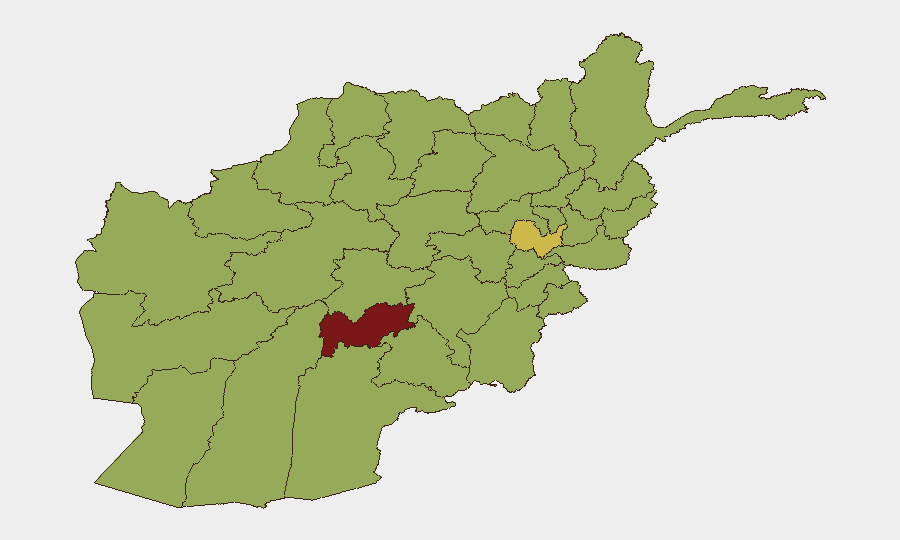
Situation Summary
Afghanistan remains at composite threat level 74/100 (#25 globally), with acute volatility along the Pakistan border, political repression in Kabul, and organized anti-Taliban resistance in the east. The last 48 hours show a marked escalation in cross-border military operations, media suppression, and civil-liberties enforcement by Taliban authorities. Risk concentration in Uruzgan, Kabul, and Ghazni provinces reflects both insurgent activity and state control measures; eastern border provinces face additional destabilization from Pakistani airstrikes and Taliban retaliation.
Key Developments
- Pakistan airstrikes on Paktika (24–25 June): Pakistani military conducted multiple airstrikes in Argun and Barmal districts, Paktika province, killing eight Afghan cricket players and wounding four; strikes occurred within the last 24–48 hours and have provoked significant public anger and Taliban statements of retaliation.
- Taliban cross-border retaliation (24–25 June): Taliban's 201 Khalid bin Walid Army Corps announced attacks on Pakistani military outposts near the Durand Line in Nangarhar and Kunar provinces as explicit retaliation, indicating active armed escalation along the eastern frontier.
- Afghanistan Freedom Front attacks (24 June): The AFF claimed a 15-minute rocket and small-arms assault on a Taliban base in Qolak village, Alingar district, Laghman province, at approximately 1:30 pm on 24 June; the group separately claimed responsibility for killing three Taliban fighters in Nangarhar province in the last 48 hours.
- Tamadon TV raid and suspension (within ~48 hours): Taliban forces raided Tamadon TV headquarters in Kabul and halted broadcasts, signaling continued media suppression and raising risk for journalists and civil-society workers in the capital.
- Muharram detention crackdown (recent days, within current period): Taliban authorities detained 25–40 people in Kabul and Mazar-e-Sharif for Muharram flag-raising and mourning; some were held in a private Ministry of Justice detention facility; raids also targeted Kabul mosques and restrictions were imposed in Mazar-e-Sharif, indicating escalated religious-civil enforcement.
- Hibati Force formation with Russian support (announced 24 June): Taliban Central Security and Vetting Commission discussed formation of an 8,000-member special unit ("Hibati Force") with reported Russian funding, training, and equipment, reflecting structural expansion of Taliban security capacity and deepening Russia–Taliban ties.
- International security discussions (24 June, Brussels): Participants at a Brussels meeting addressed rejection of security threats from Afghan soil and Afghan refugee issues, indicating sustained international concern about Afghan-origin militancy and policy implications for regional partners.
Highest-Risk Areas
Uruzgan Province (81.7) leads sub-national risk, reflecting concentrated anti-Taliban insurgency and military operations. Kabul Province (60.7) ranks second, driven by Taliban political enforcement, media raids, detention operations, and administrative tensions visible in the last 48 hours. Ghazni Province (59.6) and Herat (56) follow, associated with residual resistance and cross-provincial instability. Eastern border provinces—particularly Nangarhar, Kunar, Paktika, and Laghman—face compounded risk from cross-border Pakistani military action, Taliban retaliation, and organized anti-Taliban armed groups, creating unpredictable movement hazards and civilian collateral exposure.
How GeoBit Would Assist
Teams with personnel or assets in Afghanistan should deploy AOI Monitoring & Early Warning on Uruzgan, Ghazni, and Nangarhar border zones to capture emerging attacks and cross-border incidents before escalation. Conflict & Military battle mapping and force-structure analysis would track Taliban special-unit deployment and Pakistani military patterns, enabling proactive route and operation planning. OSINT fusion (X/Telegram, multi-language feeds, entity extraction) would provide real-time signals from Taliban media, AFF communiqués, and international policy forums, supporting duty-of-care incident response and staff safety posture adjustments.
7-Day Outlook
Pakistani–Taliban cross-border military escalation is likely to persist or intensify, with potential for tit-for-tat airstrikes and retaliatory attacks along the eastern frontier through late June. Taliban media suppression and detention operations in Kabul suggest sustained pressure on civil society and journalists; further raids on broadcasters or NGOs are plausible. Anti-Taliban insurgent activity (AFF, other groups) will continue in Uruzgan and eastern provinces, maintaining unpredictable kinetic risk for road movement and outdoor operations.
Highest-Risk Areas — Ranked
| # | State / Region | Risk |
|---|---|---|
| 1 | Uruzgan Province | 81.7 |
| 2 | Kabul Province | 60.7 |
| 3 | Ghazni Province | 59.6 |
| 4 | Herat Province | 56 |
| 5 | Bamyan Province | 52.1 |
| 6 | Zabul Province | 51.7 |
| 7 | Kandahar Province | 51.7 |
| 8 | Paktika Province | 51.7 |
| 9 | Farah Province | 51.7 |
| 10 | Nimruz Province | 51.7 |
| 11 | Helmand Province | 51.7 |
| 12 | Jowzjan Province | 51.7 |
Sources
Previous Daily Briefs
A new Afghanistan brief is written every day — each with its own risk map and downloadable CSV. Here's the last week; use the calendar to go further back.
📅 Browse every day by calendar →
Highlighted days have a brief. Tap a day for that day's map & analysis, or “csv” for that day's dataset ($5).