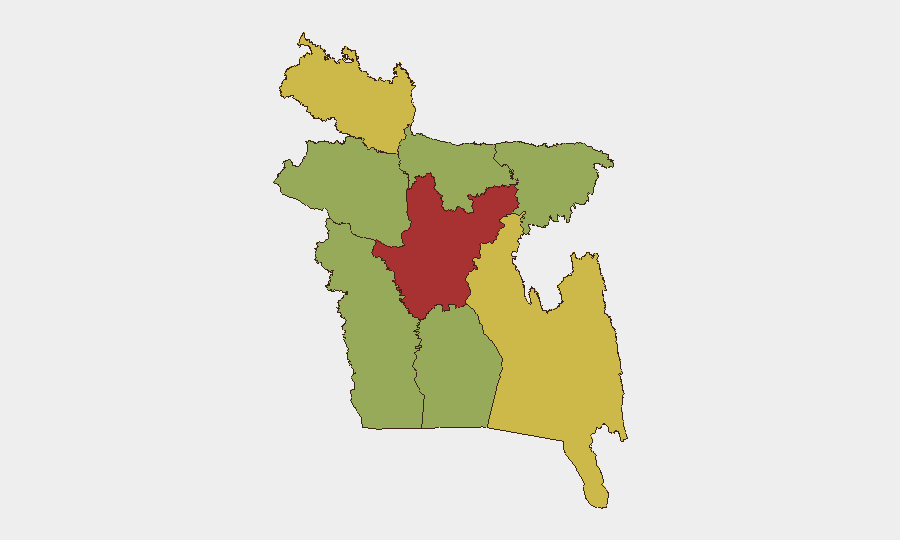
Situation Summary
Bangladesh faces elevated security tension amid a convergence of law-enforcement restructuring, border management strain, and localized civil unrest. A forced retirement of 33 senior police officials signals internal governance shifts that may affect policing continuity and operational effectiveness during a period of heightened crime and cross-border activity. The overall threat environment—ranked #19 globally with a composite score of 68—remains volatile, with Dhaka Division (risk 77.6) and Chittagong Division (66.2) presenting substantially elevated risk compared to other regions.
Key Developments
- Dhaka (city-wide) – DMP mass arrest operation (2026-07-28). The Dhaka Metropolitan Police conducted a 24-hour crackdown resulting in 440+ arrests and 29–41 criminal cases across eight divisions (Ramna, Lalbagh, Wari, Motijheel, Tejgaon, Mirpur, Gulshan, Uttara), targeting drug, weapons, and related offences. Indicates sustained law-enforcement intensity in the capital.
- Dhaka, Bhatara – fatal residential gas explosion (2026-07-28). A gas-line leak caused an explosion killing two residents (ages 24 and 8) and critically injuring a third. Underscores infrastructure safety deficits in urban residential areas and emergency-response demands.
- Kushtia District, Daulatpur border – cross-border infiltration attempt (2026-07-26). Border Guard Bangladesh intercepted an attempt to move eight unidentified individuals into Bangladesh from India; the group was forced back across the river. Reflects ongoing border management friction and irregular movement pressure.
- National (Home Ministry) – forced retirement of senior police leadership (2026-07-28). The Home Ministry ordered 33 senior police officials—14 DIGs and 18 additional DIGs—into immediate forced retirement "in public interest." This leadership reshuffle may disrupt policing continuity during a sensitive security period.
- Dhaka, Jatrabari and Turag areas – arrest sweep and surveillance expansion (2026-07-28). Police arrested 19 suspects in these zones as part of broader 377-arrest operations in 24 hours; DMP also announced plans to deploy AI-supported public-space and traffic surveillance cameras. Indicates intensified monitoring and potential community friction.
- Multi-divisional – dengue surge (2026-07-28). Bangladesh health authorities reported 327 new dengue cases and 2 deaths in a recent 24-hour period across the country, with concentration in urban centers including Dhaka. Health-sector stress may compound security-response capability.
- India–Bangladesh border region – BSF–BGB standoff and protest announcements (2026-07-27 to 28). A brief Border Security Force–BGB standoff occurred over irregular crossings; Jamaat-e-Islami and allied Islamist opposition parties announced border-area protests planned for Friday (2026-07-31). Indicates sustained political and frontier tension.
Highest-Risk Areas
Dhaka Division dominates the risk landscape at 77.6, driven by high-density urban crime, ongoing law-enforcement operations, and national-government seat status. Chittagong Division (66.2) and Rangpur Division (61) follow, reflecting port-area vulnerability, trafficking routes, and northern frontier instability. The three-division concentration of risk suggests that Dhaka's leadership vacuum from the police retirement, combined with Chittagong's criminal-enterprise density and Rangpur's cross-border exposure, will shape near-term threat escalation. Remaining divisions cluster between 47.6–59.5, indicating more distributed but lower-intensity risk.
How GeoBit Would Assist
Corporate security teams would deploy Intel Sweep and OSINT fusion to monitor police restructuring, arrest patterns, and emerging actor networks in real time; AOI Monitoring & Early Warning on Dhaka, Chittagong, and border zones (Kushtia, Rangpur) to flag protest activity, cross-border incidents, and enforcement operations; and Routing & Network Analysis to identify alternative transport corridors and safe movement windows as civil unrest and health risks evolve. Satellite and event-feed integration would enable rapid situational awareness of operational disruptions.
7-Day Outlook
The announced border-area protests (Friday, 2026-07-31) are likely to escalate localized unrest in Rangpur and frontier districts, with potential spillover friction at Dhaka checkpoints. The police leadership vacuum will persist over days, risking operational inconsistency and possible tactical vacuums that criminal and militant actors may exploit. Health-sector strain from dengue will compound pressures on emergency response and mobility in urban zones.
Highest-Risk Areas — Ranked
| # | State / Region | Risk |
|---|---|---|
| 1 | Dhaka Division | 77.6 |
| 2 | Chittagong Division | 66.2 |
| 3 | Rangpur Division | 61 |
| 4 | Khulna Division | 59.5 |
| 5 | Barishal Division | 47.6 |
| 6 | Rajshahi Division | 47.6 |
| 7 | Mymensingh Division | 47.6 |
| 8 | Sylhet Division | 47.6 |
Sources
Previous Daily Briefs
A new Bangladesh brief is written every day — each with its own risk map and downloadable CSV. Here's the last week; use the calendar to go further back.
📅 Browse every day by calendar →
Highlighted days have a brief. Tap a day for that day's map & analysis, or “csv” for that day's dataset ($5).
Atlas — our AI intelligence desk — emails them this snapshot personally. Nothing else, no list.