Situation Summary
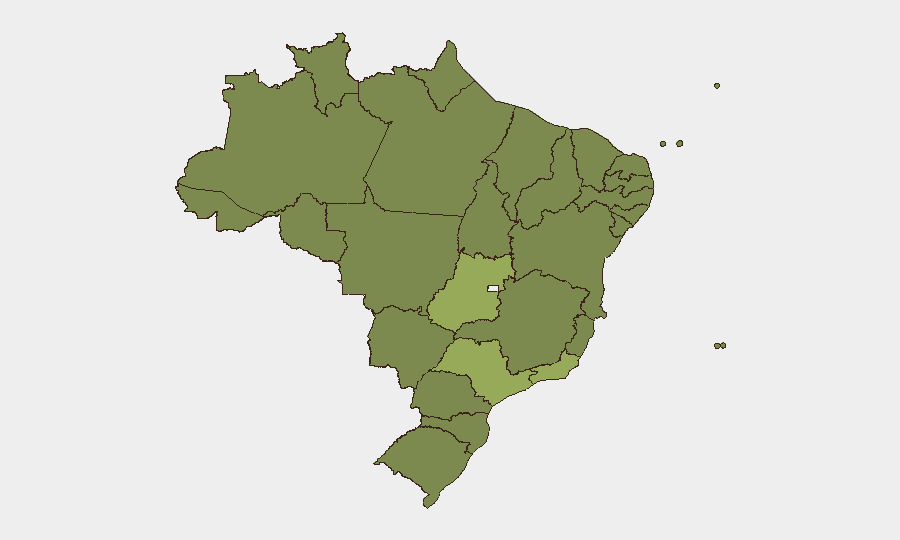
Brazil's composite threat score of 38 (ranking #37 globally) reflects a volatile security environment driven by organized crime trafficking, police-force tensions, diplomatic friction, and fragmented governance challenges. The past 48 hours have surfaced major drug and weapons interdictions, a significant helicopter accident, alleged rural violence against Indigenous persons, and a public health emergency involving vaccine suspension—signals of systemic vulnerabilities across multiple threat domains. São Paulo and Rio de Janeiro remain the epicenters of risk (54.9 and 48.8 respectively), with secondary hotspots in Goiás and Piauí. Overall trajectory remains unstable.
Key Developments
- São Paulo (state) – 27 Jul 2026: Federal and state police intercepted a helicopter carrying 288 kg of cocaine base paste near the Paraguay border; multiple suspects detained and aircraft seized. Indicates ongoing large-scale trafficking infrastructure into the southeast corridor.
- Santa Terezinha de Itaipu, Paraná – 27 Jul 2026: Polícia Rodoviária Federal conducted the largest rifle seizure in its operational history on highway BR-277, confiscating high-caliber firearms linked to organized crime trafficking toward the southeast.
- Brasília (national) – 27 Jul 2026: Brazilian government promulgated a Mercosur police cooperation agreement permitting cross-border hot-pursuit operations and coordinated law-enforcement actions, effective across Paraguay, Argentina, and Uruguay borders.
- National (Brazil) – 27 Jul 2026: Federal health authorities temporarily suspended a single-dose dengue vaccine following two suspected vaccine-related deaths; investigations ongoing. Affects traveler and resident risk assessments in dengue-endemic zones.
- Amambai, Mato Grosso do Sul – 27 Jul 2026: Security guards at a ranch reportedly tortured an Indigenous man (electric prod, kicks) over cattle-theft allegations; incident captured on video and under police investigation. Raises rural violence and Indigenous-rights concerns in the border region.
- Rio de Janeiro state (west) – 26 Jul 2026: Two helicopters collided in flight, killing at least six persons; authorities investigating operational failures and airspace management issues.
- National political level – 27–28 Jul 2026: Multiple government investigations announced; senator and politician disapproval statements issued; U.S. official statements rejected by Brazil three times in 48 hours; Argentina lodged demands against Brazil. Indicates elevated diplomatic and internal political tension.
Highest-Risk Areas
São Paulo (54.9) and Rio de Janeiro (48.8) dominate the risk landscape, both driven by large-scale drug trafficking, organized-crime violence, and police-force fragmentation. Goiás (40.1) and Piauí (37.2) show elevated risk from trafficking networks and weak state capacity in rural zones. The Paraguay and Argentina borders amplify vulnerability: recent cocaine and firearms seizures confirm active transit corridors feeding into São Paulo and the southeast, while the new Mercosur agreement signals both enforcement capability and potential operational friction. Secondary states (Minas Gerais, Bahia, Paraná) maintain moderate-to-significant risk from organized crime, though concentrated in specific corridors and urban centers.
How GeoBit Would Assist
Security teams should deploy AOI Monitoring & Early Warning on São Paulo, Rio de Janeiro, and the Paraguay border zones to track trafficking patterns and police operations in near-real time. Network & Actor Analysis combined with OSINT fusion (X/Twitter, Telegram, YouTube) would clarify emerging tensions between federal and state police, political actors, and international partners—critical for anticipating operational disruptions or policy shifts affecting duty-of-care compliance. Routing & Network Analysis enables identification of alternative transportation corridors and risk corridors as enforcement tightens on BR-277 and other transit routes.
7-Day Outlook
Interdictions and the Mercosur agreement suggest increased enforcement activity and cross-border operational tempo over the next week, likely generating transient supply disruptions and tactical shifts by trafficking networks. Political and diplomatic friction may influence resource allocation and interagency coordination. Health-sector uncertainty around the vaccine suspension will persist pending investigation closure. Risk remains elevated and operationally volatile.
Highest-Risk Areas — Ranked
| # | State / Region | Risk |
|---|---|---|
| 1 | São Paulo | 54.9 |
| 2 | Rio de Janeiro | 48.8 |
| 3 | Goiás | 40.1 |
| 4 | Piauí | 37.2 |
| 5 | Minas Gerais | 32.9 |
| 6 | Bahia | 31.1 |
| 7 | Paraná | 30.7 |
| 8 | Pernambuco | 27.5 |
| 9 | Amazonas | 27.1 |
| 10 | Rio Grande do Sul | 26.4 |
| 11 | Santa Catarina | 26 |
| 12 | Mato Grosso | 25.6 |
Previous Daily Briefs
A new Brazil brief is written every day — each with its own risk map and downloadable CSV. Here's the last week; use the calendar to go further back.
📅 Browse every day by calendar →
Highlighted days have a brief. Tap a day for that day's map & analysis, or “csv” for that day's dataset ($5).
Atlas — our AI intelligence desk — emails them this snapshot personally. Nothing else, no list.