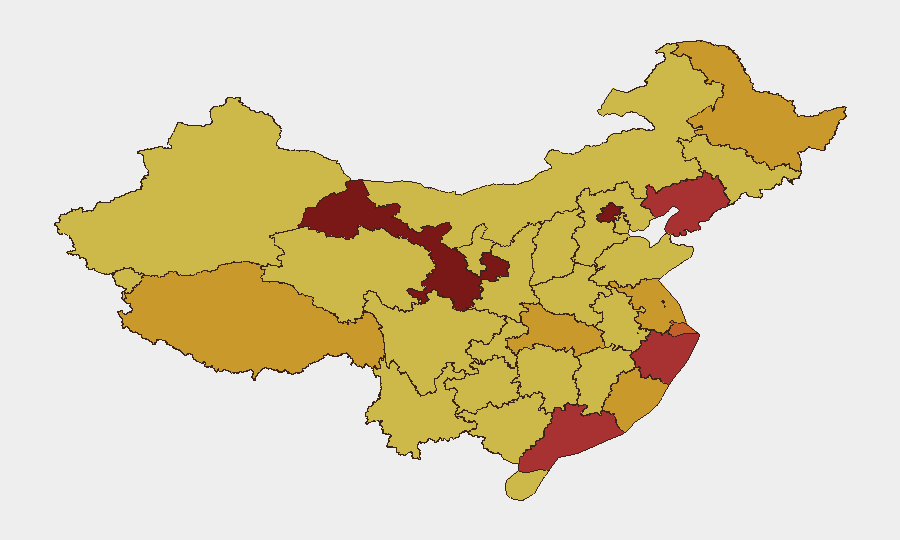
Situation Summary
China remains the second-highest global threat environment (composite score 100), with 569 tracked events driving elevated risk across corporate operations, supply chains, and personnel safety. The last 48 hours have seen a sharp escalation in foreign-relations enforcement, military signaling, and state-security detentions, alongside international sanctions and diplomatic disapproval from Japan and Europe. Cross-Strait military activity has resumed at elevated tempo, and Five Eyes cyber warnings have flagged AI-enabled intrusion capabilities. The trajectory points toward sustained tension with Western partners, tightened enforcement of foreign compliance, and continued PLA operational posture in contested domains.
Key Developments
- Dalian, Liaoning – 24 June 2026: Chinese Foreign Ministry confirmed detention of two Japanese nationals for alleged violations related to rare-earth product export controls, explicitly linking enforcement to national security authorities and escalating bilateral tension.
- Beijing (National) – 24 June 2026: Foreign Ministry issued broad guidance requiring all foreign nationals and companies operating in China to "abide by Chinese laws and regulations," with explicit connection to state-security enforcement and recent detentions. Signals potential widening of compliance scrutiny across foreign workforces.
- Taiwan Strait – 23 June 2026: PLA aircraft carrier *Fujian* conducted north–south transit with escort vessels, the first such mission since April. Indicates normalization of high-visibility cross-Strait operations and sustained military signaling.
- National (Cyber) – 24 June 2026: Five Eyes joint alert issued on elevated cyber-intrusion risk from Chinese AI-enabled offensive capabilities, targeting allied infrastructure and commercial networks.
- National – 23 June 2026: Coordinated international disapproval from Japan and Europe, combined with U.S. military conventional-force posturing. Reflects hardening alignment of Western responses to Chinese actions.
- Sectoral – 24 June 2026: NVIDIA imposed administrative sanctions related to China operations; demonstrators rallied against China-linked ocean shipping. Supply-chain and logistics sectors showing operational and reputational friction.
Highest-Risk Areas
Gansu (100), Beijing (88.9), and Liaoning (79.8) rank highest. Beijing's elevated score reflects both capital-city enforcement intensity and headquarters concentration of foreign business; Liaoning's rise correlates with the rare-earth detention and foreign-compliance messaging. Coastal and developed provinces (Zhejiang, Guangdong, Shanghai, Jiangsu, Fujian) cluster in the 71–77 range, driven by supply-chain exposure, foreign-worker density, and proximity to Taiwan Strait activity. Gansu's exceptional score warrants direct inquiry into drivers; preliminary signal suggests elevated security-force activity and possible border/regional instability factors.
How GeoBit Would Assist
Security teams should deploy Intel Sweep and multi-source OSINT fusion to track real-time foreign-ministry statements, detention announcements, and enforcement actions affecting personnel and supply chains. AOI Monitoring & Early Warning on Liaoning, Beijing, and coastal manufacturing hubs provides persistent alerting on police activity, protests, and regulatory enforcement that could impact operations or staff safety. Network & Actor Analysis combined with cyber risk assessment helps teams understand Five Eyes threat vectors and prioritize defensive posture for systems connected to China operations.
7-Day Outlook
Foreign-compliance enforcement and detention risk will likely remain elevated, particularly in sectors linked to export controls (rare earths, semiconductors, dual-use goods). PLA cross-Strait operations and air-defense exercises are expected to continue, increasing incident risk for aviation and maritime logistics. Western sanctions and technology restrictions will tighten supply-chain friction, particularly for U.S. and allied firms. Personnel in Liaoning, Beijing, and coastal provinces should anticipate increased regulatory scrutiny and document retention requirements.
Highest-Risk Areas — Ranked
| # | State / Region | Risk |
|---|---|---|
| 1 | Gansu | 100 |
| 2 | Beijing | 88.9 |
| 3 | Liaoning | 79.8 |
| 4 | Zhejiang | 76.8 |
| 5 | Guangdong Province | 76.5 |
| 6 | Shanghai | 73.2 |
| 7 | Heilongjiang | 72.8 |
| 8 | Tibet | 71.4 |
| 9 | Hubei | 71.2 |
| 10 | Jiangsu | 71.1 |
| 11 | Fujian | 71.1 |
| 12 | Hebei | 70.7 |
Sources
Previous Daily Briefs
A new China brief is written every day — each with its own risk map and downloadable CSV. Here's the last week; use the calendar to go further back.
📅 Browse every day by calendar →
Highlighted days have a brief. Tap a day for that day's map & analysis, or “csv” for that day's dataset ($5).