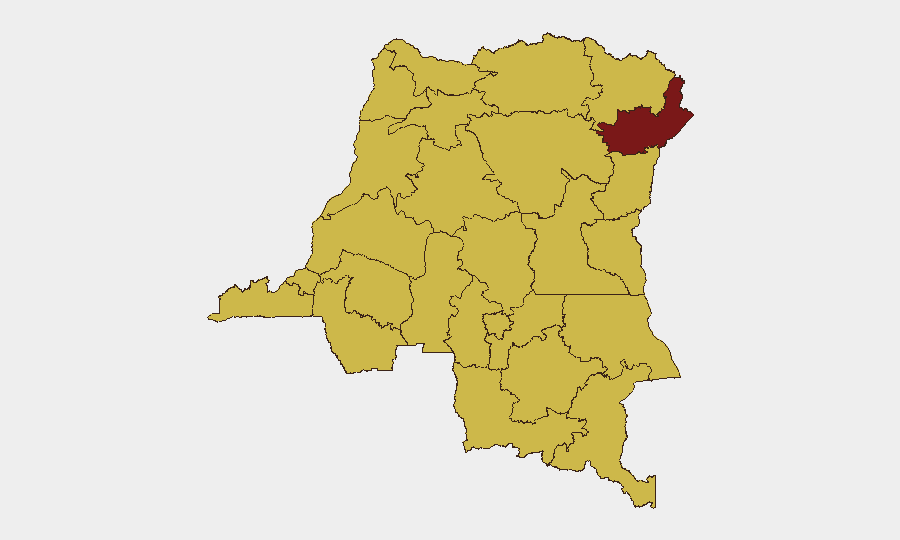
Situation Summary
DR Congo remains the 14th-highest-risk country globally (composite threat score 89), driven primarily by active civil conflict in eastern provinces and compounded by a rapidly spreading Ebola outbreak now crossing provincial and international boundaries. The last 48 hours have seen no major new armed clashes or mass-casualty incidents, but the Ebola intensification in Ituri—with 50 new cases reported on 18–19 June alone—is now the dominant operational constraint, triggering movement restrictions, health screening, and displacement that directly impede humanitarian access and corporate mobility. Political tensions in Kinshasa remain elevated following anti-constitutional-reform protests dispersed on 15 June, with security forces maintaining heightened alert near government facilities. Overall trajectory: high baseline risk with no acute escalation imminent, but persistent operational friction from disease control measures and armed-group presence across the east.
Key Developments
- Ituri Province (Bunia, Mambasa area), 18–19 June – WHO and humanitarian partners reported approximately 50 new Ebola cases (Bundibugyo strain) over two days, bringing the outbreak total to ~896 cases and 230+ deaths. Insecurity and population displacement are actively hampering response operations and restricting personnel movement across the affected zones.
- Ituri–North Kivu–South Kivu border zone, 18–19 June – Ebola outbreak is spreading beyond Ituri into neighboring North and South Kivu provinces. DRC–Uganda joint response teams are reinforcing border surveillance and lab capacity, resulting in tightened health screening at some DRC–Uganda frontier crossings and potential congestion at overland entry points.
- Kinshasa (parliament, key government sites), 18–19 June – Security services remain on elevated alert following 15 June dispersal of anti-constitutional-reform protesters. No additional large-scale confrontations verified in the last 48 hours, but authorities are positioned for rapid response and short-notice roadblocks near central government facilities.
- Eastern provinces (North Kivu, Tshopo, Lower Uele), 18–19 June – Armed-group presence and civil-conflict risk persist at baseline levels across northeastern and eastern DRC. No independently verified major clashes or mass-displacement events in the last 48 hours; ongoing risk of road ambush and banditry on secondary routes remains operative.
- National security posture, 18–19 June – Consolidated briefing assesses DR Congo as high-risk but stable within the last 48 hours, with no major nationwide escalation in conflict, crime, or political violence beyond the Ebola-related operational constraints noted above.
Highest-Risk Areas
Ituri Province (risk 91.9) dominates the sub-national ranking, driven by the convergence of entrenched armed-group activity and the accelerating Ebola outbreak—now the single largest impediment to freedom of movement and operational continuity. Nord-Ubangi (63.2) follows, reflecting persistent low-level armed-group presence and limited state capacity. The remaining nine highest-risk provinces (Maniema through North Kivu, all scoring 61.9) form a contiguous band of insurgency-affected territory across the eastern DRC, characterized by sporadic clashes, banditry, and humanitarian access constraints. All tier-1 and tier-2 risk zones are remote or partially ungoverned, amplifying both armed-group risk and the reach of communicable-disease outbreaks.
How GeoBit Would Assist
Security and duty-of-care teams should deploy AOI Monitoring & Early Warning on Ituri, North Kivu, and key border crossings to track Ebola-response mobility restrictions and armed-group activity in real time. Intel Sweep and OSINT fusion (social media, local radio SIGINT, and humanitarian-partner feeds) provide rapid early signals of protest escalation in Kinshasa or new displacement events. Routing & Network Analysis enables identification of safe alternative routes and border crossings as health screening regimes tighten, reducing travel friction and exposure risk.
7-Day Outlook
No imminent escalation in armed conflict or mass civil unrest is anticipated in the next 7 days; however, the Ebola outbreak is expected to sustain or accelerate within Ituri and the Kivu provinces, prolonging movement restrictions and operational disruptions through at least late June. Kinshasa remains susceptible to sudden protest activity and associated security-force responses, particularly if proposed constitutional reforms advance. Corporate and humanitarian personnel should prepare for extended access delays across eastern and northeastern provinces and maintain real-time situational awareness near Kinshasa.
Highest-Risk Areas — Ranked
| # | State / Region | Risk |
|---|---|---|
| 1 | Ituri | 91.9 |
| 2 | Nord-Ubangi | 63.2 |
| 3 | Maniema | 61.9 |
| 4 | Sud-Ubangi | 61.9 |
| 5 | Équateur | 61.9 |
| 6 | Mongala | 61.9 |
| 7 | Lower Uele | 61.9 |
| 8 | Tshopo | 61.9 |
| 9 | Tshuapa | 61.9 |
| 10 | Upper Uele | 61.9 |
| 11 | North Kivu | 61.9 |
| 12 | Lualaba | 61.9 |
Sources
Previous Daily Briefs
A new DR Congo brief is written every day — each with its own risk map and downloadable CSV. Here's the last week; use the calendar to go further back.
📅 Browse every day by calendar →
Highlighted days have a brief. Tap a day for that day's map & analysis, or “csv” for that day's dataset ($5).