Situation Summary
Egypt's overall security posture remains stable but with persistent underlying vulnerabilities to terrorism, cross-border smuggling, and spillover from regional conflicts. The country ranks #18 globally (composite threat score 70) with 94 tracked events; however, open-source reporting reveals few discrete domestic incidents in the past 24–48 hours. Current risk is concentrated in border operations, diplomatic response to regional Iranian–Israeli escalation, and sensitivity around the Gaza frontier, rather than new internal security failures. The trajectory reflects heightened official vigilance and enforcement rather than acute deterioration.
Key Developments
- Egypt–Sudan border region (23–24 July 2026): Egyptian security forces conducted a major operation detaining 87 Egyptians and 136 foreign nationals for illegal gold mining and smuggling, signaling intensified border-control enforcement and concern over unauthorized cross-border movement on the southern frontier.
- Egypt–Gaza border, Rafah (24 July 2026): Egypt deployed additional military reinforcements and formally rejected an Israeli proposal for an "experimental humanitarian zone" in Tel Al-Sultan, citing security concerns about mass displacement along the frontier; reflects heightened sensitivity at the Egypt–Gaza crossing.
- Regional diplomatic response (24 July 2026): Egyptian leadership, including President El-Sisi and Foreign Minister Badr Abdelatty, publicly condemned renewed Iranian attacks on Kuwait and Bahrain and warned of potential spillover risks to infrastructure and civilian assets across the region, indicating official concern about indirect effects on Egypt's security environment.
- Nationwide terrorism advisory posture (last 24–48 hours): Official advisories from Germany and Australia reaffirm that while Egypt is rated "stable and calm," the persistent threat of terrorist attacks remains and is heightened in North Sinai, Libyan and Sudanese border regions, and remote Sahara areas; regional conflict is flagged as a potential trigger for sudden travel disruptions.
- No major domestic incidents reported: Open-source research confirms very few credible, multi-sourced reports of civil unrest, major crime spikes, or infrastructure attacks inside Egypt proper in the last 24–48 hours; current risk signals are primarily border operations and regional posture rather than new internal events.
Highest-Risk Areas
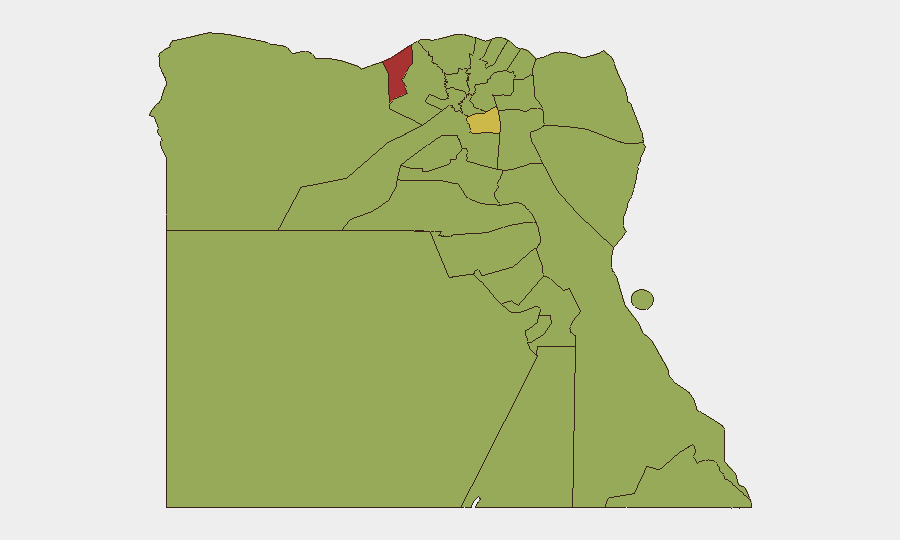
Alexandria (78.9) and Cairo (61.8) drive Egypt's sub-national risk ranking, with Alexandria's elevated score reflecting its position as a major port city exposed to maritime security, smuggling, and terrorism risks. Cairo's composite risk reflects large population density, infrastructure concentration, and historical targeting by extremist groups. Secondary risk clusters in Suez (55.3), Giza (49.8), and the border regions (North and South Sinai at 48.9) reflect chokepoint geography, militant activity, and cross-border smuggling networks. The consistency of risk scores across remote and border areas (Halaib Triangle, Matruh, Red Sea) underscores chronic instability in peripheral regions and difficulty enforcing state authority in sparsely populated zones.
How GeoBit Would Assist
Security teams managing personnel or assets in Egypt should deploy AOI Monitoring & Early Warning on Alexandria, Cairo, Suez, and the Sinai regions to detect incident escalation in real time. OSINT fusion (combining X/Twitter, Telegram, YouTube, multi-language search, and entity extraction) provides continuous visibility into activist movements, militant communications, and civil-unrest signals across major urban centers. Border & Disputed-Territory Search and Routing & Network Analysis enable identification of safe corridors, alternative transport routes, and vulnerability hotspots along the Sudan and Libya frontiers—critical for supply-chain and personnel-movement planning.
7-Day Outlook
Near-term risk is likely to remain at current elevated baseline, with borderline probability of escalation if regional Iran–Israel tensions reignite. Expect continued intensive enforcement on the Sudan border and heightened military posture at the Gaza frontier. No significant decrease in terrorism threat is anticipated over the coming week; monitoring advisories for sudden changes tied to regional events remains essential.
Highest-Risk Areas — Ranked
| # | State / Region | Risk |
|---|---|---|
| 1 | Alexandria | 78.9 |
| 2 | Cairo | 61.8 |
| 3 | Suez | 55.3 |
| 4 | Giza | 49.8 |
| 5 | South Sinai | 49.2 |
| 6 | North Sinai | 48.9 |
| 7 | Qena | 48.9 |
| 8 | Red Sea | 48.9 |
| 9 | Halaib Triangle | 48.9 |
| 10 | Matruh | 48.9 |
| 11 | Kafr El Sheikh | 48.9 |
| 12 | The Lake | 48.9 |
Sources
Previous Daily Briefs
A new Egypt brief is written every day — each with its own risk map and downloadable CSV. Here's the last week; use the calendar to go further back.
📅 Browse every day by calendar →
Highlighted days have a brief. Tap a day for that day's map & analysis, or “csv” for that day's dataset ($5).
Atlas — our AI intelligence desk — emails them this snapshot personally. Nothing else, no list.