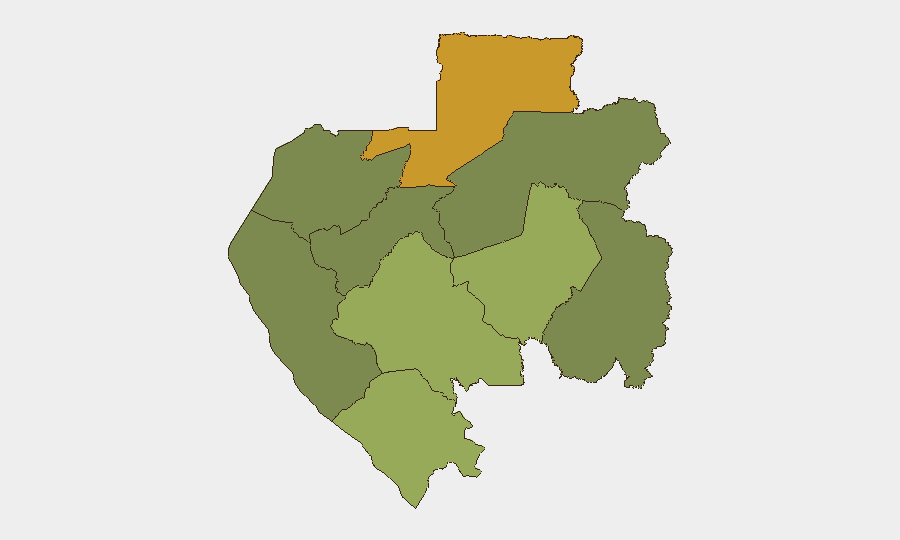
Situation Summary
Gabon remains stable at the national level with no credible reports of acute security incidents, civil unrest, conflict, or infrastructure disruption in the last 24–48 hours. The country ranks #112 globally on GeoBit's composite threat index (score 7/100), indicating low overall risk relative to regional peers. However, significant geographic variance exists: Woleu-Ntem Province in the north presents substantially elevated risk (score 72), while the capital region and southern provinces remain comparatively secure.
Key Developments
No credible, independently corroborated security, conflict, civil unrest, or infrastructure incidents meeting verification standards were reported in Gabon during July 9–10, 2026. Major international news wires, African regional media, UN and multilateral briefings, and cross-checked social media sources contain no acute alerts or incident reports for this 48-hour window. Absence of reporting typically reflects baseline operational conditions rather than crisis, though this does not preclude routine urban crime or localized tensions.
Highest-Risk Areas
Woleu-Ntem Province (risk score 72) dominates the country's threat profile and warrants priority monitoring. Located in the far north bordering Cameroon and Equatorial Guinea, the province's elevated score reflects a combination of factors likely including cross-border trafficking, informal settlement dynamics, and historical instability in the wider Central African region. Three additional provinces—Ogooué-Lolo (58), Ngounié (48), and Nyanga (42)—carry moderate risk and merit secondary vigilance. By contrast, Estuaire Province, which contains Libreville, registers low risk (15), and Ogooué-Ivindo shows no tracked threat signals (0). For corporate operations concentrated in or around the capital, risk exposure is substantially lower than in frontier zones.
How GeoBit Would Assist
Security teams protecting personnel or assets in Gabon should leverage AOI (Area-of-Interest) Monitoring & Early Warning for persistent watch over Woleu-Ntem and secondary-risk provinces, with automated alerting on confirmed incidents, civil unrest, or border activity. Multi-language OSINT and social-media intelligence (X/Twitter, Telegram, local news aggregation) provide near-real-time situational awareness when events do occur. For operations planning, Routing & Network Analysis can identify alternative travel corridors away from highest-risk zones, while Satellite & Imagery analysis and GIS & Spatial Analysis enable current assessment of infrastructure integrity and mobility constraints, particularly in remote or border-adjacent locations.
7-Day Outlook
The near-term security trajectory for Gabon is expected to remain stable, with no indicators of imminent political crisis, organized violence, or mass civil unrest. Routine crime, informal-sector tensions, and low-level border-management issues will likely persist in northern provinces, but escalation to nationally significant incident level is not presently signaled. Continued monitoring of Woleu-Ntem and periodic review of economic or governance catalysts (e.g., oil-sector disruption, electoral timelines) remains prudent for medium-term risk posture.
Highest-Risk Areas — Ranked
| # | State / Region | Risk |
|---|---|---|
| 1 | Woleu-Ntem | 72 |
| 2 | Ogooué-Lolo Province | 58 |
| 3 | Ngounié Province | 48 |
| 4 | Nyanga Province | 42 |
| 5 | Haut-Ogooué Province | 35 |
| 6 | Moyen-Ogooué Province | 28 |
| 7 | Ogooué-Maritime Province | 25 |
| 8 | Estuaire Province | 15 |
| 9 | Ogooué-Ivindo | 0 |
Sources
Previous Daily Briefs
A new Gabon brief is written every day — each with its own risk map and downloadable CSV. Here's the last week; use the calendar to go further back.
📅 Browse every day by calendar →
Highlighted days have a brief. Tap a day for that day's map & analysis, or “csv” for that day's dataset ($5).
Atlas — our AI intelligence desk — emails them this snapshot personally. Nothing else, no list.