Situation Summary
Germany remains at moderate baseline risk (composite threat score 5; #134 globally), but a sharp spike in violent incidents over the past 48 hours—including a mass shooting, school attack, large-scale sexual violence prosecution, and infrastructure sabotage—signals a deteriorating public safety environment. Thuringia dominates sub-national risk metrics (32.1) with Berlin and Hamburg elevated above the national average. The concurrent spike in criminal violence, custody-related homicide, and suspected deliberate infrastructure attack suggests no single coordinated threat but rather a concerning clustering of high-impact incidents within a compressed timeframe.
Key Developments
- Stade (Lower Saxony) – mass shooting, 6 fatalities. A shooting at a youth support center on July 16–17 killed six people and wounded one; the suspected shooter, involved in an ongoing custody dispute over a 3-month-old child, was arrested. Two additional persons remain subject to police measures. This is the deadliest single incident in the reporting window.
- Bavaria – secondary school attack, 2 serious injuries. Police responded to a reported *"amok"* (rampage) incident at a college-lycée on July 16–17; two women were seriously injured and a 16-year-old male suspect was arrested at the scene.
- Berlin – supermarket hostage rescue. Berlin police freed a hostage held for several hours in a Neukölln supermarket overnight into Saturday, July 18. The male perpetrator was captured and the hostage released unharmed.
- Berlin – major sexual violence prosecution. The Berlin prosecutor's office charged a 68-year-old man with 22 counts of rape and serious bodily injury involving 58 presumed victims, reflecting a long-running pattern of sexual violence now entering judicial proceedings.
- Western Germany – suspected railway sabotage. A fire damaged signaling cables on a major western German railway line on Friday, July 17; authorities assess the damage as deliberate sabotage rather than accidental. Long-distance rail traffic was disrupted during repair operations.
- North Rhine-Westphalia & Netherlands – coordinated drug-lab raids. On July 15, hundreds of officers conducted joint raids on 10 properties in NRW and 3 in the Netherlands, targeting suspected amphetamine laboratories; nine German and Dutch suspects are under investigation for precursor acquisition and lab operation.
- Hamburg–Hanover railway corridor – reopened. One of Germany's busiest rail routes resumed service on July 18 following major renovation works, reducing near-term infrastructure risk on this corridor.
Highest-Risk Areas
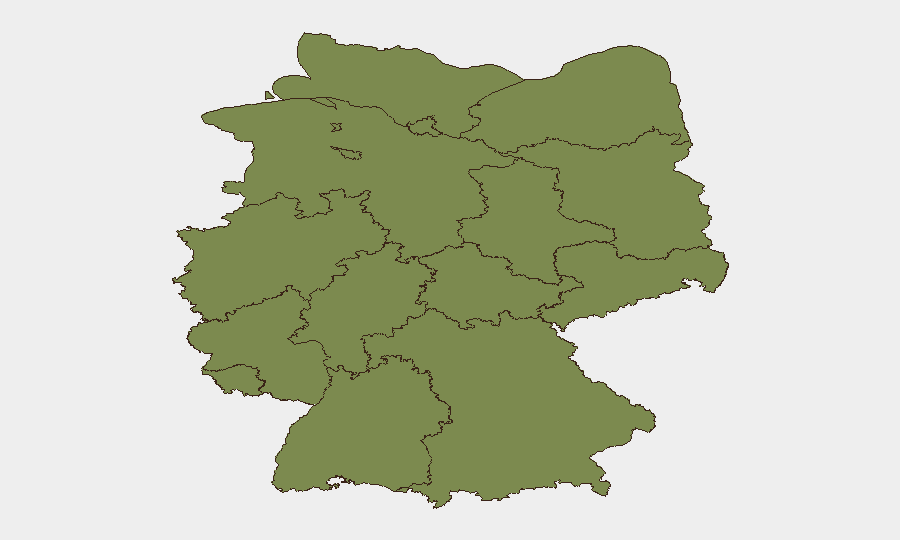
Thuringia's composite risk score of 32.1 is substantially higher than any other state, indicating concentrated instability drivers; Berlin (13.2) and Hamburg (8.1) follow as secondary hotspots. The gap between Thuringia and all other regions suggests either persistent organized-crime or far-right activity, or acute political/social polarization. The violent incidents reported in Bavaria, Lower Saxony, and Berlin do not yet explain Thuringia's elevated baseline but underscore that violent crime and crisis intervention are distributed across multiple regions rather than geographically isolated.
How GeoBit Would Assist
Security teams monitoring Germany should deploy AOI Monitoring & Early Warning on Thuringia, Berlin, and Hamburg to detect emerging protest activity, far-right mobilization, or organized-crime signals before escalation. Network & Actor Analysis and OSINT Sweep (X/Twitter, Telegram, local media) across these regions will establish baseline sentiment and identify radicalization or threat-narrative clustering. Routing & Network Analysis can identify safe alternative transport corridors should rail infrastructure disruption recur, and Risk & Threat Assessment dashboards should be calibrated to flag custody-dispute homicides and school-violence precursors in real time.
7-Day Outlook
The clustering of violent incidents in a 48-hour window likely reflects independent, low-coordination events rather than a coordinated campaign. However, media amplification of mass violence may trigger copycat behavior or inspire vulnerable actors in the coming 7 days, particularly affecting schools and public facilities. Enhanced police presence and crisis-response readiness should be expected; routine travel and business continuity in major cities (Berlin, Hamburg, Munich) are not materially constrained, but heightened situational awareness is warranted.
Highest-Risk Areas — Ranked
| # | State / Region | Risk |
|---|---|---|
| 1 | Thuringia | 32.1 |
| 2 | Berlin | 13.2 |
| 3 | Hamburg | 8.1 |
| 4 | Lower Saxony | 7 |
| 5 | Saxony | 7 |
| 6 | Bavaria | 3.6 |
| 7 | Baden-Württemberg | 2.7 |
| 8 | North Rhine-Westphalia | 2.5 |
| 9 | Schleswig-Holstein | 2.3 |
| 10 | Mecklenburg-Vorpommern | 2.3 |
| 11 | Brandenburg | 2.3 |
| 12 | Rhineland-Palatinate | 2.1 |
Sources
Previous Daily Briefs
A new Germany brief is written every day — each with its own risk map and downloadable CSV. Here's the last week; use the calendar to go further back.
📅 Browse every day by calendar →
Highlighted days have a brief. Tap a day for that day's map & analysis, or “csv” for that day's dataset ($5).
Atlas — our AI intelligence desk — emails them this snapshot personally. Nothing else, no list.