Situation Summary
Iran faces elevated domestic and regional tensions as of 22 June 2026, with 935 tracked security events placing it at #4 global threat rank (composite score 100). Today's signals include intra-governmental disapproval of the president, threats from Iranian actors toward the presidency, active demonstrations, and security-force coercion of protesters—indicating both regime instability and public unrest. International friction with the UK and media criticism compound the environment. The trajectory remains volatile with no clear de-escalation signals.
Key Developments
- Tehran Province, 22 June: Demonstration/rally activity reported with concurrent security-force coercion of protesters. No casualty count confirmed; location and specific trigger unknown from available reporting.
- Tehran Province, 22 June: Intra-regime disapproval directed at the president, coupled with threats from Iranian nationals toward the presidency. Nature of threat and speaker identity require clarification; signals potential factional or public opposition.
- Iran (national), 22 June: Demand issued by Iranian actors to Iranian targets (specificity unclear from available data). May relate to ongoing domestic political or economic grievance.
- Iran vs. UK, 20 June: Formal disapproval statement by Iran toward the United Kingdom. Cause and scope of diplomatic friction not detailed in available signals; warrants monitoring for escalation.
- Media/Public Statement Activity, 19–22 June: Academic rejection of Iran's position and media disapproval of Iranian policy/actions documented. Suggests reputational pressure and international criticism intensifying.
- Mashhad (Razavi Khorasan Province), 21 June: Public statement issued by Lebanon-based actor(s) regarding Mashhad; content unclear but signals potential regional actor involvement or commentary on Iranian northeastern region.
Note: Available event signals lack granular incident reporting (specific times, precise triggers, casualty/damage counts, named organizations). Verification of these signals against independent news sources and real-time X/Telegram OSINT required for operational decision-making.
Highest-Risk Areas
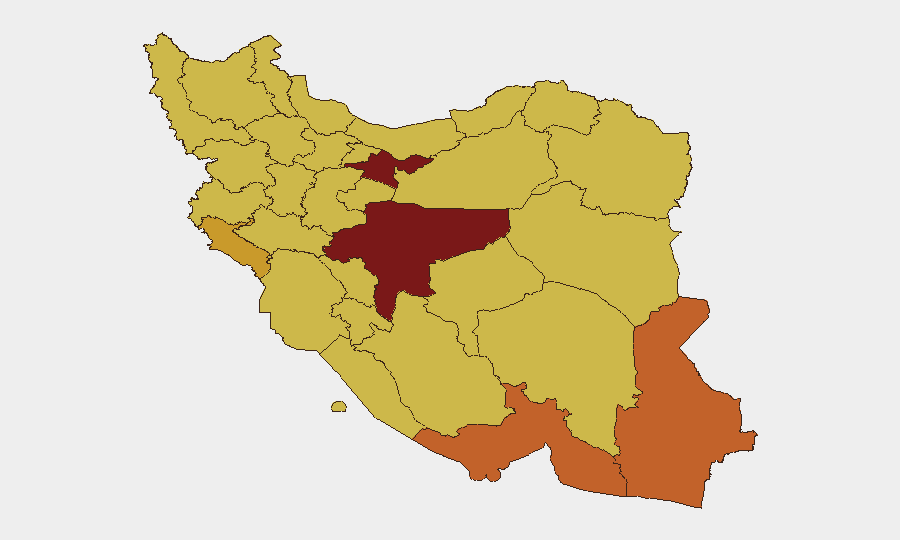
Tehran Province (risk 100) and Isfahan Province (risk 98.7) dominate the threat landscape, both showing signs of active civil unrest and security-force response. The concentration of political power, security apparatus, and urban density in Tehran makes it the epicenter; Isfahan's high ranking suggests either parallel unrest or critical infrastructure/economic vulnerabilities. Borderland provinces—Sistan and Baluchestan (73.3), Hormozgan (73.1), Ilam (71), and West Azerbaijan (70.4)—remain elevated due to cross-border trafficking, militant activity, and ethnic tensions. Razavi Khorasan (70.7, home to Mashhad) has emerged as a secondary concern given today's regional signals. Corporate and personnel security postures should reflect highest vigilance in Tehran and Isfahan, with secondary precautions extended to Khuzestan and border zones.
How GeoBit Would Assist
Security teams in Iran should deploy AOI (Area-of-Interest) Monitoring & Early Warning on Tehran and Isfahan to receive real-time alerting on demonstration, coercion, and force-deployment events before they impact staff safety. Intel Sweep and X/Telegram OSINT capabilities enable continuous tracking of emerging protest triggers, regime factional messaging, and international statements to anticipate escalation windows. Sentiment & Temporal Analysis across multiple data sources (media, social, official statements) would clarify whether today's intra-regime disapproval represents a transient political maneuver or a structural challenge to stability.
7-Day Outlook
Domestic tension is likely to sustain or intensify over the next week absent a major concession or policy shift by the regime. Demonstrations may widen to secondary cities, and security-force response could harden. International diplomatic friction with the UK and media criticism may drive nationalist rhetoric, temporarily uniting regime factions but risking miscalculation in border or maritime incidents. Personnel and asset security postures should remain at elevated readiness.
Highest-Risk Areas — Ranked
| # | State / Region | Risk |
|---|---|---|
| 1 | Tehran Province | 100 |
| 2 | Isfahan Province | 98.7 |
| 3 | Sistan and Baluchestan Province | 73.3 |
| 4 | Hormozgan Province | 73.1 |
| 5 | Ilam Province | 71 |
| 6 | Razavi Khorasan | 70.7 |
| 7 | West Azerbaijan Province | 70.4 |
| 8 | Bushehr Province | 70.1 |
| 9 | North Khorasan Province | 70 |
| 10 | Chaharmahal and Bakhtiyari Province | 70 |
| 11 | Khuzestan Province | 70 |
| 12 | Kohgiluye and Buyer Ahmad Province | 70 |
Previous Daily Briefs
A new Iran brief is written every day — each with its own risk map and downloadable CSV. Here's the last week; use the calendar to go further back.
📅 Browse every day by calendar →
Highlighted days have a brief. Tap a day for that day's map & analysis, or “csv” for that day's dataset ($5).