Situation Summary
Libya remains in a fragmented state marked by competing power centers, institutional instability, and persistent civil-war dynamics. Recent diplomatic activity—including Malta-based talks between eastern and western Libyan officials and US–Libya security cooperation discussions—suggests efforts to stabilize the political settlement, but these remain nascent and have not arrested underlying factional tensions. The security environment is characterized by localized militia activity, institutional weakness, and vulnerability to transnational crime and cyber threats, rather than active large-scale combat in the last 48 hours.
Key Developments
- Diplomatic engagement (Malta, 2026-07-09–10): Eastern and western Libyan officials held talks aimed at supporting state consolidation and political settlement. No security incidents reported in conjunction with these meetings.
- US–Libya security cooperation discussions (2026-07-09–10): Official-level engagement on security matters underway; indicates international effort to reinforce Libyan institutional capacity.
- Cyber-fraud dismantling (2026-07-08–09, location unspecified): Libyan authorities reported successful disruption of an organized cyber-fraud ring. Operational details and precise timing remain limited in open sources.
- Embassy relations reduction (2026-07-10, multiple missions): Two separate instances of embassy-to-Libya relations reduction signaled, likely reflecting broader diplomatic reassessment; specific causes under investigation.
- International statements and rejections (2026-07-09–10): Washington and Geneva-aligned actors issued public statements and formal rejections concerning Libyan governance or compliance matters; substance and targets remain preliminary.
Note: No discrete violent incidents—attacks, clashes, hostage-takings, or mass-casualty events—were confirmed in open sources within the last 24–48 hours. Recent political and diplomatic signals dominate reporting. Older incidents (e.g., May 2026 Az Zawiya refinery shelling) are outside the current reporting window.
Highest-Risk Areas
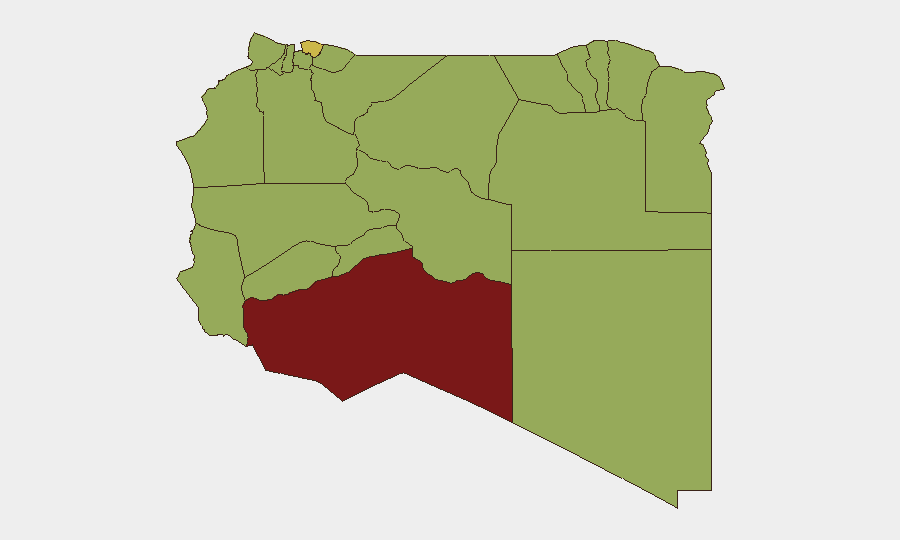
Murzuq (risk 86.9) remains the single highest-risk location, driven by militia fragmentation, weapons proliferation, and limited state presence in the southern Fezzan region. Tripoli (65.5) ranks second, reflecting political contestation, organized-crime networks, and periodic militia clashes within the capital and surrounding coastal zones. The southern and western districts—Nalut, Ghat, Az Zawiya, Wadi al Shatii, Kufra, and others—cluster at risk 56.9, indicating sustained instability from armed-group activity, border permeability, and weak governance capacity. These zones collectively drive Libya's #21 global ranking and pose the highest risk to expatriate presence, supply chains, and critical infrastructure.
How GeoBit Would Assist
Teams with personnel or assets in Libya should deploy AOI Monitoring & Early Warning on Murzuq, Tripoli, and key supply-route corridors to flag emerging militia or criminal activity with real-time alerting. Intel Sweep and multi-language OSINT fusion (X/Telegram, local media, radio SIGINT) provide continuous detection of factional statements, checkpoint activity, and threats to roads and ports. Conflict & Military force-structure tracking and Network & Actor Analysis help identify which militia leaders and armed groups control specific districts, enabling risk-calibrated routing and facility-security decisions.
7-Day Outlook
Diplomatic engagement is likely to continue at a measured pace, with limited immediate security spillover. Underlying militia fragmentation and institutional weakness will persist, sustaining chronic risk in Murzuq, southwestern zones, and coastal Tripoli. No major escalation is forecast in the near term, but the absence of recent large-scale violence should not be mistaken for de-escalation; risk remains elevated and distributed across multiple sub-national zones.
Highest-Risk Areas — Ranked
| # | State / Region | Risk |
|---|---|---|
| 1 | Murzuq | 86.9 |
| 2 | Tripoli | 65.5 |
| 3 | Nalut | 56.9 |
| 4 | Ghat | 56.9 |
| 5 | Baladiyah Surman | 56.9 |
| 6 | Az Zawiya District | 56.9 |
| 7 | Wadi al Shatii | 56.9 |
| 8 | Wadi al Hayaa | 56.9 |
| 9 | Kufra | 56.9 |
| 10 | Nuqat al Khams | 56.9 |
| 11 | Jafara | 56.9 |
| 12 | Murqub | 56.9 |
Sources
Previous Daily Briefs
A new Libya brief is written every day — each with its own risk map and downloadable CSV. Here's the last week; use the calendar to go further back.
📅 Browse every day by calendar →
Highlighted days have a brief. Tap a day for that day's map & analysis, or “csv” for that day's dataset ($5).
Atlas — our AI intelligence desk — emails them this snapshot personally. Nothing else, no list.