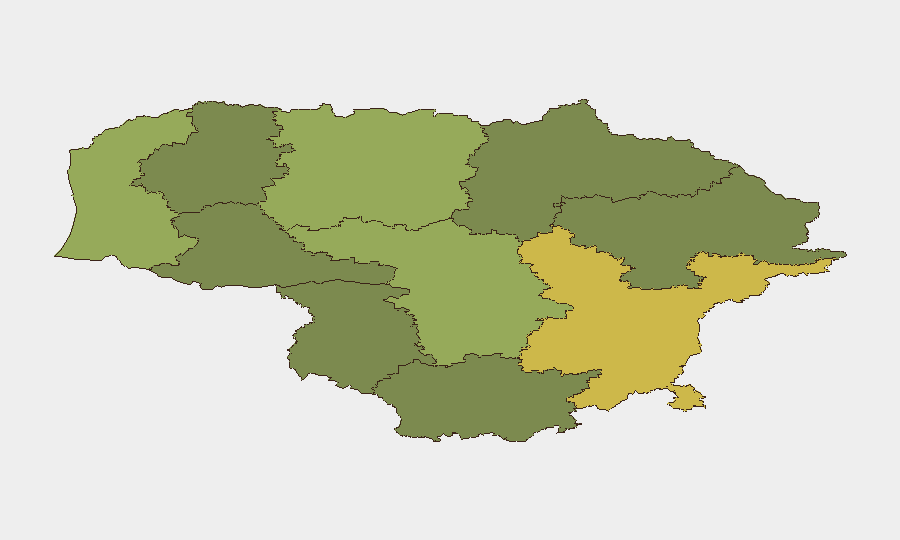
Situation Summary
Lithuania remains a low-threat environment globally (rank #126, composite score 10) with no discrete security events tracked in the current assessment window. However, recent 24–48-hour developments—including a contained infrastructure incident, elevated air-defense posture around the capital, and ongoing defense-industrial engagement with Ukraine—reflect a precautionary security posture aligned with NATO obligations and regional hybrid-threat vigilance. Official messaging confirms no indicators of imminent large-scale military threat, though heightened awareness of Russian hybrid capabilities persists across the Baltic region.
Key Developments
- Vilnius – Ministry of Foreign Affairs ventilation fire (27 Aug 2026, 0900h local)
A fire in the ventilation shaft of the Lithuanian Ministry of Foreign Affairs building in central Vilnius was rapidly contained by four fire engines and specialist response. Preliminary cause: malfunctioning electric motor. No injuries, no building structural damage, no operational impact. Fire and Rescue Department confirmed full containment and no ongoing security threat.
- Vilnius area – Enhanced air-defense deployment (27–28 Aug 2026)
Lithuanian Armed Forces have strengthened airspace defense around Vilnius, including deployment of a NASAMS medium-range air-defense system, in response to heightened regional concern over hybrid and military threats. Posture remains precautionary; no active threat reported.
- Jonava – Leopard-2 tank handover to Ukraine (28 Aug 2026)
Lithuania Defense Services (LDS) and the German Embassy formally handed over repaired Leopard-2 main battle tanks to Ukraine in Jonava. Tanks will return to active service. Underscores Lithuania's ongoing defense-industrial engagement with Ukraine conflict, with associated security and political sensitivities.
- National – Official reassurance on Russian military threat (27–28 Aug 2026)
Baltic and NATO-aligned officials publicly stated no indicators of imminent large-scale Russian invasion or major new border troop build-ups. Messaging aims to reassure populations while maintaining vigilance on hybrid threats and intelligence-sharing (including recent CIA Director engagement).
- Cross-border – EPPO VAT-fraud case (26–27 Aug 2026, arrests outside Lithuania)
European Public Prosecutor's Office arrested five suspected ringleaders of a cross-border VAT-fraud scheme involving wireless earbuds (Investigation Echo). Assets seized in Czechia, Germany, and Lithuania. Indicates ongoing financial-crime exposure via Lithuanian territory, though arrests executed abroad.
Highest-Risk Areas
Vilnius County (risk 68) significantly outpaces other regions and drives national risk assessment, followed by Kaunas County (58) and Klaipeda County (52). Risk concentration in Vilnius reflects capital status, density of government and diplomatic facilities, and infrastructure criticality—factors heightened by both conventional and hybrid-threat vectors. Kaunas and Klaipeda, as secondary urban and logistics hubs respectively, carry elevated exposure to criminal and transnational financial activity; Klaipeda's Baltic port status adds maritime and supply-chain dimensions.
How GeoBit Would Assist
Intel Sweep and OSINT Fusion would provide 24/7 multi-language monitoring of Lithuanian media, official channels, and regional threat actors, enabling early detection of hybrid campaigns, protests, or security incidents before escalation. AOI Monitoring & Early Warning with persistent watch over Vilnius, Kaunas, and Klaipeda would alert security teams to emerging infrastructure, border, or protest activity affecting personnel and assets. Network & Actor Analysis combined with Economic & Trade intelligence would track financial-crime exposure (e.g., VAT-fraud networks, sanctions evasion) and cross-border risk vectors touching Lithuanian operations.
7-Day Outlook
No major escalation expected over the next seven days; official messaging and intelligence assessments indicate stable military threat environment. Air-defense posture and hybrid-threat vigilance will likely persist as NATO precautionary measures. Corporate and diplomatic operations should maintain standard duty-of-care protocols; infrastructure and border monitoring will remain elevated given regional sensitivities and Ukraine conflict dynamics.
Highest-Risk Areas — Ranked
| # | State / Region | Risk |
|---|---|---|
| 1 | Vilnius County | 68 |
| 2 | Kaunas County | 58 |
| 3 | Klaipeda County | 52 |
| 4 | Siauliai County | 42 |
| 5 | Panevezys County | 38 |
| 6 | Taurage County | 35 |
| 7 | Utena County | 33 |
| 8 | Alytus County | 32 |
| 9 | Telsiai County | 28 |
| 10 | Marijampole County | 25 |
Sources
Previous Daily Briefs
A new Lithuania brief is written every day — each with its own risk map and downloadable CSV. Here's the last week; use the calendar to go further back.
- August 25, 2026
- August 23, 2026
- August 21, 2026
- August 19, 2026
- August 17, 2026
- August 15, 2026
- August 13, 2026
📅 Browse every day by calendar →
Highlighted days have a brief. Tap a day for that day's map & analysis, or “csv” for that day's dataset ($5).
Atlas — our AI intelligence desk — emails them this snapshot personally. Nothing else, no list.