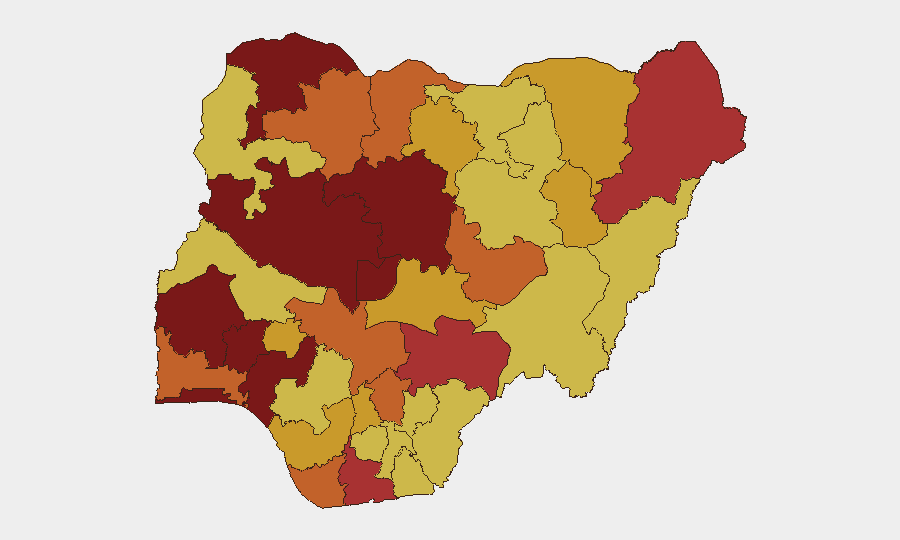
Situation Summary
Nigeria remains the second-highest composite-threat environment globally, with 1,022 tracked security events reflecting widespread violent crime, banditry, kidnapping, and emerging terrorist activity across multiple regions. Recent 48-hour reporting indicates concurrent incidents spanning building collapse, communal bandit attacks with abductions, emergence of new terrorist cells, and credible threats to financial infrastructure, signaling sustained multi-vector pressure on civilians and commercial operations. Government institutional responses—including passage of a State Police Bill and police parade of armed-crime suspects—indicate official acknowledgment of insecurity but underline persistent capacity gaps at both state and federal levels. Trajectory remains volatile and regionally fragmented rather than showing signs of stabilization.
Key Developments
- Port Harcourt, Rivers State (25 June): A three-storey building under construction collapsed on Peter Odili Road, killing at least one worker and trapping others; two rescued and hospitalized. Highlights infrastructure/occupational-safety risks alongside security concerns in Rivers State (ranked #9 sub-nationally, risk 78.4).
- Sokoto State (24–25 June): Armed bandits attacked a community, killed the Chief Imam, and abducted multiple married women. Incident underscores persistence of organized banditry in Sokoto (ranked #7, risk 83.7), a zone already marked by high kidnapping and extortion activity.
- Kebbi State (24 June): Authorities publicly flagged emergence of a new terrorist group termed the "Salam sect" operating in Argungu area. Indicates potential franchise or splinter activity and a new named threat actor requiring monitoring and threat intelligence focus.
- Oyo State (24 June): Police command paraded five armed-crime suspects with recovered firearms. Concurrent directive from Christian Association of Nigeria (CAN), Oyo chapter, ordered churches to tighten perimeter security, suspend night activities, and limit premises access in response to rising abductions and kidnappings. Oyo State is ranked #1 sub-nationally (risk 100).
- National security cluster (22–24 June, reported 21–24 June): Aggregated reporting flagged a mass killing of approximately 20 people in Bokkos LGA, Plateau State; an attack and abduction incident at a girls' school in Kebbi State; and a credible threat message with live ammunition directed at FirstBank on 24 June. This cluster illustrates concurrence of high-lethality incidents and financial-sector targeting.
- National legislative action (24 June): Nigerian Senate passed the State Police Bill into law, reflecting policy response to decentralize policing authority in recognition of persistent insecurity and localized threat patterns.
- Presidential narrative (25 June): Media aide Bayo Onanuga acknowledged ongoing kidnappings and attacks but characterized many as nocturnal, urging media restraint. Reflects official messaging tension between acknowledging insecurity and managing public perception.
Highest-Risk Areas
Oyo, Niger, and Lagos states drive the composite threat ranking at 100, 97.7, and 96.3 respectively, driven by overlapping armed robbery, kidnapping, and organized crime. The contiguous band of northwestern states—Sokoto, Kebbi, Kaduna, and Niger—faces acute banditry and emerging terrorist activity including the newly identified "Salam sect," with abductions and mass-casualty incidents reported in the last 48 hours. Federal Capital Territory (FCT, risk 83.8), despite centralized government presence, reflects kidnapping and extortion targeting both residents and commercial operators. Lagos (96.3), though economically dominant and international-facing, experiences sustained violent crime and maritime security challenges affecting port and supply-chain operations.
How GeoBit Would Assist
GeoBit's AOI (area-of-interest) monitoring and alerting on Oyo, Sokoto, and Kebbi states would provide real-time notification of new bandit, terrorist, or organized-crime incidents, enabling rapid duty-of-care escalation for employees. Entity and network analysis would track the "Salam sect" and other emerging threat actors, correlating aliases, operational patterns, and attack geography. Conflict and OSINT fusion across X/Twitter, Telegram, radio SIGINT, and local news would triangulate credible threats (e.g., the FirstBank messaging) and distinguish signal from noise in a high-event environment.
7-Day Outlook
Banditry, kidnapping, and low-intensity militant activity are likely to persist across northwestern and southwestern zones without major escalation or de-escalation. The institutional policy shift (State Police Bill) will take weeks to operationalize, leaving immediate security gaps. Corporate and humanitarian operations should anticipate continued nocturnal kidnapping, extortion targeting businesses in Oyo and Lagos, and sporadic mass-casualty incidents in Plateau and Kebbi, with heightened church and school targeting reflecting organized abduction networks.
Highest-Risk Areas — Ranked
| # | State / Region | Risk |
|---|---|---|
| 1 | Oyo State | 100 |
| 2 | Niger State | 97.7 |
| 3 | Lagos State | 96.3 |
| 4 | Kaduna State | 91.9 |
| 5 | Ondo State | 84.8 |
| 6 | Federal Capital Territory | 83.8 |
| 7 | Sokoto State | 83.7 |
| 8 | Osun State | 81.3 |
| 9 | Rivers State | 78.4 |
| 10 | Benue State | 77 |
| 11 | Borno State | 76.4 |
| 12 | Ogun State | 75.8 |
Sources
Previous Daily Briefs
A new Nigeria brief is written every day — each with its own risk map and downloadable CSV. Here's the last week; use the calendar to go further back.
📅 Browse every day by calendar →
Highlighted days have a brief. Tap a day for that day's map & analysis, or “csv” for that day's dataset ($5).