Situation Summary
Pakistan faces elevated and volatile security conditions across multiple domains: militant attacks on state infrastructure (particularly in Sindh), counter-terrorism operations in Balochistan, and significant political-judicial tension manifesting in contested detentions and activist sentencing. The overall threat ranking of #25 globally reflects sustained terrorism, criminal violence, and governance instability, with Khyber Pakhtunkhwa and Islamabad Capital Territory presenting the sharpest immediate risks. The trajectory shows continued operational tempo by non-state actors and security forces responding with intensity, compounded by environmental hazards (flash flooding, seismic activity) that degrade infrastructure and mobility.
Key Developments
- Karachi, Sindh – Vehicle-borne IED attack on Sindh Rangers facility (27 June 2026, 27–28 June ongoing). Militants detonated an explosives-laden vehicle against the outer perimeter of a Rangers paramilitary complex in Gulistan-e-Jauhar, killing 3–4 personnel and triggering sustained gunfire and security clearance operations through the night. The incident reflects a coordinated, resourced attack on uniformed security infrastructure and suggests operational capability among militant networks in the city.
- Karachi, Sindh – Police encounter killing near Liaquatabad post office (27 June 2026). Police killed two suspected armed criminals in a shootout near Liaquatabad, recovering firearms and a motorcycle. Encounters of this type are routine but signal continued armed crime within the city.
- Balochistan – Eight militants killed in intelligence-based operations (25–26 June operations, reported 27–28 June 2026). Security forces conducted raids in Kharan and Mastung districts, killing alleged India-backed militants and a suspected suicide bomber. Recovered materiel included IEDs, explosives, and small arms.
- Quetta, Balochistan – Life sentences for Baloch rights activists (verdict 25 June, widely reported 27 June 2026). An anti-terrorism court sentenced prominent activist Mahrang Baloch and co-defendant Sibghatullah Shahji to life imprisonment for alleged involvement in a 2024 protest-related death. The ruling is expected to inflame grievances and risk localized unrest in an already-fractious province marked by longstanding allegations of enforced disappearance and extrajudicial killing.
- Pakistan (national) – 5.4-magnitude earthquake reported (late 27–early 28 June 2026). Seismic activity jolted Islamabad, Lahore, and other urban centers, creating transient alarm and potential minor structural damage to already-degraded infrastructure.
- Khyber Pakhtunkhwa and Balochistan – Flash-flood alerts issued (27–28 June 2026). The National Disaster Management Authority warned of elevated flood risk in both provinces, signaling potential disruption to transport routes and humanitarian access in vulnerable areas.
Highest-Risk Areas
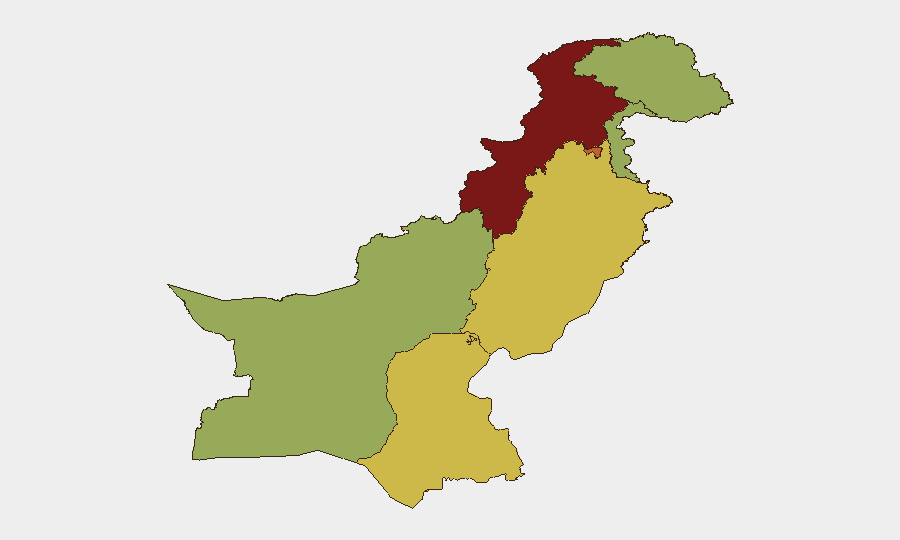
Khyber Pakhtunkhwa (86.8) and Islamabad Capital Territory (74.7) anchor the risk profile, reflecting sustained militant activity (TTP and splinter groups), proximity to the Afghanistan border, and dense population centers including the capital. Punjab (70.9) and Sindh (62.2), while lower-ranked, have experienced recent high-profile attacks on security facilities and active criminal networks; Sindh's Karachi remains a node for both militant and organized-crime operations. Balochistan (59) is driven by separatist insurgency, counter-terrorism operations, and documented extra-judicial practices that deepen political alienation. All provinces face compounded risk from environmental factors (flooding, earthquakes) degrading response capacity and accessibility.
How GeoBit Would Assist
Security teams covering Pakistan would deploy AOI Monitoring & Early Warning to track militant movements, attack patterns, and police/paramilitary deployments in high-risk provinces. Conflict & Military mapping and Network & Actor Analysis capabilities enable real-time tracking of militant group structure and target selection. Routing & Network Analysis helps corporate and NGO teams identify safe transit corridors in Karachi and other urban hotspots, while Environmental & Health monitoring integrates flood and seismic alerts into duty-of-care protocols.
7-Day Outlook
Expect continued militant pressure on security infrastructure in urban Sindh (particularly Karachi) and ongoing counter-terrorism sweeps in Balochistan. The Baloch activist sentencing will likely trigger civil unrest, protests, and potential secondary incidents across the province. Environmental hazards (flooding, aftershocks) will compound accessibility and supply-chain risk, particularly in KP and Balochistan, through early July.
Highest-Risk Areas — Ranked
| # | State / Region | Risk |
|---|---|---|
| 1 | Khyber Pakhtunkhwa | 86.8 |
| 2 | Islamabad Capital Territory | 74.7 |
| 3 | Punjab | 70.9 |
| 4 | Sindh | 62.2 |
| 5 | Balochistan | 59 |
| 6 | Azad Kashmir | 57.2 |
| 7 | Gilgit-Baltistan | 56.8 |
Sources
Previous Daily Briefs
A new Pakistan brief is written every day — each with its own risk map and downloadable CSV. Here's the last week; use the calendar to go further back.
📅 Browse every day by calendar →
Highlighted days have a brief. Tap a day for that day's map & analysis, or “csv” for that day's dataset ($5).