Situation Summary
Russia remains the 5th-highest-threat country globally, driven primarily by active conflict dynamics and 739 tracked events in the monitoring window. The last 24–48 hours show limited new internal security incidents; however, infrastructure strain in Russian-annexed Crimea—energy blackouts and fuel rationing—signals deepening logistical pressure from Ukrainian operations. Moscow, Krasnoyarsk Krai, and Saint Petersburg continue to anchor the sub-national risk profile, while broader event signals reflect internal friction (small-arms incidents near Moscow governance, public statements on military posture) alongside cross-border tensions with NATO and Ukraine.
Key Developments
- Sevastopol, Crimea – 2026-06-22: City authorities cancelled all outdoor public events and ordered street-light shutdowns as emergency power-conservation measures following sustained Ukrainian drone strikes on supply routes and energy infrastructure. Governor Mikhail Razvozhayev issued directives via Telegram urging residents to restrict electricity usage.
- Crimea (region-wide) – 2026-06-22: Regional authorities halted retail fuel sales to general public and businesses, restricting fuel distribution to government agencies and emergency services only. Measure attributed to Ukrainian attacks on logistics routes and energy facilities supplying the peninsula.
- Moscow – 2026-06-21: Small-arms combat incident recorded in relation to Sergey Sobyanin (Moscow Mayor), suggesting localized security friction or enforcement action; limited detail available in open sources.
- Russia (national) – 2026-06-21: Conventional military force operations reported; specific location and scope not geolocated in current research.
- Russia-Lithuania – 2026-06-22: Russian public statement(s) issued; indicates elevated diplomatic or rhetorical tensions with NATO/EU periphery.
- Russia-Ukraine – 2026-06-20: Threat statement issued by Russia toward Ukrainian actors; consistent with ongoing conflict escalation rhetoric.
Highest-Risk Areas
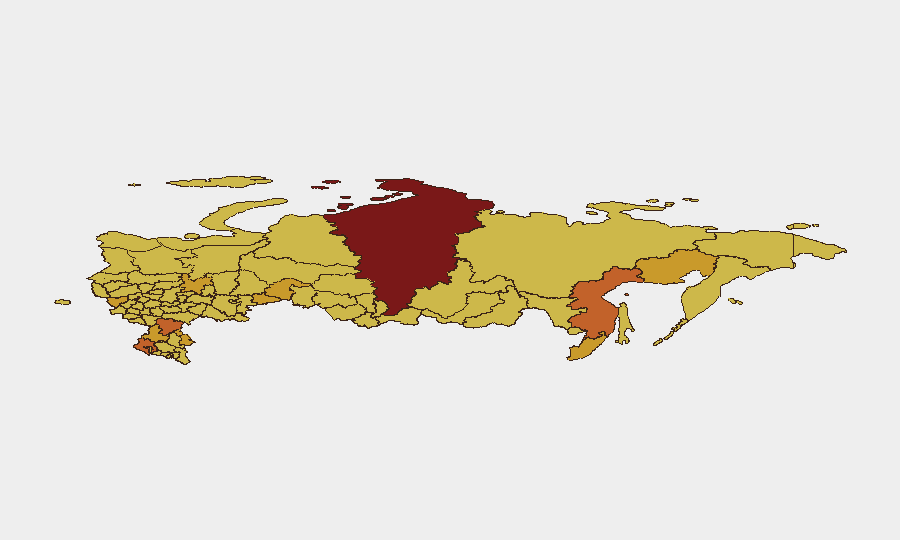
Moscow (risk 100) remains the apex vulnerability, reflecting both governance instability signals and operational exposure as the national capital. Krasnoyarsk Krai and Saint Petersburg (85 and 74.8 respectively) face compound risk from remote geography, energy infrastructure concentration, and demonstrated military targeting patterns. Southern and Far Eastern regions—Volgograd, Krasnodar, Rostov, Khabarovsk, Primorsky—cluster in the 71–75 range, driven by proximity to conflict zones (Ukraine, disputed borders) and infrastructure criticality. Energy supply interruptions in Crimea exemplify the cascading vulnerability affecting logistics and civilian movement across southern territories.
How GeoBit Would Assist
Corporate security and risk teams in Russia would deploy AOI Monitoring & Early Warning on Moscow, Saint Petersburg, and Crimea to detect infrastructure disruptions, public-event cancellations, and supply-chain breakdowns in real time. OSINT Fusion & Corroboration (Telegram monitoring, Russian-language news wires, entity extraction) would clarify internal political tensions and military posture shifts hours ahead of mainstream reporting. Routing & Network Analysis would supply alternative transport and supply-chain pathways as fuel and power rationing tightens, enabling duty-of-care protocols for personnel movement.
7-Day Outlook
Infrastructure strain and energy rationing in Russian-annexed territories will likely persist and expand to mainland regions if Ukrainian strikes continue at current intensity. Political friction signals (small-arms incidents, internal statements) suggest internal security posture may sharpen, increasing checkpoint activity and movement restrictions in Moscow and other major centers. Overall threat level will remain elevated absent material change in Ukraine conflict trajectory.
Highest-Risk Areas — Ranked
| # | State / Region | Risk |
|---|---|---|
| 1 | Moscow | 100 |
| 2 | Krasnoyarsk Krai | 85 |
| 3 | Saint Petersburg | 74.8 |
| 4 | Volgograd Oblast | 74.7 |
| 5 | Krasnodar Krai | 73.6 |
| 6 | Khabarovsk Krai | 73 |
| 7 | Kurgan Oblast | 72.9 |
| 8 | Tyumen Oblast | 72.9 |
| 9 | Magadan Oblast | 72.4 |
| 10 | Smolensk Oblast | 72.4 |
| 11 | Rostov Oblast | 72.1 |
| 12 | Primorsky Krai | 71.6 |
Sources
Previous Daily Briefs
A new Russia brief is written every day — each with its own risk map and downloadable CSV. Here's the last week; use the calendar to go further back.
📅 Browse every day by calendar →
Highlighted days have a brief. Tap a day for that day's map & analysis, or “csv” for that day's dataset ($5).