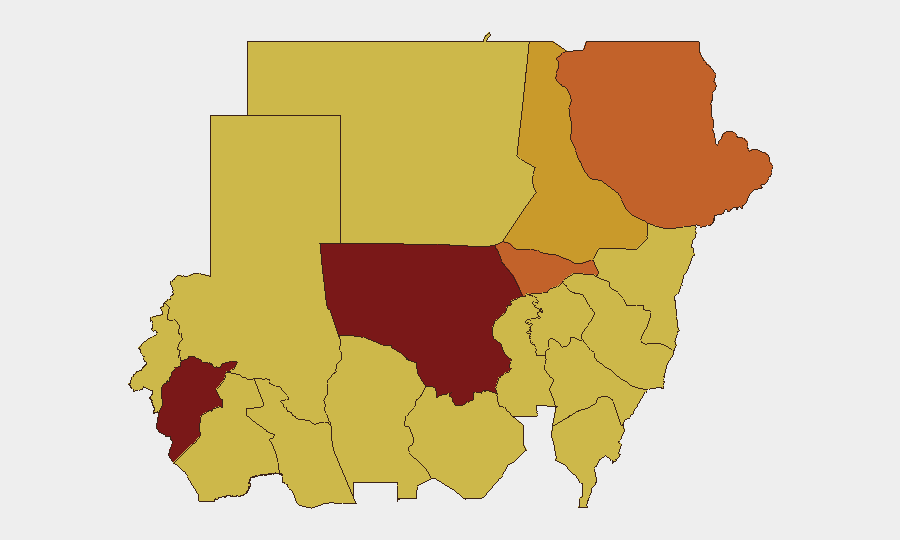
Situation Summary
Sudan's civil war remains the primary driver of the country's #10 global threat ranking, with 36 tracked events in the assessment period. Military escalation is intensifying across multiple fronts, particularly in North Kordofan State, where RSF buildup, drone strikes, and infrastructure damage are creating acute humanitarian and security risks. International pressure—evidenced by fresh U.S. sanctions on war-procurement networks and UN warnings of civilian endangerment—underscores the conflict's regional and geopolitical dimensions. The trajectory favors continued deterioration absent major diplomatic intervention or significant operational shifts by either party.
Key Developments
- El Obeid, North Kordofan — 2026-06-26/27: UN reporting indicates RSF and allied forces have concentrated around the city with intensified drone strikes and shelling. The UN envoy warned that further escalation could place thousands of civilians at immediate risk and worsen the humanitarian crisis.
- El Obeid, North Kordofan — 2026-06-26/27: Drone strikes have targeted critical civilian infrastructure, including power, fuel, and water facilities. UN OCHA assessments flag this as a dangerous new dimension of the conflict, with systematic targeting of non-military assets.
- Washington, D.C. — 2026-06-27: The U.S. Treasury (OFAC) announced sanctions on eight individuals and entities linked to procurement and recruitment networks sustaining Sudan's war, signaling heightened international enforcement of conflict-financing restrictions.
- Sudan-wide, emphasis Kordofan — 2026-06-25/26: Security Council reporting confirms hostilities continue to intensify across multiple fronts with fluid front lines and fierce fighting. North Kordofan remains the most active theater.
- Al Khartum — 2026-06-26: Event signals indicate conventional military force used against civilians and ongoing arrest/detention of asylum seekers, pointing to sustained urban security pressure and potential detention of internally displaced persons.
- Libya–Sudan border — 2026-06-25: Libya imposed administrative sanctions on Sudan, reflecting regional diplomatic strain tied to conflict spillover and cross-border refugee/militant movement.
- South Sudan–Kingdom border — 2026-06-26: South Sudan issued threats and announced a blockade against an unnamed kingdom, likely related to cross-border militia activity or resource access and signaling wider regional friction.
- Iran–Sudan — 2026-06-27: An event signal of conventional military force involvement by Iran in Sudan was registered, potentially indicating military advisory activity, equipment provision, or direct personnel deployment.
Highest-Risk Areas
Central Darfur State (risk 100) and North Kordofan State (89.2) dominate the sub-national ranking, driven by active military operations, civilian targeting, and humanitarian access denial. Al Khartum (74.8) and Red Sea State (73.6) rank third and fourth, reflecting urban conflict dynamics and regional instability spillover. The concentration of risk in Darfur and Kordofan reflects sustained RSF offensive pressure and government counter-operations; Al Khartum's ranking reflects civilian casualty exposure and detention activity; Red Sea State's elevation reflects potential Iranian involvement and arms trafficking networks.
How GeoBit Would Assist
Security and risk teams should employ AOI Monitoring & Early Warning on El Obeid, North Kordofan and Darfur towns to detect further RSF buildup or drone strike patterns. Conflict & Military force-structure and weapons-capability tracking, combined with Network & Actor Analysis of procurement-network nodes, would support sanctions compliance and supply-chain risk assessment. Intel Sweep feeds and OSINT fusion on U.S. Treasury designations and UN Security Council reporting would provide near-real-time fusion of diplomatic and operational developments.
7-Day Outlook
El Obeid faces the highest tactical risk over the next week, with potential for offensive operations and continued infrastructure targeting. Diplomatic pressure from the U.S. and UN is unlikely to produce immediate military de-escalation. Expect sustained drone operations, humanitarian access restrictions, and possible cross-border refugee surges in regions bordering Ethiopia, South Sudan, and Libya.
Highest-Risk Areas — Ranked
| # | State / Region | Risk |
|---|---|---|
| 1 | Central Darfur State | 100 |
| 2 | North Kordofan State | 89.2 |
| 3 | Al Khartum | 74.8 |
| 4 | Red Sea State | 73.6 |
| 5 | River Nile State | 71.2 |
| 6 | Blue Nile | 70 |
| 7 | Aj Jazira | 70 |
| 8 | Al Qadarif State | 70 |
| 9 | Kassala State | 70 |
| 10 | Sennar State | 70 |
| 11 | South Darfur State | 70 |
| 12 | West Kurdufan State | 70 |
Sources
Previous Daily Briefs
A new Sudan brief is written every day — each with its own risk map and downloadable CSV. Here's the last week; use the calendar to go further back.
📅 Browse every day by calendar →
Highlighted days have a brief. Tap a day for that day's map & analysis, or “csv” for that day's dataset ($5).