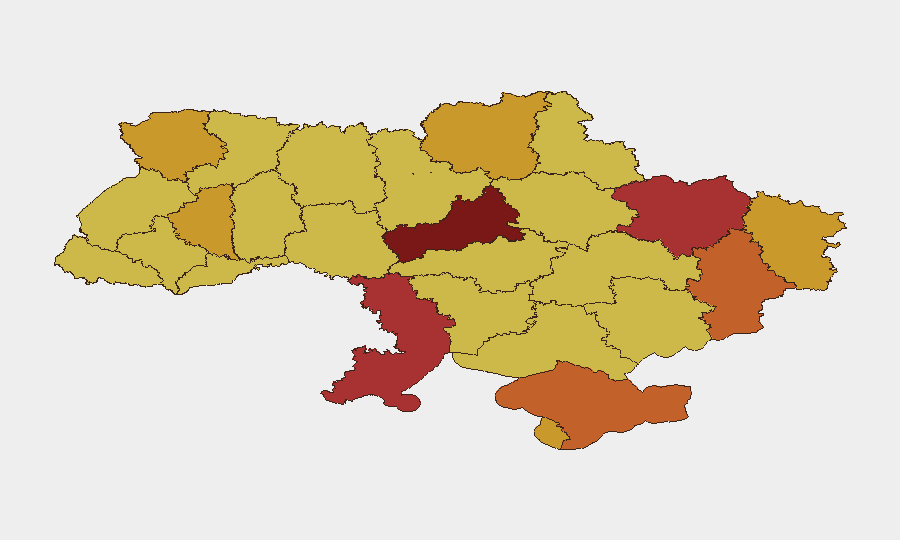
Situation Summary
Ukraine remains under sustained conventional military pressure, with Russia conducting large-scale ballistic and drone strikes on civilian infrastructure in and around Kyiv, while Ukrainian forces execute precision strikes on Russian energy, logistics, and ammunition targets across occupied territory. The past 48 hours have seen significant escalation in both aerial bombardment of the capital and Ukrainian counter-strikes on Crimean and eastern occupied zones, resulting in civilian casualties, widespread infrastructure damage, and energy disruption. Kyiv's air defense capabilities appear strained, and NATO-critical infrastructure remains under recurring threat ahead of the scheduled NATO summit. The composite threat trajectory remains elevated across all major population centers and logistics corridors.
Key Developments
- Kyiv City, July 7 (early morning): Russia launched sustained waves of ballistic missiles and drones, striking all 29 reported ballistic missiles on target. Official casualty counts: 15 killed and 56 injured in Kyiv proper; 7 killed and 29 injured (including four emergency responders) in suburban Kyiv Oblast. Extensive damage to residential areas and critical infrastructure reported; air defense capability described as inadequate by national authorities.
- Crimea—Hvardiiske airfield, night of July 5–6: Ukrainian General Staff confirmed precision strikes on the military airfield's runway, aviation infrastructure, and associated ammunition depots, with follow-on effects on Russian air operations documented in subsequent reporting.
- Crimea—power infrastructure, July 5–7: Ukrainian Unmanned Systems Forces struck at least 16 power stations across occupied Crimea over 48 hours, triggering widespread blackouts affecting Sevastopol and other urban centers and creating an acute energy and fuel crisis on the peninsula.
- Donetsk Oblast (occupied)—logistics corridor, night of July 5–6: Ukrainian forces damaged two key logistics bridges used by Russian supply lines, confirmed by General Staff reporting and elevating travel risk on main road corridors in Russian-controlled territory.
- Ammunition depots—occupied Donetsk, Luhansk, Kherson, night of July 5–6: Multiple Ukrainian strikes on Russian ammunition storage caused significant secondary explosions and fires, with pro-Ukrainian social media footage corroborating large detonations and increasing unexploded-ordnance risk in surrounding civilian zones.
Highest-Risk Areas
Kyiv (composite risk 100) faces the most acute immediate threat from sustained aerial bombardment and infrastructure targeting, compounded by demonstrable air-defense gaps. Cherkasy, Kharkiv, and Odesa oblasts (risk 85–76) form a secondary tier of vulnerability driven by proximity to active military operations, drone-strike patterns, and critical infrastructure concentration. Crimea and eastern oblasts (Donetsk, Luhansk, Kherson; risk 71–75) remain high-risk due to active combat, logistics interdiction, and the concentration of unexploded ordnance following recent strikes. Civilian infrastructure—power, water, transport—is now a primary target across all zones, elevating duty-of-care risk for corporate assets and personnel.
How GeoBit Would Assist
Security teams would deploy AOI Monitoring & Early Warning on Kyiv and key oblast centers to detect and alert on incoming strike patterns and air-defense gaps in near-real time. Conflict & Military mapping combined with Satellite & Imagery analysis would track infrastructure damage, logistics interdiction, and force repositioning across occupied and Ukrainian-controlled zones. Routing & Network Analysis would enable alternative journey and supply-chain planning around damaged bridges, energy outages, and conflict zones; concurrent OSINT Sweep and multi-language Telegram/X monitoring would surface emerging civilian risks and emergency-services capacity in targeted areas.
7-Day Outlook
Russian strike tempo on Kyiv and critical infrastructure is likely to persist or intensify ahead of the NATO summit, with air-defense strain creating windows for civilian impact. Ukrainian counter-strikes on Crimean and eastern logistics nodes will continue, maintaining disruption of Russian supply chains but raising cumulative unexploded-ordnance and secondary-effect risk in occupied areas. Corporate personnel and asset security should assume sustained aerial threat, infrastructure volatility, and travel-corridor degradation across all major zones through at least mid-July.
Highest-Risk Areas — Ranked
| # | State / Region | Risk |
|---|---|---|
| 1 | Kyiv | 100 |
| 2 | Cherkasy Oblast | 85.1 |
| 3 | Kharkiv Oblast | 77.9 |
| 4 | Odesa Oblast | 76.3 |
| 5 | Donetsk Oblast | 74.6 |
| 6 | Autonomous Republic of Crimea | 73.9 |
| 7 | Luhansk Oblast | 72.5 |
| 8 | Chernihiv Oblast | 72.3 |
| 9 | Ternopil Oblast | 72.2 |
| 10 | Sevastopol | 71.6 |
| 11 | Volyn Oblast | 71 |
| 12 | Kherson Oblast | 70.5 |
Sources
Previous Daily Briefs
A new Ukraine brief is written every day — each with its own risk map and downloadable CSV. Here's the last week; use the calendar to go further back.
📅 Browse every day by calendar →
Highlighted days have a brief. Tap a day for that day's map & analysis, or “csv” for that day's dataset ($5).
Atlas — our AI intelligence desk — emails them this snapshot personally. Nothing else, no list.