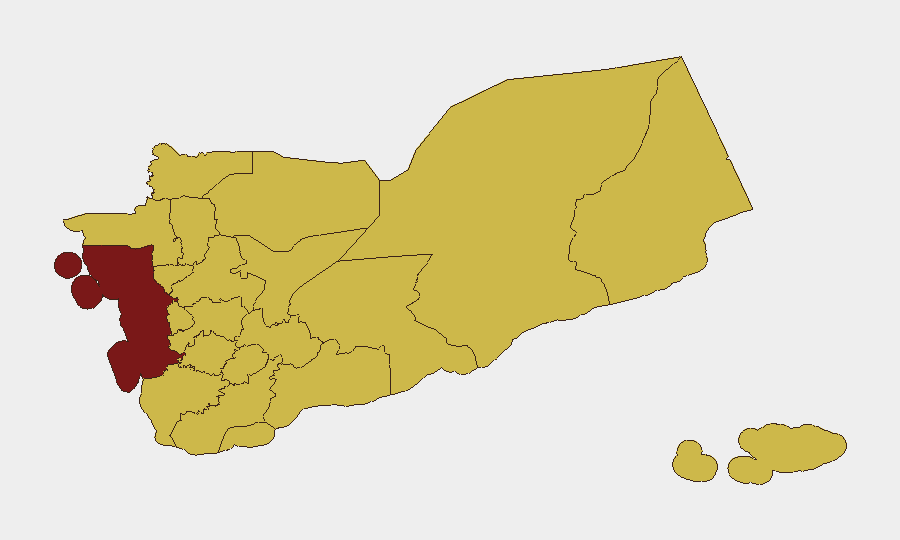
Situation Summary
Yemen's security environment has sharply deteriorated over the past 48 hours following Iran's delivery of military personnel and equipment to Houthi-controlled Sanaa and concurrent escalations along multiple fronts—including ground force repositioning in Al-Jawf, Red Sea maritime attacks, and explicit cross-border threats between Houthi forces and the Saudi-led coalition. The combination of Iranian intervention, renewed military mobilization, and heightened rhetoric signals erosion of the informal ceasefire that has held since late 2022. Composite threat activity across Yemen now ranks 15th globally, with Al Hudaydah Governorate emerging as the single highest-risk sub-national zone due to port infrastructure exposure and maritime attack frequency.
Key Developments
- Sanaa International Airport, 7–8 July 2026 – A Mahan Air flight carrying Iranian military and security personnel, technical experts, and command-and-control equipment landed at Houthi-controlled Sanaa, breaking an 11-year Saudi blockade. The arrival triggered immediate Yemeni government and coalition alert and is assessed as direct Iranian military intervention.
- Yemeni airspace incursion, 7–8 July 2026 – Saudi warplanes entered Yemeni airspace at approximately 05:20 to intercept the Iranian aircraft. Houthi military leadership publicly threatened strikes on Saudi airports and "vital interests on land and sea" if violations recur, significantly escalating cross-border rhetoric and aviation risk.
- Al-Rayyan, Al-Jawf Governorate, 7–8 July 2026 – Government Emergency Forces brigades deployed to Al-Rayyan while Houthi forces repositioned two brigades plus a special operations unit to Al-Jawf frontline areas amid intelligence of a broader Houthi offensive toward Marib. This sector is now assessed as an acute flashpoint.
- Red Sea maritime attack, 5 July 2026 – Palau-flagged bulk carrier *Lady Naeima* came under fire from armed assailants in a skiff approximately 30 nm southwest of Al Hudaydah; security returned fire and the threat withdrew. UK Maritime Trade Operations (UKMTO) confirmed the incident and flagged elevated attack frequency across the Red Sea and Gulf of Aden corridor in recent 24 hours.
- Sanaa Ministry of Foreign Affairs statement, 7–8 July 2026 – Houthi authorities declared a "definitive decision to end the aggression and break the blockade," warning Yemen's Armed Forces will target Saudi airports and maritime/land assets if coalition pressure continues. Saudi-led coalition responded with threats of "unprecedented force," signaling reciprocal escalation.
- Red Sea shipping corridor, 5–8 July 2026 – MarineTraffic and UKMTO sources confirm sustained disruption efforts in Bab el-Mandeb and northern Gulf of Aden, with recent intelligence indicating interception of Houthi-bound drone and explosive-boat equipment near the strait. Commercial shipping risk remains acute.
Highest-Risk Areas
Al Hudaydah Governorate dominates the risk landscape (94.4 composite score), driven by proximity to the Red Sea's critical Bab el-Mandeb chokepoint, active maritime militia activity, and ongoing ground conflict. Amanat Al Asimah (Sanaa city, 81.6) ranks second due to the Iranian military presence, political contestation, and airspace volatility. The Al-Jawf sector, reflected in the broader northern governorate cluster (64.4–64.8), now poses acute tactical conflict risk. Together, these three zones account for the majority of active military movements, cross-border threats, and infrastructure targeting in the current 48-hour window.
How GeoBit Would Assist
Security teams would employ AOI Monitoring & Early Warning to maintain persistent watch on Al Hudaydah, Sanaa, and Al-Jawf with real-time alerting on force movements and airspace incursions; Maritime & Aviation tracking to plot vessel routes and air corridors for duty-of-care assessment; and Network & Actor Analysis combined with OSINT Fusion (Intel Sweep, Telegram/X monitoring, multi-language feeds) to track Houthi and Iranian military communications, rhetoric escalation, and targeting intent.
7-Day Outlook
The arrival of Iranian military assets and the simultaneous ground mobilization in Al-Jawf strongly suggest Houthi preparation for offensive operations—either against Saudi targets or toward Marib. Cross-border threats are likely to translate into kinetic action within 5–10 days unless de-escalation talks materialize. Maritime attack frequency is expected to remain elevated; commercial shipping and aviation assets should assume heightened threat posture through mid-July.
Highest-Risk Areas — Ranked
| # | State / Region | Risk |
|---|---|---|
| 1 | Al Hudaydah Governorate | 94.4 |
| 2 | Amanat Al Asimah | 81.6 |
| 3 | Shabwah Governorate | 66.1 |
| 4 | Sa'dah Governorate | 64.4 |
| 5 | Hajjah Governorate | 64.4 |
| 6 | Al Mahwit Governorate | 64.4 |
| 7 | 'Amran Governorate | 64.4 |
| 8 | Sana'a Governorate | 64.4 |
| 9 | Raymah Governorate | 64.4 |
| 10 | Dhamar Governorate | 64.4 |
| 11 | Ibb Governorate | 64.4 |
| 12 | Ta'izz Governorate | 64.4 |
Sources
Previous Daily Briefs
A new Yemen brief is written every day — each with its own risk map and downloadable CSV. Here's the last week; use the calendar to go further back.
📅 Browse every day by calendar →
Highlighted days have a brief. Tap a day for that day's map & analysis, or “csv” for that day's dataset ($5).
Atlas — our AI intelligence desk — emails them this snapshot personally. Nothing else, no list.