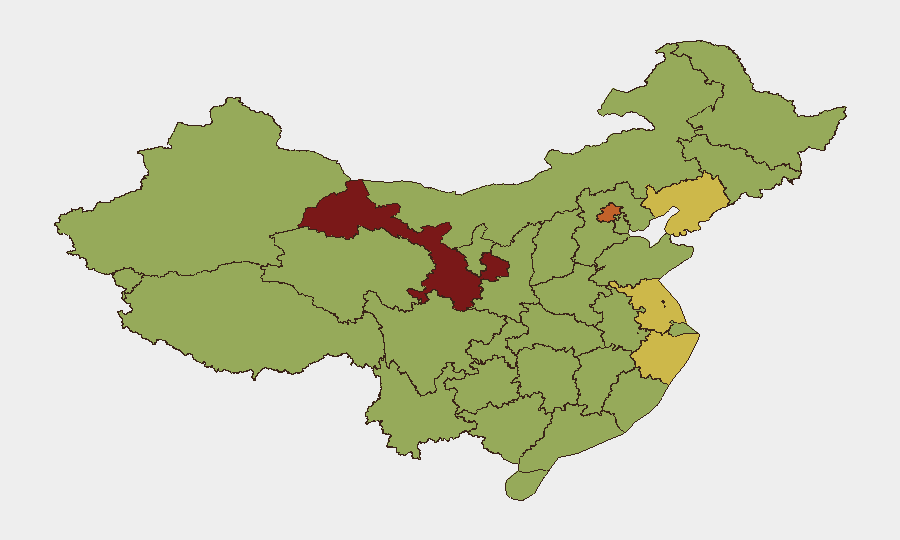
Situation Summary
China's composite security threat level remains moderate (rank #19 globally; score 79), with 651 tracked events driving current assessment. The past 24 hours have been marked by a high-profile aviation incident in Beijing, precautionary security tightening in Shanghai's financial sector, and intensified national enforcement against drug-laced e-cigarettes and synthetic narcotics targeting youth. Simultaneously, diplomatic tensions with Japan, the EU, and New Zealand over geopolitical and maritime matters have elevated rhetoric, though these do not yet translate to direct public-order disruptions in major business centers.
Key Developments
- Beijing – CITIC Tower small-aircraft crash (June 26, 06:00–14:00 local). A small aircraft struck the upper floors of CITIC Tower in Chaoyang District, scattering debris, triggering emergency response, area cordons, and structural-damage assessment. No casualty figures confirmed as of brief publication; cause under investigation. (GeoBit source: live X/Twitter corroboration from Beijing residents, emergency-response imagery.)
- Shanghai – Precautionary security escalation in Lujiazui (June 26, post-Beijing incident). Finance-district events and outdoor activities postponed or moved indoors; visible increases in police patrols, bag inspections, and access controls at major skyscrapers reported by on-site X users and local journalists. No formal government notice issued; actions appear reactive to Beijing crash.
- Guangzhou – Coordinated police operations against drug-laced e-cigarette distribution (June 26). Multi-district raids in Tianhe and Baiyun districts targeting vape shops and warehouses, with seized cartridges and detentions reported. Actions directly linked by local media to Supreme People's Court warning on synthetic-drug e-cigarettes and etomidate abuse.
- National – Supreme People's Court enforcement escalation on youth synthetic-drug use (June 26). Official messaging signals heightened penalties and expanded police operations targeting drug-laced e-cigarettes, particularly in nightlife and school-adjacent areas in major cities. Precursor to localized enforcement spikes expected in coming weeks.
- Multiple provinces – National audit reveals USD 4.12 billion rural-fund diversion to debt service (reported June 26). Disciplinary action against local officials underway; analysts flag elevated protest and local-stability risk in heavily indebted counties due to service-delivery and wage pressures.
- Taiwan strait and adjacent waters – Sustained Chinese Coast Guard and PLA Navy presence (reported June 26). Ongoing diplomatic criticism from U.S., UK, France, and Germany; open-source maritime and satellite tracking confirms persistent operational activity. No acute incident reported; elevated baseline tension sustained.
Highest-Risk Areas
Gansu (85.4), Beijing (73.4), and Liaoning (64.4) lead the sub-national ranking. Beijing's elevated score reflects the CITIC Tower incident and heightened security posture in financial and government districts; Gansu and Liaoning scores reflect accumulated event density, local governance instability, and labor/resource-competition friction. Coastal and prosperous provinces (Zhejiang, Jiangsu, Shanghai, Guangdong) remain in the middle range (56–65), driven by ongoing trade-friction enforcement, supply-chain disruptions, and maritime-adjacent tensions rather than acute civil unrest.
How GeoBit Would Assist
Security teams with personnel or assets in China should employ Intel Sweep and X/Twitter OSINT for real-time incident detection and crowd-sourced early warning in key cities; GIS & Spatial Analysis to map enforcement crackdowns and avoid affected districts; and AOI Monitoring & Early Warning on Lujiazui, Beijing CBD, and Guangzhou commercial zones to flag security cordons, patrols, or event postponements that disrupt business operations. Routing & Network Analysis aids contingency planning around transport disruptions tied to security incidents.
7-Day Outlook
The Beijing aviation incident will dominate security posture in the capital for 72–96 hours, with sustained elevated police presence and intermittent transport delays expected. National enforcement against youth synthetic-drug use will intensify operational activity in major-city nightlife and education zones, creating intermittent bag checks and temporary venue closures. Diplomatic tensions with regional powers and the West will remain elevated in tone but are unlikely to trigger direct mainland China public-order incidents in the near term.
Highest-Risk Areas — Ranked
| # | State / Region | Risk |
|---|---|---|
| 1 | Gansu | 85.4 |
| 2 | Beijing | 73.4 |
| 3 | Liaoning | 64.4 |
| 4 | Zhejiang | 64.2 |
| 5 | Jiangsu | 60.8 |
| 6 | Shanghai | 59.7 |
| 7 | Jiangxi | 59.2 |
| 8 | Guangdong Province | 58.8 |
| 9 | Anhui | 57.7 |
| 10 | Sichuan | 56.3 |
| 11 | Guangxi | 56.1 |
| 12 | Shaanxi | 56.1 |
Sources
Previous Daily Briefs
A new China brief is written every day — each with its own risk map and downloadable CSV. Here's the last week; use the calendar to go further back.
📅 Browse every day by calendar →
Highlighted days have a brief. Tap a day for that day's map & analysis, or “csv” for that day's dataset ($5).