Situation Summary
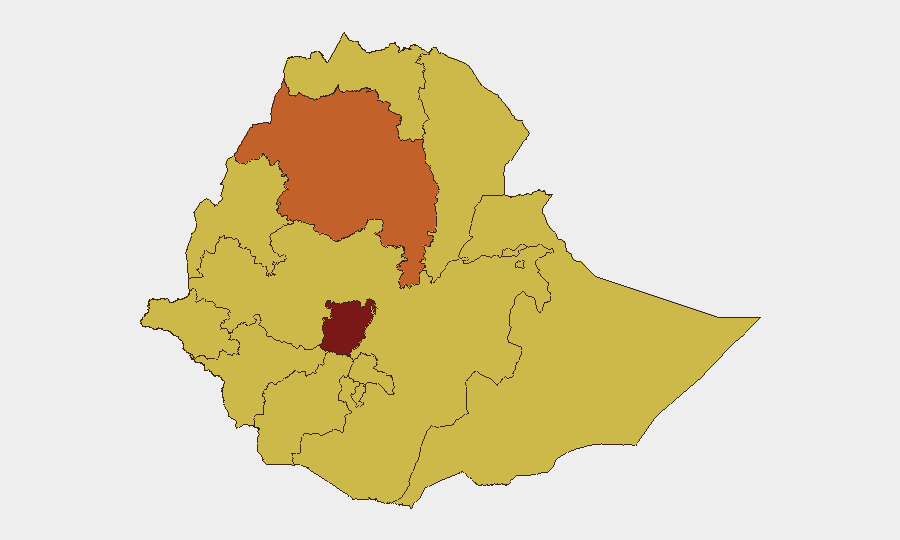
Ethiopia remains the 9th-highest-threat country globally (composite score 100), driven primarily by civil war dynamics across 12 tracked sub-national regions. Central Ethiopia Regional State presents the highest composite risk (100), while Tigray, Amhara, and peripheral regions (Afar, Benishangul-Gumuz, Somali, Gambela) all score 70 or above, indicating sustained instability. Current momentum is dominated by forced military recruitment in Tigray and rising cross-border tensions with Eritrea, creating elevated risk of renewed armed confrontation and internal displacement.
Key Developments
- Tigray Region – Forced recruitment sweeps (reported 6 July 2026): Human Rights Watch released documentation of ongoing nighttime house-to-house searches and street round-ups across multiple Tigray towns and gold-mining areas, targeting civilians including children as young as 15 for military conscription without family notification. Testimonies indicate intensified enforcement since late April, signaling preparation for potential conflict escalation.
- Tigray Region – Compulsory military service proclamation enforcement (early June, highlighted 6 July 2026): A proclamation issued by Tigray's ruling party is being enforced through coercive conscription despite official denials. Witnesses report sweeps in streets, markets, and mining sites, with those evading recruitment facing threats or pressure—indicating elevated personal security risk for young males and former combatants.
- National / Tigray–Eritrea axis – Currency recall signals heightened tensions (analysis dated 6 July 2026): Horn Review analysis frames Eritrea's decision to recall all Nakfa currency by 31 July as a possible indicator of preparation for major confrontation and evidence of Eritrea's alignment with TPLF/Tigray actors against Ethiopia. While not a discrete incident, widespread regional commentary on 6 July points to elevated cross-border political and conflict risk.
- Tigray Region – Internal displacement and freedom-of-movement constraints (reported 6 July 2026): Human Rights Watch documentation indicates families across multiple Tigray towns are already hiding sons, relocating youths, or considering departure due to recruitment fears. This signals rising internal displacement, civil unrest, and protection concerns.
- International advocacy escalation (6 July 2026): Human Rights Watch issued a call on 6 July for African Union, Kenya, South Africa, US, and EU intervention to halt forced recruitment in Tigray. Social-media amplification the same day indicates international attention and potential diplomatic friction around Ethiopia's northern security posture.
Highest-Risk Areas
Central Ethiopia Regional State (100) and Tigray (70) are the primary near-term flashpoints. Central Ethiopia's extreme risk score reflects the ongoing civil war dynamics; Tigray's recruitment drive and Eritrean re-engagement suggest imminent renewed armed confrontation. Amhara (73.1) remains volatile due to longstanding federal tensions. Peripheral regions—Afar, Benishangul-Gumuz, Somali, Gambela, and South West Ethiopia Peoples (all 70)—present sustained secondary risk from cross-border instability, resource competition, and irregular armed groups.
How GeoBit Would Assist
Security teams would deploy AOI Monitoring & Early Warning on Tigray recruitment sites, mining areas, and Eritrea–Ethiopia border crossings for real-time alerting on military buildups or displacement flows. Network & Actor Analysis combined with OSINT fusion (X, Telegram, local media) would track TPLF and Eritrean command-intent signals and cross-border coordination. GIS & Spatial Analysis with satellite imagery would corroborate forced conscription claims and map safe corridors or high-risk zones for duty-of-care routing and personnel relocation.
7-Day Outlook
Tigray recruitment intensity is likely to accelerate through mid-July as the regional authority consolidates forces ahead of potential renewed confrontation with federal authorities. Eritrean currency recall deadline (31 July) creates a compressed window for diplomatic de-escalation or conflict onset. Internal displacement from Tigray into neighboring regions—particularly Amhara—should be monitored as an indicator of imminent broader instability.
Highest-Risk Areas — Ranked
| # | State / Region | Risk |
|---|---|---|
| 1 | Central Ethiopia Regional State | 100 |
| 2 | Amhara Region | 73.1 |
| 3 | Tigray | 70 |
| 4 | Afar Region | 70 |
| 5 | Benishangul-Gumuz Region | 70 |
| 6 | Somali Region | 70 |
| 7 | Gambela Region | 70 |
| 8 | South West Ethiopia Peoples | 70 |
| 9 | Addis Ababa | 70 |
| 10 | South Ethiopia Regional State | 70 |
| 11 | Oromia Region | 70 |
| 12 | Sidama | 70 |
Sources
Previous Daily Briefs
A new Ethiopia brief is written every day — each with its own risk map and downloadable CSV. Here's the last week; use the calendar to go further back.
📅 Browse every day by calendar →
Highlighted days have a brief. Tap a day for that day's map & analysis, or “csv” for that day's dataset ($5).
Atlas — our AI intelligence desk — emails them this snapshot personally. Nothing else, no list.