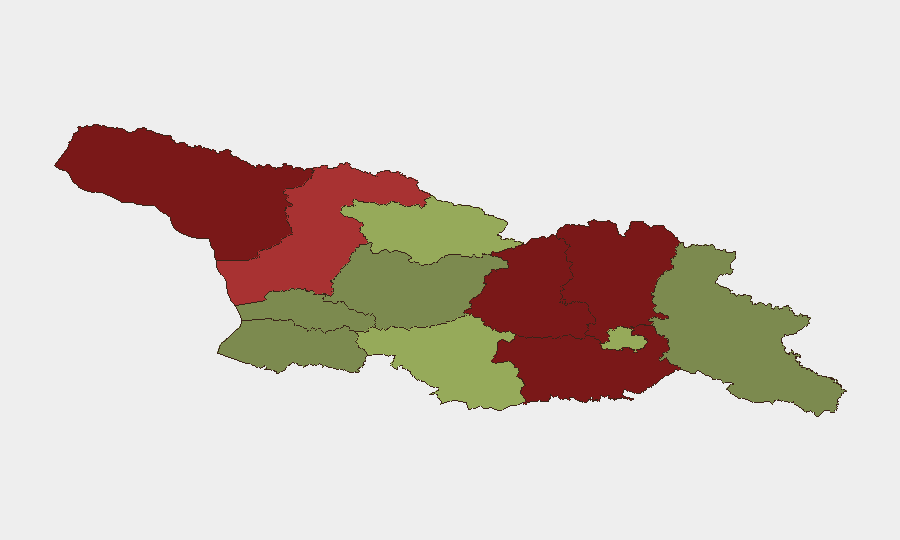
Situation Summary
Georgia faces a confluence of acute infrastructure and organized-crime threats alongside persistent geopolitical instability in contested territories. A nationwide power-grid sabotage investigation, large-scale drug trafficking arrests, and opposition warnings of regional political encroachment have all surfaced within 48 hours, creating elevated operational uncertainty for critical-infrastructure operators and cross-border supply chains. The composite national threat score of 11 reflects a disaggregated risk profile, with northern border regions (Abkhazia, Shida Kartli, Lower Kartli) commanding substantially higher exposure than the capital or western lowlands.
Key Developments
- Nationwide power-grid sabotage investigation (24–25 July): Georgia's State Security Service formally opened a criminal investigation under Article 318 (sabotage) following multiple large-scale blackouts across Tbilisi and regions on 24–25 July. The National Energy and Water Supply Regulatory Commission (GNERC) launched a parallel inquiry. Electricity has been restored, but authorities frame the incidents as potential threats to critical infrastructure and state security, signaling heightened alert posture.
- Opposition warnings on Tskhinvali regional integration (25–26 July): Georgian opposition figures issued public statements warning of growing geopolitical isolation and potential Russian-backed deepening of de-facto annexation in the Tskhinvali region (South Ossetia), framed as a heightened national-security and Western-integration risk.
- Large-scale psychotropic-drug trafficking ring dismantled (within last 24 hours): The Investigative Service of the Ministry of Finance announced arrests of 17 individuals in a narcotics and money-laundering scheme centered in Tbilisi involving ₾53.8 million in illicit psychotropic medications, flagging organized-crime and public-health dimensions across multiple regions.
- Cross-border methadone trafficking arrests in Samegrelo–Zemo Svaneti (within last 24 hours): Police arrested two Ukrainian nationals for large-scale illegal possession and trafficking of methadone in western Georgia, underscoring persistent cross-border narcotics activity and associated travel/supply-chain risks.
- Senior-official backing of critical-infrastructure security posture (25–26 July): Parliament Speaker Shalva Papuashvili and ruling-party leadership publicly endorsed the SSS sabotage investigation, signaling sustained political attention to infrastructure protection and implying continued heightened alert at government level.
Highest-Risk Areas
The Autonomous Republic of Abkhazia (risk 95), Shida Kartli (88), and Lower Kartli (85) drive the national risk profile, reflecting entrenched conflicts, separatism, and Russian military presence in de-facto independent territories. These northern border regions account for disproportionate threat concentration. Samtskhe-Javakheti (48) and Tbilisi (45) occupy middle-risk positions, driven by political instability and organized crime respectively. Imereti, Guria, and Adjara in the south and west remain comparatively lower-risk, though the recent drug-trafficking cases demonstrate that organized-crime operations span the country.
How GeoBit Would Assist
Security teams monitoring Georgia would employ Intel Sweep and global event feeds for real-time tracking of power-grid incidents and law-enforcement operations; conflict and regime-stability search to assess implications of opposition statements and geopolitical escalation; AOI Monitoring & Early Warning on critical-infrastructure nodes in Tbilisi and regions; and Network & Actor Analysis to map the scale and foreign-involvement dimensions of drug-trafficking rings. Cross-border route and supply-chain routing analysis would flag disruption risks from both blackouts and narcotics interdiction.
7-Day Outlook
The sabotage investigation will likely drive sustained heightened alert among Georgian security services and operators of power, telecom, and water infrastructure through early August. Opposition political messaging may intensify ahead of any formal SSS disclosures. Drug-trafficking prosecutions will proceed routinely, though organized-crime networks operating across Ukraine–Georgia borders remain active. No immediate escalation in contested-territory military activity is signaled, but the geopolitical messaging compounds ambient instability.
Highest-Risk Areas — Ranked
| # | State / Region | Risk |
|---|---|---|
| 1 | Autonomous Republic of Abkhazia | 95 |
| 2 | Shida Kartli | 88 |
| 3 | Lower Kartli | 85 |
| 4 | Mtskheta-Mtianeti | 82 |
| 5 | Samegrelo-Upper Svaneti | 78 |
| 6 | Samtskhe-Javakheti | 48 |
| 7 | Tbilisi | 45 |
| 8 | Racha-Lechkhumi and Kvemo Svaneti | 42 |
| 9 | Kakheti | 38 |
| 10 | Autonomous Republic of Adjara | 35 |
| 11 | Imereti | 32 |
| 12 | Guria | 28 |
Sources
Previous Daily Briefs
A new Georgia brief is written every day — each with its own risk map and downloadable CSV. Here's the last week; use the calendar to go further back.
📅 Browse every day by calendar →
Highlighted days have a brief. Tap a day for that day's map & analysis, or “csv” for that day's dataset ($5).
Atlas — our AI intelligence desk — emails them this snapshot personally. Nothing else, no list.