Situation Summary
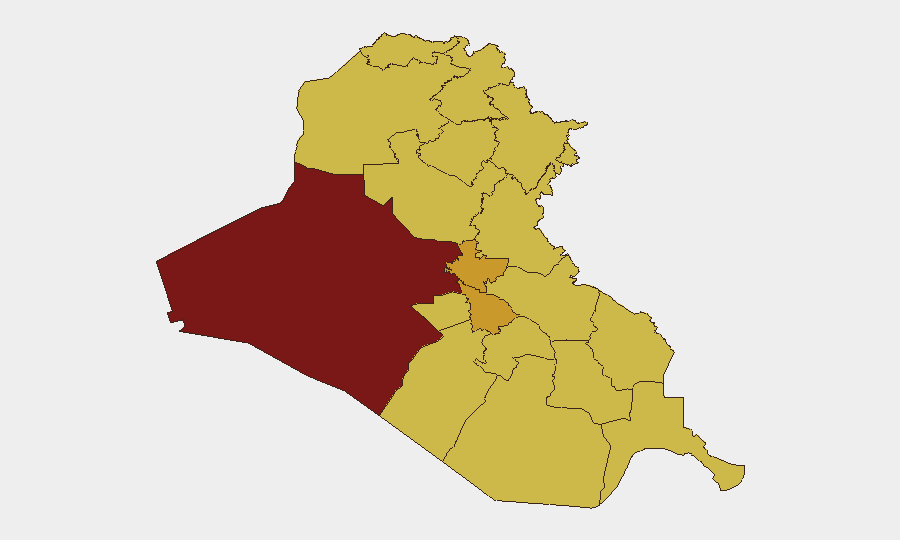
Iraq's security environment remains fragmented across sub-national lines, with Al-Anbar Governorate (risk 99.3) significantly outpacing all other regions. Political and institutional instability is accelerating: a surprise reshuffle of top security leadership on June 24–25 reflects central authority's attempt to consolidate control, while the transition of US-led coalition operations from combat to bilateral security cooperation (concluding by September 2026) is reshaping Iraq's strategic posture. Concurrent with state-building efforts—including a drive to centralize armed-group weapons—sectarian and tribal violence, utility-sector protests, and international diplomatic friction persist.
Key Developments
- Baghdad – 24–25 June – Prime Minister Ali al-Zaidi executed a surprise reshuffle of senior security posts, removing National Security Adviser Qasim al-Araji and appointing Qasim al-Aboudi as replacement, and replacing Abu Ali al-Basri with Bassem al-Badri as head of the National Security Service. This marks a significant shift in internal security leadership.
- Baghdad – 24 June – Iraq's Supreme Judicial Council issued a directive instructing courts nationwide to apply Anti-Terrorism Law No. 13 (2005) to manufacture, possession, or use of drones for illegal purposes. Security officials stated the directive explicitly targets armed factions using unauthorized drones.
- Amara, Maysan Governorate – 25 June – Fatal tribal clashes erupted in the al-Qadisiyah neighborhood of central Amara, leaving at least one dead and two wounded. Incident linked to an ongoing blood feud.
- Diwaniyah Province – 23–25 June – Protests over severe electricity outages escalated into a second week, with daily blackouts reaching 18 hours in most towns. Unrest continues as temperatures rise and power cuts persist.
- Kurdistan Region – 24–25 June – Foreign oil companies resumed staggered operations following a prolonged suspension. Gulf Keystone restarted production on 24 June; HKN (US) aims to resume Atrush field operations by 26 June; DNO (Norway) targets Tawke and Peshkabir field restart by 26 June. Restarts reflect improving but still-sensitive security conditions.
- Nationwide – 24–25 June – Armed groups across Iraq have begun surrendering weapons to state authorities as part of a committee-led effort to ensure all weapons remain under state control, linked to anticipated reduction of foreign military presence.
- Nationwide – 24–25 June – The first phase of the US-led coalition mission in Iraq has concluded, with operations transitioning to bilateral security cooperation and economic partnership through September 2026. Coalition activities related to Syria continue from inside Iraq.
Highest-Risk Areas
Al-Anbar Governorate dominates the risk profile at 99.3—a significant gap above Baghdad (72.5) and the mid-tier cluster of Babil, Karbala, and Kirkuk (69–71). The southern governorates (Basra, Najaf, Maysan, Dhi Qar, Al-Muthanna, Al-Qadisiyah, Wasit) form a risk band at 69.3, where utility-sector stress and tribal/sectarian friction create persistent instability. Baghdad's 72.5 score reflects leadership instability and the intersection of state-building, armed-group dynamics, and international military transition. Al-Anbar remains the outlier driver, likely reflecting residual ISIS-affiliated activity and tribal-militant fragmentation.
How GeoBit Would Assist
Security teams should employ AOI Monitoring & Early Warning on Al-Anbar, Baghdad, Kirkuk, and Maysan to track militia activity and protest escalation in near-real time. Conflict & Military and Network & Actor Analysis capabilities support tracking of armed-group weapons transfers and leadership changes within security apparatus. OSINT fusion (including Telegram/X signals and event extraction) provides situational awareness of sectarian tensions and utility crises that precede unrest; Routing & Network Analysis enables alternative-route planning for personnel and supply chains in high-risk governorates.
7-Day Outlook
The leadership reshuffle and weapons-centralization drive signal state consolidation efforts likely to intensify through late June–early July. However, tribal violence, service-sector protests, and the fragmented armed-group landscape suggest localized instability will persist, particularly in the southern cluster and Al-Anbar. The oil-sector restart in Kurdistan and ongoing US coalition transition create a window of relative operational focus but do not reduce baseline sectarian or factional friction.
Highest-Risk Areas — Ranked
| # | State / Region | Risk |
|---|---|---|
| 1 | Al-Anbar Governorate | 99.3 |
| 2 | Baghdad Governorate | 72.5 |
| 3 | Babil Governorate | 71.4 |
| 4 | Karbala | 69.8 |
| 5 | Kirkuk Governorate | 69.5 |
| 6 | Wasit Governorate | 69.3 |
| 7 | Al-Qadisiyah Governorate | 69.3 |
| 8 | Dhi Qar Governorate | 69.3 |
| 9 | Al-Muthanna Governorate | 69.3 |
| 10 | Maysan Governorate | 69.3 |
| 11 | Al-Basra Governorate | 69.3 |
| 12 | Al-Najaf Governorate | 69.3 |
Sources
Previous Daily Briefs
A new Iraq brief is written every day — each with its own risk map and downloadable CSV. Here's the last week; use the calendar to go further back.
📅 Browse every day by calendar →
Highlighted days have a brief. Tap a day for that day's map & analysis, or “csv” for that day's dataset ($5).