Situation Summary
Malta's security environment remains stable overall (global ranking #144), but two major developments this week have heightened near-term governance and infrastructure risk. A nationwide blackout on 9 September affecting over 30 localities exposed critical vulnerabilities in energy infrastructure, while an acquittal in the high-profile Daphne Caruana Galizia murder case (2 September) has triggered widespread political tensions and allegations of systemic corruption centered on Valletta. Minor crime activity (theft, immigration enforcement) continues but does not significantly alter the composite threat profile.
Key Developments
- Nationwide power outage – Malta and Gozo, evening of 9 September 2026
Equipment failure at the LNG facility serving the main power station caused loss of approximately 200 MW of generation capacity, forcing disconnection across multiple localities. Enemalta activated contingency measures and restored supply to most consumers within roughly one hour; root cause remained under investigation as of 10 September.
- Extended blackout affecting 30+ municipalities – Malta and Gozo, 10 September 2026
Follow-up reports confirmed that more than 30 towns and villages remained without electricity, with significant impact on households, hotels, and tourist-facing businesses. Gradual restoration continued throughout the day.
- Political escalation over Daphne Caruana Galizia acquittal – Valletta, 9 September 2026
Opposition leader Alex Borg reaffirmed allegations that the 2017 murder "was hatched inside Castille" (the Prime Minister's office), heightening public mistrust and creating potential civil unrest around governance institutions. Reporters Without Borders and international media sources warned of deepening corruption and rule-of-law concerns.
- Public outrage at court verdict – Valletta and nationwide, ongoing through 9 September 2026
The Criminal Court's acquittal of businessman Yorgen Fenech on complicity and criminal-association charges (2 September verdict) prompted widespread shock and accusations of systemic judicial interference, fueling broader dissatisfaction with state institutions.
- Police enforcement action on irregular migration – Malta, 11 September 2026
Malta Police apprehended 24 individuals living and working illegally, continuing immigration-compliance operations with potential labor-exploitation dimensions.
- Theft from recreational users – Gozo, reported 13 September 2026
A man received a suspended sentence after being caught stealing from a divers' vehicle, illustrating opportunistic crime targeting visitors and recreational users.
- Infrastructure governance scrutiny – Malta, 11 September 2026
Media commentary on maintenance and contractor accountability issues underscored broader public dissatisfaction with state infrastructure management.
Highest-Risk Areas
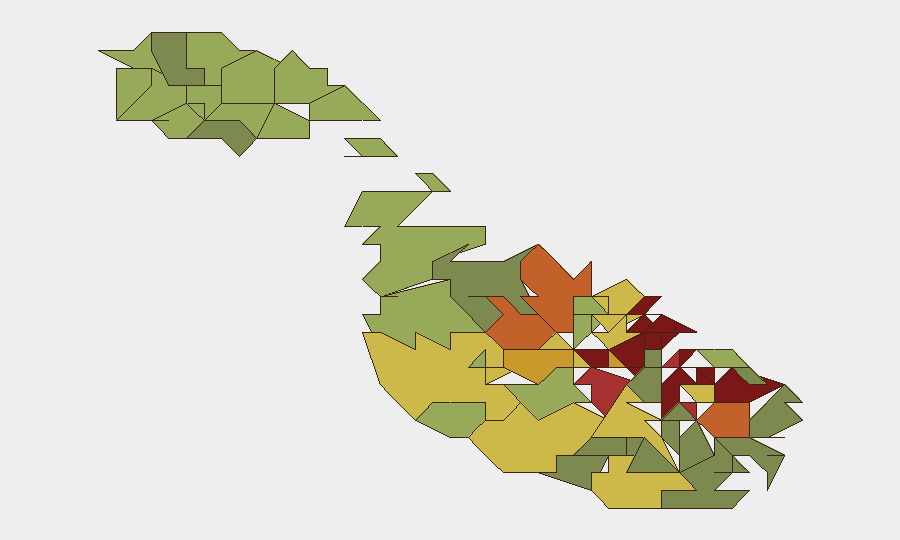
Valletta (95), Sliema (92), and Saint Julian's (90) drive the sub-national risk ranking, reflecting concentration in the capital and prime commercial/tourist zones where political institutions, financial services, and hospitality infrastructure are densest. The power outage and political turmoil centered on Valletta, and ongoing allegations of government complicity create reputational and governance-continuity risk in these urban cores. Valletta's dominance reflects both its role as the seat of power and the current judiciary/corruption concerns affecting institutional credibility.
How GeoBit Would Assist
Security teams would deploy AOI Monitoring & Early Warning to track Valletta and Sliema for signs of escalating protest activity or civil unrest around the ongoing political crisis. Intel Sweep and X/Twitter OSINT would provide real-time sentiment tracking and entity-network analysis to detect emerging narratives of institutional destabilization or calls to action. Routing & Network Analysis would support contingency planning for staff and supply chains, particularly in light of infrastructure vulnerabilities exposed by the blackout.
7-Day Outlook
Political tensions are likely to remain elevated through mid-September, with opposition parties continuing to press the government on rule-of-law and corruption allegations. Infrastructure scrutiny will intensify, especially around Enemalta's investigation into the LNG failure and prevention of recurrence. No imminent security escalation is forecast, but institutional trust deficits may create conditions for larger protests or civil-society mobilization if judicial or political developments worsen.
Highest-Risk Areas — Ranked
| # | State / Region | Risk |
|---|---|---|
| 1 | Valletta | 95 |
| 2 | Sliema | 92 |
| 3 | Saint Julian's | 90 |
| 4 | Gżira | 88 |
| 5 | Hamrun | 87 |
| 6 | Paola | 86 |
| 7 | Msida | 85 |
| 8 | Birkirkara | 84 |
| 9 | Birgu | 83 |
| 10 | Senglea | 82 |
| 11 | Cospicua | 81 |
| 12 | Żabbar | 80 |
Sources
Previous Weekly Briefs
A new Malta brief is written every Monday, covering the week — each with its own risk map and downloadable CSV. Use the calendar to go further back.
- September 8, 2026
- September 1, 2026
- August 29, 2026
- August 26, 2026
- August 24, 2026
- August 22, 2026
- August 20, 2026
📅 Browse past briefs by calendar →
Highlighted days have a brief. Tap a day for that day's map & analysis, or “csv” for that day's dataset ($5).
Atlas — our AI intelligence desk — emails them this snapshot personally. Nothing else, no list.