Situation Summary
North Korea remains at composite threat score 73 (global rank #26) with 30 tracked events over the assessment period. Recent signals reflect escalating rhetorical tension with the US and inter-Korean messaging, coupled with observable infrastructure expansion in naval and port facilities. No major kinetic incidents or civil unrest have been corroborated in the last 24–48 hours; current activity appears concentrated in military modernization and diplomatic posturing rather than acute instability.
Key Developments
- Nampo and Chongjin, 23 Jun 2026: Satellite imagery confirms ongoing expansion of shipbuilding and port infrastructure, including new workers' barracks, rail track construction, and assembly halls—consistent with sustained naval capability buildup.
- Inter-Korean border areas, 25 Jun 2026: United Nations Command assessed recent North Korean defensive activities (fencing, road repairs, landmine emplacement) as permissible civil/defensive measures under armistice frameworks; no breach determination issued.
- Wonsan/Songdowon, 25 Jun 2026: North Korea withdrew its ambassador to the UK in diplomatic response to UK sanctions targeting Songdowon International Children's Camp; no field-level security impact reported.
- Rhetoric vs. US and South Korea, 23–24 Jun 2026: Multiple public statements and rejection declarations from North Korean government and military organs directed at US and South Korean targets; messaging consistent with established protest patterns rather than indicative of imminent military action.
- Verification gap: Open-source corroboration remains limited for incident-level events in the last 48 hours; available reporting reflects policy announcements, military-development activity, and commentary rather than field incidents or population-level unrest.
Highest-Risk Areas
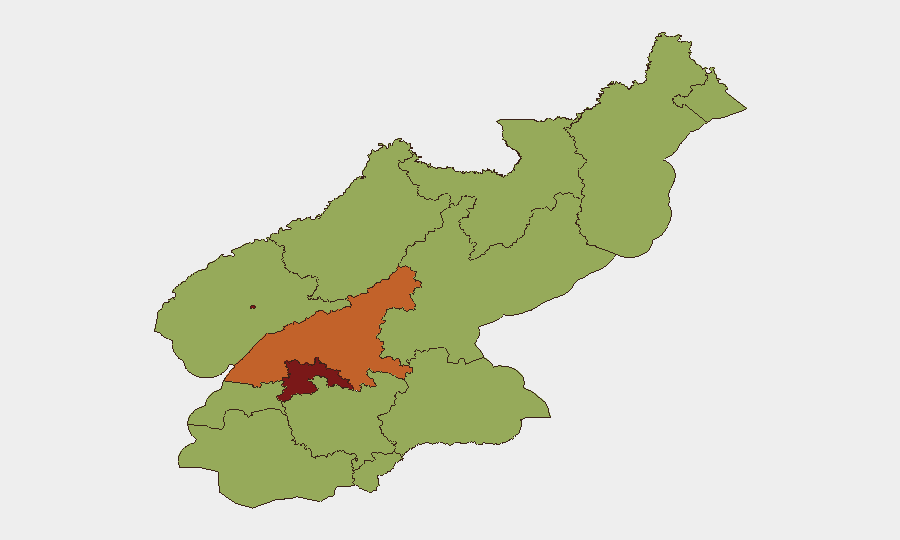
Pyongyang (81.1) significantly outpaces all other regions and reflects concentration of government, security apparatus, and foreign-resident populations in the capital. South Pyongan (74) ranks second, likely driven by proximity to the inter-Korean border and ongoing military infrastructure activity. All remaining tracked provinces cluster between 51–56, indicating more uniform baseline risk outside the capital and secondary urban centers. Risk elevation in Nampo and port regions correlates directly with observable naval and shipbuilding expansion; border regions reflect routine military posturing rather than acute incident concentration.
How GeoBit Would Assist
Organizations with personnel or assets in North Korea should prioritize persistent area-of-interest monitoring and alerting on Pyongyang, South Pyongan, and port zones (Nampo, Chongjin) to detect shifts in military activity or security operations. Satellite and imagery analysis paired with OSINT fusion and corroboration across X/Twitter, Telegram, and open media sources will enable early warning of infrastructure disruptions, border incidents, or population-level unrest that may not appear in official channels. Routing and network analysis supports contingency planning for personnel movement and supply chains in higher-risk corridors.
7-Day Outlook
Rhetorical tension with the US and South Korea is expected to persist at current levels; no indicators suggest imminent military escalation or domestic instability. Continued naval infrastructure expansion and routine border-area military activity will likely dominate observable signals. Organizations should maintain baseline monitoring posture and update duty-of-care contingency protocols in light of sustained geopolitical friction, particularly affecting Pyongyang and inter-Korean border regions.
Highest-Risk Areas — Ranked
| # | State / Region | Risk |
|---|---|---|
| 1 | P'yŏngyang | 81.1 |
| 2 | South Pyongan | 74 |
| 3 | Nampo | 56.4 |
| 4 | Ryanggang | 51.1 |
| 5 | North Hamgyong | 51.1 |
| 6 | North Pyongan | 51.1 |
| 7 | Chagang | 51.1 |
| 8 | South Hwanghae | 51.1 |
| 9 | North Hwanghae | 51.1 |
| 10 | South Hamgyong | 51.1 |
| 11 | Kaesong | 51.1 |
| 12 | Kangwon | 51.1 |
Sources
Previous Daily Briefs
A new North Korea brief is written every day — each with its own risk map and downloadable CSV. Here's the last week; use the calendar to go further back.
📅 Browse every day by calendar →
Highlighted days have a brief. Tap a day for that day's map & analysis, or “csv” for that day's dataset ($5).