Situation Summary
Russia faces sustained cross-border drone pressure from Ukraine targeting critical civilian infrastructure, with a major drone wave striking Moscow airspace on the night of 22–23 June prompting temporary airport closures and heightened air-defence operations. Putin has convened the Security Council to prioritize domestic stability and air-defence posture, signalling elevated concern over supply-chain disruption and public confidence. Concurrent maritime attacks on commercial shipping in the Black Sea and fuel restrictions in Crimea underscore strain across multiple operational domains. The conflict trajectory remains active and geographically diffuse, with escalating risk to civilian infrastructure, transportation hubs, and supply networks across western and southern Russia.
Key Developments
- Moscow drone intercept surge (22–23 June). Russian air defences claimed to have shot down 301 drones overnight across Russian airspace, with 60–80 near Moscow; Moscow Mayor Sergei Sobyanin reported more than 80 drones intercepted in 24 hours. Multiple Moscow-area airports suspended flights temporarily before resuming operations.
- Oil refinery strike (prior to 23 June). A Ukrainian drone strike on a Moscow-area refinery preceded the largest drone wave; Putin stated that Ukrainian drone attacks on Russian refineries have roughly doubled since January 2026, destabilizing fuel supplies.
- Black Sea civilian shipping attacks (night of 21–22 June). Turkish-operated cargo vessel *Victress* (Panama flag) was struck by Russian drones, killing one Egyptian crew member; Ukrainian sources reported at least three foreign-flagged vessels (Palau, Belize flags) attacked or threatened, raising maritime routing and insurance risk.
- Crimea fuel and electricity rationing (announced 22 June). Sevastopol authorities cancelled outdoor public events and halted retail fuel sales to the public, reserving fuel for government and security services; street lighting shut off at night in response to infrastructure damage and supply-route vulnerability.
- Security Council escalation focus (23 June). Putin convened permanent Security Council members via video to emphasize protecting critical infrastructure and maintaining public order amid "massive" cross-border strikes, reflecting heightened internal security posture.
- Cross-border strike attribution messaging (23 June). Putin publicly linked fuel shortages and rising gasoline prices in multiple Russian regions to Ukrainian strikes, signalling tighter state control over internal logistics and border-hinterland security.
Highest-Risk Areas
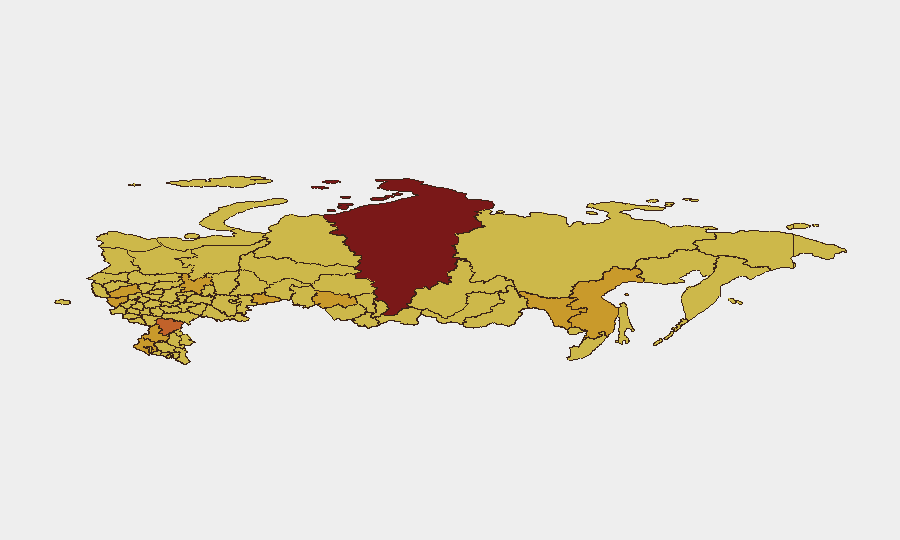
Moscow (99.5) remains the acute focal point due to drone targeting of airports, fuel infrastructure, and administrative hubs; the 22–23 June wave demonstrated vulnerability despite claimed high interception rates. Krasnoyarsk Krai (84.5) and Volgograd Oblast (73) rank second and third nationally, likely reflecting oil and energy-sector concentration and proximity to logistics choke points. Western and southern regions (Tver, Saint Petersburg, Smolensk, Rostov, Krasnodar) cluster in the 71–72 range, driven by proximity to active conflict zones, supply-route exposure, and dependence on refined-fuel distribution. The sub-national pattern reflects infrastructure vulnerability and logistical strain as primary risk drivers rather than localized military engagements.
How GeoBit Would Assist
Security teams in Russia should deploy AOI Monitoring & Early Warning on critical infrastructure zones (refineries, airport complexes, fuel depots) in Moscow and western regions to detect emerging strike patterns and advance warning of air-defence strain. Maritime & Aviation tracking combined with Routing & Network Analysis would enable real-time assessment of Black Sea shipping risk and alternative supply-chain routing to mitigate drone and denial-of-fuel impacts. Conflict & Military (air-defence posture, drone-intercept claims corroboration) and Sentiment & Temporal Analysis on state messaging would clarify the gap between official claims and operational capacity, informing contingency planning.
7-Day Outlook
Ukrainian drone operations are likely to continue targeting energy infrastructure and transportation hubs in Moscow and western Russia, with no indication of de-escalation. Short-term risk of further fuel-supply disruption, airport delays, and maritime incident escalation remains elevated. Government tightening of internal security and logistics control will likely accelerate, increasing checkpoint, inspection, and movement restrictions in border-adjacent regions and major urban centres.
Highest-Risk Areas — Ranked
| # | State / Region | Risk |
|---|---|---|
| 1 | Moscow | 99.5 |
| 2 | Krasnoyarsk Krai | 84.5 |
| 3 | Volgograd Oblast | 73 |
| 4 | Tver Oblast | 72.7 |
| 5 | Saint Petersburg | 72.5 |
| 6 | Amur Oblast | 72.3 |
| 7 | Khabarovsk Krai | 71.8 |
| 8 | Kurgan Oblast | 71.8 |
| 9 | Krasnodar Krai | 71.8 |
| 10 | Smolensk Oblast | 71.5 |
| 11 | Novosibirsk Oblast | 71.3 |
| 12 | Rostov Oblast | 71.1 |
Sources
Previous Daily Briefs
A new Russia brief is written every day — each with its own risk map and downloadable CSV. Here's the last week; use the calendar to go further back.
📅 Browse every day by calendar →
Highlighted days have a brief. Tap a day for that day's map & analysis, or “csv” for that day's dataset ($5).