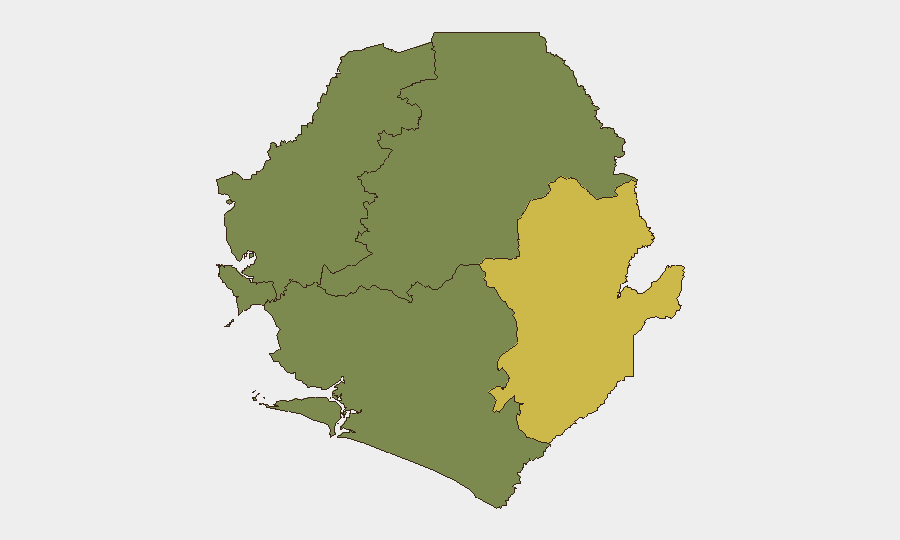
Situation Summary
Sierra Leone remains a low-to-moderate threat environment globally (rank #103, composite score 9/100). No significant security incidents, civil unrest, crime spikes, or infrastructure disruptions have been reported in the last 24–48 hours based on available open-source and social-media intelligence. Risk is concentrated in two regions—Eastern Province (score 68) and Western Area (score 35)—while Northern, North West, and Southern provinces present minimal tracked threat signals. The security baseline is stable with no indication of imminent deterioration.
Key Developments
No credible incident-level developments have been confirmed for Sierra Leone in the last 24–48 hours. Available web and X/Twitter reporting contains no corroborated reports of attacks, protests, violence, or service disruptions meeting incident criteria. Recent mentions of Sierra Leone in regional forums (e.g., ECOWAS early-warning workshops on illicit drug flows in the Mano River Union) reflect multilateral capacity-building, not active security events. Duty-of-care teams should monitor the gradual consolidation of regional drug-trafficking networks, a longer-term trend, but no acute trigger has emerged in the current reporting window.
Highest-Risk Areas
Eastern Province dominates the risk profile (score 68), driven by historical patterns of cross-border trafficking, limited state presence, and porous boundaries with Guinea and Liberia. Western Area (score 35), which includes Freetown and its urban periphery, faces elevated urban crime, gang activity, and occasional communal tensions, though it remains the most populated and economically integrated region. Northern, North West, and Southern provinces show negligible tracked threat signals and are suitable for routine operations. Corporate teams with personnel or assets in Freetown or diamond-mining regions (Eastern Province) should maintain standard protective posture; those in Northern and Southern areas face lower residual risk.
How GeoBit Would Assist
Intel Sweep & OSINT Fusion would consolidate real-time event feeds, X/Twitter intelligence, and multi-language reporting to detect emerging incidents (crime, trafficking, protests) before they escalate. AOI Monitoring & Early Warning on Eastern Province border zones and Western Area urban hotspots would provide persistent watch and alert teams to trafficking activity, communal flashpoints, or infrastructure disruption. Conflict & Military tracking, combined with Network & Actor Analysis, would map trafficking networks and state-capacity gaps in ungoverned regions, enabling risk-informed routing and personnel placement decisions.
7-Day Outlook
No acute security deterioration is forecast for the next seven days. Baseline risk will remain tied to chronic challenges (regional drug flows, urban crime, border permeability) rather than acute incidents. Corporate teams should maintain routine vigilance and use persistent OSINT monitoring to capture any emerging developments early, particularly in Eastern Province and Freetown's periphery.
Report Date: 2026-07-08 | GeoBit Threat Rank (Global): #103 | Composite Score: 9/100 | Tracked Events (7d): 8
Highest-Risk Areas — Ranked
| # | State / Region | Risk |
|---|---|---|
| 1 | Eastern Province | 68 |
| 2 | Western Area | 35 |
| 3 | North West Province, Sierra Leone | 0 |
| 4 | Northern Province, Sierra Leone | 0 |
| 5 | Southern Province, Sierra Leone | 0 |
Sources
Previous Daily Briefs
A new Sierra Leone brief is written every day — each with its own risk map and downloadable CSV. Here's the last week; use the calendar to go further back.
📅 Browse every day by calendar →
Highlighted days have a brief. Tap a day for that day's map & analysis, or “csv” for that day's dataset ($5).
Atlas — our AI intelligence desk — emails them this snapshot personally. Nothing else, no list.