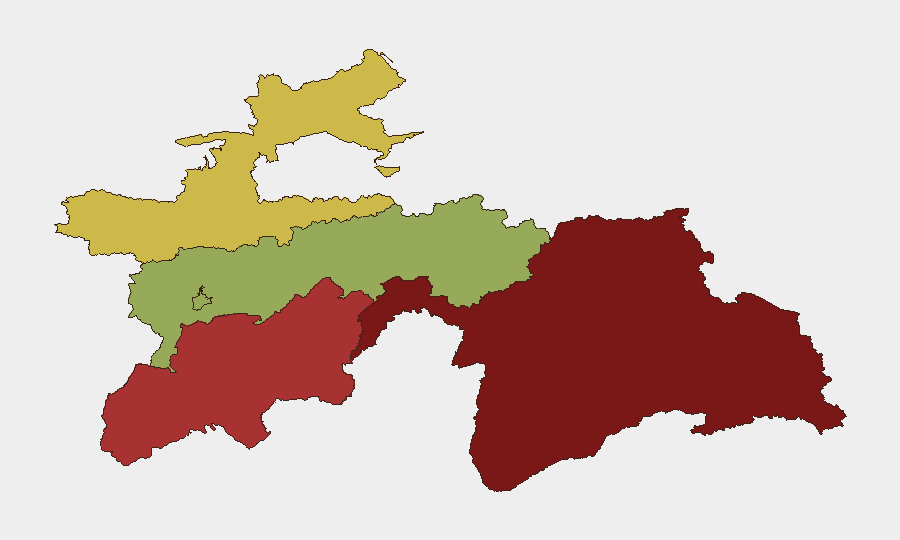
Situation Summary
Tajikistan remains a low-frequency threat environment globally (rank #132), with no confirmed security incidents tracked in the past 24–48 hours. The country's risk profile is heavily concentrated in its mountainous eastern and southern regions, where remote geography, porous borders, and limited state capacity create persistent vulnerabilities. The broader security trajectory remains stable absent new triggering events, though border-adjacent activity in Afghanistan and periodic cross-border tensions warrant monitoring.
Key Developments
- No confirmed discrete security incidents in Tajikistan identified in the 24–48 hour window ending 14 July 2026. Recent web research and event feeds returned no independently corroborated reports of conflict, civil unrest, crime spikes, infrastructure failures, or travel emergencies meeting current verification standards.
- Border-region geophysical activity noted but not operationally confirmed as Tajikistan-impacting. Seismic events in the broader Badakhshan region have been reported; verification of domestic Tajikistan consequences remains incomplete.
- Afghanistan border reporting (Badakhshan/Faizabad) monitored for spillover risk but no confirmed incursion or cross-border incident in Tajikistan proper reported in current window.
Highest-Risk Areas
Gorno-Badakhshan Autonomous Region (GBAO) dominates the threat landscape at risk score 92, driven by extreme remoteness, minimal government presence, drug-trafficking corridors, and direct exposure to Afghan instability. Khatlon Region (score 78) follows as the country's southern exposure, with porous borders and informal settlement patterns. Sughd Region (score 65) in the north presents secondary risk tied to transnational criminal networks and historical drug transit. Dushanbe (score 42), the capital, remains the lowest-risk zone due to central authority presence and economic activity concentration, making it the safest operating environment for corporate personnel.
How GeoBit Would Assist
Security and duty-of-care teams should employ AOI Monitoring & Early Warning against Gorno-Badakhshan and Khatlon regions to detect emerging conflict, criminal activity, or border incidents with automated alerting; pair this with Intel Sweep and multi-language OSINT (Twitter, Telegram, local sources) for real-time event corroboration. Routing & Network Analysis capabilities enable alternative journey planning and border-crossing risk assessment, while conflict mapping and border-territory search provide granular visibility into Afghan spillover zones adjacent to Tajik operations. For personnel in Dushanbe or Sughd, regime-stability and entity-network analysis support early warning of political or criminal shifts affecting corporate access or movement.
7-Day Outlook
No material escalation is anticipated in the near term absent external triggering events (e.g., major cross-border incident, regional geopolitical shock). Routine border management and low-frequency criminal activity should remain the primary operational concern. Teams should maintain standard vigilance protocols, particularly for GBAO and Khatlon transits, and flag any new reports of Afghan border instability or Tajik military mobilization for rapid re-assessment.
Highest-Risk Areas — Ranked
| # | State / Region | Risk |
|---|---|---|
| 1 | Gorno-Badakhshan Autonomous Region | 92 |
| 2 | Khatlon Region | 78 |
| 3 | Sughd Region | 65 |
| 4 | Districts of Republican Subordination | 58 |
| 5 | Dushanbe | 42 |
Sources
Previous Daily Briefs
A new Tajikistan brief is written every day — each with its own risk map and downloadable CSV. Here's the last week; use the calendar to go further back.
📅 Browse every day by calendar →
Highlighted days have a brief. Tap a day for that day's map & analysis, or “csv” for that day's dataset ($5).
Atlas — our AI intelligence desk — emails them this snapshot personally. Nothing else, no list.