Situation Summary
The United Arab Emirates faces acute but contained security risk from cross-border Iranian missile and drone strikes that have occurred over the past 48 hours, resulting in debris impacts on civilian and industrial areas across Abu Dhabi and Dubai emirates. Air-defense activations have successfully intercepted hostile projectiles, preventing direct hits on critical infrastructure, though falling debris has caused minor-to-moderate civilian casualties and facility damage. Simultaneously, the UAE has thwarted a coordinated cyberattack campaign against the financial sector, maintaining service continuity. The overall security posture remains stable with normal commercial and civil operations continuing, but heightened alert levels and infrastructure vulnerability remain the dominant risk factors.
Key Developments
- July 2–3 · Air-defense activations and debris impacts, Dubai residential areas: UAE air defenses intercepted hostile UAVs and missiles over southern Dubai; falling debris struck civilian homes, injuring four foreign nationals (Indian, Bangladeshi, Sri Lankan).
- July 2–3 · Drone strike and debris near Barakah nuclear facility, Abu Dhabi: The Ministry of Defence reported Iranian-launched drones from Iraqi territory struck near the Barakah nuclear power plant; regional air defenses activated in response.
- July 2–3 · Fatality and injuries from debris impact, Abu Dhabi residential area: Intercepted projectile debris struck civilian vehicle and residences, killing one Palestinian national and injuring multiple residents.
- July 2–3 · Industrial fire and worker injuries, UAE petroleum facility: An Iranian drone strike triggered a major fire at a petroleum site serving as an alternative export route; three Indian nationals sustained moderate injuries and were hospitalized.
- July 2–3 · Facility damage and worker injuries, Emirates Global Aluminium complex: Debris from strikes caused significant damage to EGA facilities; emergency closure of sections initiated; 12 workers (Nepali and Indian nationals) injured.
- July 2–3 · Telecom facility impact, Sharjah: Iranian ballistic missile struck a government-affiliated telecom building, causing minor structural damage and moderate injuries to two civilians.
- July 2–3 · Debris impact on Habshan gas complex, Abu Dhabi: Intercepted missile and drone debris struck the gas complex, injuring three personnel; no operational shutdown reported.
- July 3 · Thwarted cyberattack campaign against UAE financial sector: The UAE Cyber Security Council announced successful blocking of sophisticated cyberattacks targeting financial institutions nationwide; no service disruption occurred.
Highest-Risk Areas
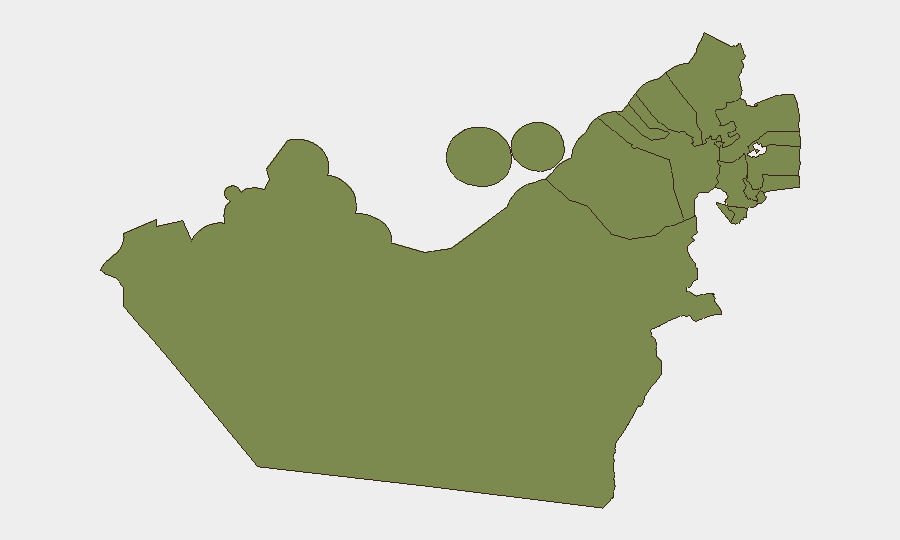
Abu Dhabi Emirate (risk 31.8) and Dubai (risk 30.9) account for virtually all current elevated risk and are the primary impact zones for recent cross-border strikes and debris falls. Abu Dhabi's concentration of energy infrastructure, the Barakah nuclear facility, and industrial export corridors makes it a focal point for regional targeting; Dubai's dense residential and commercial areas create secondary casualty risk from air-defense interceptions. The remaining five emirates show minimal comparative risk (1.8 each), reflecting their distance from current strike zones and lower strategic-asset density. Risk distribution is heavily weighted toward the two major emirates' geographic and economic footprints.
How GeoBit Would Assist
Security teams would deploy AOI Monitoring & Early Warning on critical facilities (Barakah, EGA, Habshan, key telecom nodes) to detect incoming threats in near-real time and enable protective action. Conflict & Military capabilities—including battle mapping and force-structure tracking—would contextualize Iranian and Iraqi-based launch sites, projectile types, and trajectory prediction to support protective routing and facility hardening. Cyber threat intelligence and network analysis would provide ongoing visibility into financial-sector attack vectors and command infrastructure behind coordinated campaigns, enabling defensive posture adjustments.
7-Day Outlook
Iranian strike activity may continue or escalate through mid-week depending on regional political dynamics; UAE air defenses have proven effective but debris-fall risk to populated areas remains elevated. Industrial and energy-sector facilities will remain priority targets; cyberattack coordination against financial infrastructure is likely to persist. Expect maintained high alert posture, possible further facility closures, and continued logistics disruption for multinational staff rotation and supply chains.
Highest-Risk Areas — Ranked
| # | State / Region | Risk |
|---|---|---|
| 1 | Abu Dhabi Emirate | 31.8 |
| 2 | Dubai | 30.9 |
| 3 | Sharjah Emirate | 1.8 |
| 4 | Ajman Emirate | 1.8 |
| 5 | Ras al-Khaimah | 1.8 |
| 6 | Fujairah Emirate | 1.8 |
| 7 | Umm al-Quwain | 1.8 |
Sources
Previous Daily Briefs
A new United Arab Emirates brief is written every day — each with its own risk map and downloadable CSV. Here's the last week; use the calendar to go further back.
📅 Browse every day by calendar →
Highlighted days have a brief. Tap a day for that day's map & analysis, or “csv” for that day's dataset ($5).