Situation Summary
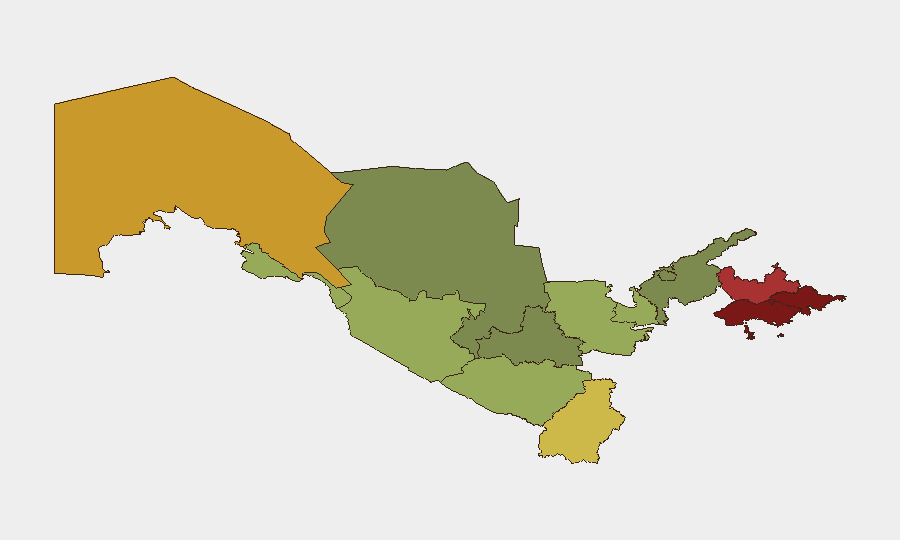
Uzbekistan remains stable with no significant security incidents reported in the last 24–48 hours. The national composite threat score of 2 reflects a low-risk environment overall. However, sub-national risk concentrates sharply in the Fergana Valley region (Andijan, Fergana, and Namangan), where historical factors including militant networks, border tensions, and socioeconomic pressures sustain elevated risk profiles. Personnel and assets in central and western regions face substantially lower exposure.
Key Developments
No credible, confirmed security, civil unrest, crime, or infrastructure incidents were reported in Uzbekistan between 2026-07-04 and 2026-07-06 00:00 UTC. Open-source monitoring (news wires, social media, local agency bulletins) identified no events meeting the 24–48-hour window and significance threshold for this brief. Scheduled public events and forums planned for September 2026 remain on calendar; no cancellations or security-driven postponements have been announced.
Highest-Risk Areas
The Fergana Valley—comprising Andijan (risk 88), Fergana (82), and Namangan (78) regions—drives the country's security profile and accounts for the majority of tracked historical incidents. These territories are separated by borders with Tajikistan and Kyrgyzstan, contain dense populations, and have experienced periodic militant activity, smuggling, and localized clan tensions since the 1990s. Karakalpakstan (risk 72) and Surxondaryo (risk 65) present secondary risk clusters linked to border instability and resource competition. Western and southern regions (Navoiy, Samarqand, Bukhara) remain comparatively low-risk for corporate operations.
How GeoBit Would Assist
Corporate security teams operating in or traveling to Uzbekistan should employ AOI Monitoring & Early Warning on the Fergana Valley and border zones to detect emerging unrest, cross-border activity, or militant indicators before they escalate. Intel Sweep and multi-language OSINT (news, Telegram, social media) provide continuous scanning for protest mobilization, transport disruptions, or criminal events affecting supply chains and staff movement. Routing & Network Analysis enables real-time alternative journey planning around Fergana hotspots and border checkpoints, ensuring duty-of-care compliance for personnel transit.
7-Day Outlook
No acute security trigger is apparent over the next seven days. Routine monitoring should continue, with heightened attention to Fergana Valley developments and any cross-border incident spillover from Tajikistan or Kyrgyzstan. Summer heat and holiday schedules may dampen public activity; standard administrative and commercial operations are expected to proceed normally in major cities.
Highest-Risk Areas — Ranked
| # | State / Region | Risk |
|---|---|---|
| 1 | Andijan Region | 88 |
| 2 | Fergana Region | 82 |
| 3 | Namangan Region | 78 |
| 4 | Republic of Karakalpakstan | 72 |
| 5 | Surxondaryo Region | 65 |
| 6 | Qashqadaryo Region | 58 |
| 7 | Sirdaryo Region | 55 |
| 8 | Jizzakh Region | 48 |
| 9 | Xorazm Region | 45 |
| 10 | Bukhara Region | 42 |
| 11 | Navoiy Region | 38 |
| 12 | Samarqand Region | 35 |
Sources
Previous Daily Briefs
A new Uzbekistan brief is written every day — each with its own risk map and downloadable CSV. Here's the last week; use the calendar to go further back.
📅 Browse every day by calendar →
Highlighted days have a brief. Tap a day for that day's map & analysis, or “csv” for that day's dataset ($5).
Atlas — our AI intelligence desk — emails them this snapshot personally. Nothing else, no list.