Résumé de la situation
La Côte d'Ivoire reste une préoccupation de sécurité régionale modérée (classement mondial #64), l'insurrection et le terrorisme étant les principaux facteurs, bien qu'aucun incident majeur n'ait été enregistré au cours de la semaine écoulée. L'élan en matière de sécurité reflète une double priorité : la coordination continue du contre-terrorisme avec le Mali face à la pression djihadiste sur la frontière nord, et la prévention de la criminalité intérieure grâce à des opérations policières renforcées et la protection des infrastructures critiques. Les districts de savane du nord (Savanes, Zanzan, Denguélé) continuent de présenter le profil de risque le plus élevé, tandis qu'Abidjan et les zones du sud demeurent relativement plus stables.
Développements clés
- Abidjan, 12 octobre : Les autorités ont inauguré un Centre d'opérations intégrées pour l'action de l'État en mer dotée de procédures opérationnelles maritimes normalisées, signalant une capacité accrue de surveillance maritime et de réaction aux menaces.
- Abidjan, 12 octobre : Le président du conseil stratégique du PPA-CI, Sébastien Dano Djédjé, a été inculpé de 17 infractions, notamment des menaces présumées à la sécurité de l'État et des accusations liées au terrorisme ; il a été placé sous contrôle judiciaire, indiquant une sensibilité politique intérieure accrue autour des narratives extrémistes.
- Bamako (Mali), 15–17 octobre : Le chef du renseignement ivoirien Vassiriki Traoré a conduit des pourparlers de sécurité de haut niveau avec ses homologues maliens sur le contre-terrorisme et la coopération en matière de renseignement, reflétant une préoccupation bilatérale face à l'activité djihadiste affectant la région frontalière.
- Département de Kani, 15 octobre : La gendarmerie et les forces de Séguéla ont mené des opérations coordonnées en fin de nuit (après 22h00) en réaction à des rapports de vols et de cambriolages, suggérant une augmentation localisée de la criminalité justifiant une mobilisation des ressources.
- Korhogo, 15 octobre : La police a arrêté un suspect lié au vol de câbles électriques et d'équipements de l'usine COOPEX-CI (cambriolage survenu les 9–10 octobre). L'arrestation reflète la criminalité persistante liée aux biens, de faible à moyen niveau, affectant les sites industriels.
- Abidjan, 13 octobre : Un accord de coopération en cybersécurité a étendu les capacités de sécurité opérationnelles exploitées localement pour les institutions publiques et les exploitants d'infrastructures critiques, indiquant une sensibilisation accrue aux menaces cybernétiques parmi les intervenants gouvernementaux.
Zones à plus haut risque
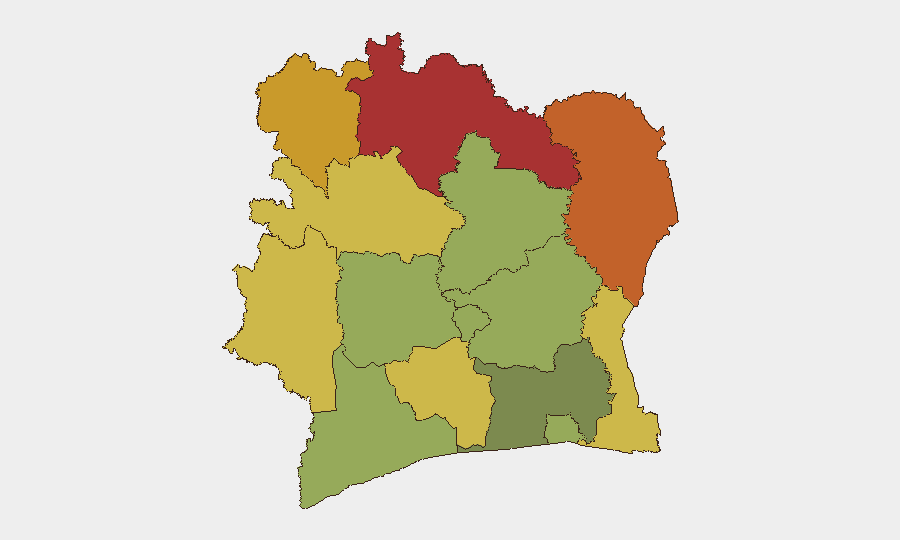
La ceinture de savane du nord—composée des districts de Savanes (risque 78), Zanzan (75) et Denguélé (72)—domine le profil de risque, reflétant l'infiltration djihadiste persistante, les frontières poreuses avec le Mali et la présence limitée de la sécurité de l'État dans les zones reculées. Comoé (70) et Montagnes (68) étendent cet arc vers l'est et le sud, créant un croissant à haut risque au nord. En contraste, Abidjan (45) et les districts côtiers du sud affichent des scores composites sensiblement plus faibles, bien qu'Abidjan demeure un centre de criminalité organisée et transnationale. La visite de renseignement d'octobre au Mali souligne que le terrorisme en région frontalière reste le principal moteur de l'élévation des menaces au niveau national.
Comment GeoBit pourrait être utile
Les équipes de sécurité devraient déployer la Surveillance AOI et l'Alerte précoce sur les zones frontalières du nord (Savanes, Zanzan, Denguélé) pour détecter les mouvements militants et les incursions transfrontalières. L'Analyse du réseau et des acteurs combinée à l'OSINT multilingue (X/Twitter, Telegram, SIGINT radio locale) suivra le recrutement djihadiste, le financement et la messagerie opérationnelle. L'Analyse du routage et du réseau permet aux équipes responsables d'identifier les couloirs de transit sûrs et les routes d'évacuation d'urgence, notamment pour le personnel se déplaçant vers ou près du nord.
Perspective à 7 jours
Attendez-vous à un renforcement continu et graduel des capacités du secteur de la sécurité (maritime, cyber, opérations de gendarmerie) tandis que les autorités traitent les menaces fragmentées couvrant la criminalité, l'extrémisme et la protection des infrastructures. L'activité djihadiste en région frontalière restera vraisemblablement la préoccupation stratégique primaire, bien qu'aucune escalade majeure ne soit signalée pour la semaine à venir. Les sensibilités politiques intérieures (comme en témoignent les accusations contre la direction du PPA-CI) pourraient s'amplifier si les voix d'opposition contestent la rhétorique du contre-terrorisme.
Zones les Plus à Risque — Classées
| # | État / Région | Risque |
|---|---|---|
| 1 | Savanes District | 78 |
| 2 | Zanzan District | 75 |
| 3 | Denguélé District | 72 |
| 4 | Comoé District | 70 |
| 5 | Montagnes District | 68 |
| 6 | Woroba District | 65 |
| 7 | Gôh-Djiboua District | 60 |
| 8 | Sassandra-Marahoué District | 58 |
| 9 | Vallée du Bandama District | 55 |
| 10 | Bas-Sassandra District | 52 |
| 11 | Lacs District | 48 |
| 12 | Abidjan | 45 |
Sources
Bulletins Hebdomadaires Précédents
Un nouveau bulletin Ivory Coast est publié chaque lundi, couvrant la semaine — chacun avec sa carte de risque et son CSV téléchargeable. Voici la dernière semaine ; utilisez le calendrier pour remonter plus loin.
- October 12, 2026
- October 5, 2026
- September 28, 2026
- September 21, 2026
- September 14, 2026
- September 7, 2026
- September 2, 2026
📅 Browse past briefs by calendar →
Highlighted days have a brief. Tap a day for that day's map & analysis, or “csv” for that day's dataset ($5).
Atlas — our AI intelligence desk — emails them this snapshot personally. Nothing else, no list.