Situation Summary
Lithuania faces a sharp spike in hybrid-threat activity following coordinated incidents on 18 October that included an attempted sabotage of critical Starlink infrastructure and an unidentified airborne intrusion. Prime Minister Sinkevičius publicly attributed the arson attempt to Russian hybrid-war operations, and the government has initiated a National Security Commission review to expand drone-neutralization authorities. While the overall national threat score remains moderate (rank 144 globally), the concentration of activity in Vilnius, Kaunas, and northern border regions signals a tactical escalation requiring heightened vigilance from corporate and diplomatic security teams.
Key Developments
- Starlink facility, Lithuania (17–18 October): An unidentified group attempted to ignite satellite antennas and control units supporting Ukraine communications; incendiary-liquid containers were recovered. The attack failed after security reinforcement; no suspects detained and operations continued uninterrupted.
- Unidentified airborne object, Juodėnai village, Panevėžys District (18 October): An object of unknown origin entered Lithuanian airspace, triggering NATO fighter scrambles. Authorities issued a red air-threat alert across central and northern Lithuania, instructing residents to shelter for approximately one hour.
- Kaunas International Airport (18 October): The airport was temporarily closed during the air-alert response; NATO air-policing assets investigated the object amid poor weather conditions that prevented visual identification.
- Lithuania–Poland border approach (18 October): Officials reported the airborne object appeared to enter Lithuanian airspace from the Polish direction, though origin and classification remain unconfirmed.
- National security response (18 October): The Lithuanian government announced a National Security Commission discussion on expanded powers for security services to detect and neutralize unidentified drones in response to both the arson attempt and airspace incident.
- Prime ministerial attribution (18 October): PM Sinkevičius publicly characterized the attempted Starlink arson as likely Russian-directed hybrid warfare, signaling official assessment of state-level threat activity.
Highest-Risk Areas
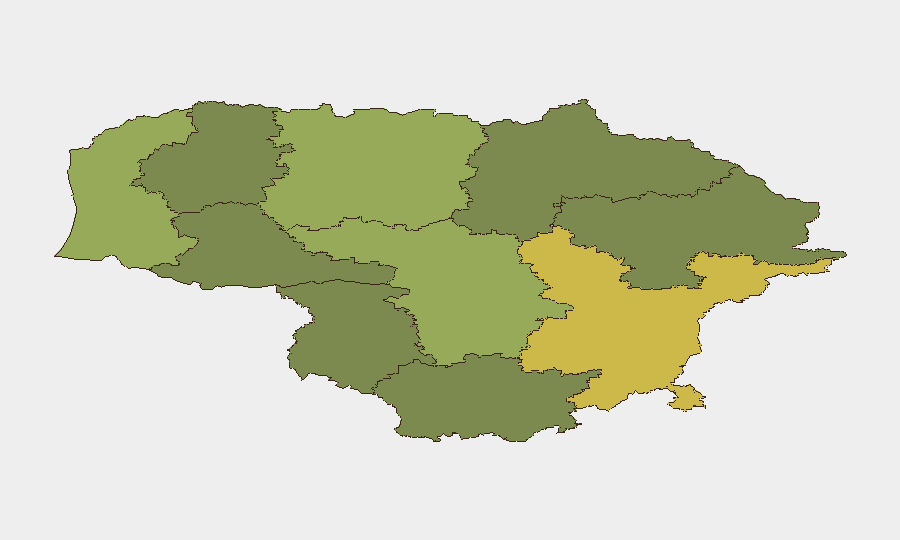
Vilnius County (risk 68) and Kaunas County (risk 58) dominate Lithuania's sub-national threat landscape, driven by concentration of critical infrastructure, diplomatic presence, and telecommunications assets. The cyberattack on Vilnius hospitality infrastructure (8 October) and this week's attempted sabotage of Starlink facilities underscore both urban vulnerability and targeting of systems linked to Ukraine support. Northern counties bordering Kaliningrad and Poland—including Klaipeda (52) and Siauliai (42)—face persistent hybrid-threat exposure tied to airspace incursions and border-area instability. Corporate teams with personnel or operations in Vilnius and Kaunas should prioritize facility hardening and situational awareness.
How GeoBit Would Assist
Security teams should deploy GeoBit's AOI Monitoring & Early Warning capabilities to establish persistent watch on critical infrastructure clusters in Vilnius, Kaunas, and northern border zones, enabling real-time alerting to airspace incursions or attempted intrusions. Multi-language OSINT and Telegram/X intelligence would triangulate threat-actor attribution, detect pre-attack signaling, and track hybrid-warfare campaign evolution. GIS & Spatial Analysis combined with Conflict & Military force-structure tracking provides dynamic mapping of NATO responses and border-area military posture to inform duty-of-care decisions for staff movements.
7-Day Outlook
The coordination and timing of the 18 October incidents (sabotage and airspace intrusion within hours) suggest a deliberate campaign rhythm rather than isolated events. Authorities' announced expansion of security-service powers and NATO's visible air-policing presence will likely deter follow-on activity in the near term, but hybrid-threat tempo typically persists through autumn. Corporate security teams should anticipate secondary targeting of telecom, energy, or diplomatic infrastructure and reinforce facility access controls and communications resilience.
Highest-Risk Areas — Ranked
| # | State / Region | Risk |
|---|---|---|
| 1 | Vilnius County | 68 |
| 2 | Kaunas County | 58 |
| 3 | Klaipeda County | 52 |
| 4 | Siauliai County | 42 |
| 5 | Panevezys County | 38 |
| 6 | Taurage County | 35 |
| 7 | Utena County | 33 |
| 8 | Alytus County | 32 |
| 9 | Telsiai County | 28 |
| 10 | Marijampole County | 25 |
Sources
Previous Weekly Briefs
A new Lithuania brief is written every Monday, covering the week — each with its own risk map and downloadable CSV. Use the calendar to go further back.
- October 13, 2026
- October 6, 2026
- September 29, 2026
- September 22, 2026
- September 15, 2026
- September 8, 2026
- September 1, 2026
📅 Browse past briefs by calendar →
Highlighted days have a brief. Tap a day for that day's map & analysis, or “csv” for that day's dataset ($5).
Atlas — our AI intelligence desk — emails them this snapshot personally. Nothing else, no list.