Situation Summary
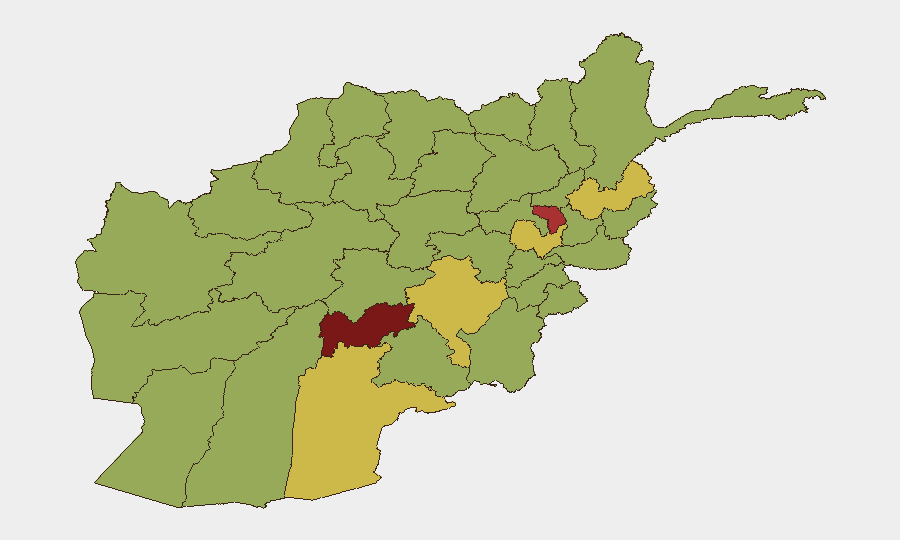
Afghanistan remains at composite threat rank #24 globally, with a national risk score of 84 reflecting persistent instability across multiple threat vectors including conventional military activity, detention-related tensions, and judicial proceedings linked to counterterrorism operations. Sub-national risk concentration in Uruzgan, Kapisa, and Kabul provinces (scores 88.9–68.9) indicates geographically uneven threat distribution. Recent activity signals show elevated legal/institutional strain alongside reports of unconventional violence, though open-source incident confirmation for the past 24–48 hours remains limited outside humanitarian and border-crossing data. The security environment remains volatile but not acute in the immediate cycle.
Key Developments
- Severe Weather Impact Across Eight Provinces (26–27 June 2026)
Afghanistan's National Disaster Management Authority (ANDMA) reported widespread damage to homes, roads, and agricultural infrastructure over the past 48 hours affecting at least eight provinces. This indirect threat multiplies logistics disruption and constrains travel and supply-chain resilience for corporate operations and personnel mobility in affected areas.
- Cross-Border Deportation Surge: Torkham and Spin Boldak (26–27 June 2026)
Afghanistan's returns commission reported 382 Afghans deported from Iran entering through Torkham (Nangarhar) and Spin Boldak (Kandahar) border crossings during the same reporting window. Elevated cross-border flows may increase congestion, resource strain on local authorities, and social tension at these critical transit nodes.
- Judicial and Detention Activity Signals (25–27 June 2026)
GeoBit event feeds capture multiple concurrent signals: Supreme Court arrests of alleged terrorist actors, District Court detentions, Federal Judge demands, and lawyer/detainee public statements (25–27 June). While not a single discrete incident, the concentration of judicial/detention events in a 72-hour window suggests heightened counterterrorism enforcement and possible legal friction around detainee treatment.
- Unconventional Violence Event (27 June 2026)
A signal of unconventional violence was logged on 27 June with an Afghan actor designation, but open-source corroboration and specific location data remain unavailable. Security teams should monitor for clarification through localized reporting channels.
- Cross-Border Statement Activity (27 June 2026)
Iran-linked disapproval statements regarding an operative were recorded, indicating continued interstate attention to actors with cross-border significance. Context remains limited; this reflects diplomatic or intelligence signaling rather than a direct operational incident.
Highest-Risk Areas
Uruzgan Province (88.9) emerges as the single highest-risk sub-national area, followed by Kapisa (78.8) and Kabul (68.9). The concentration of risk in Uruzgan likely reflects persistent Taliban territorial control, militia activity, and limited state presence; Kapisa's elevation reflects proximity to Kabul and historical insurgent networks; Kabul's score reflects urban-density risk including political/institutional volatility and terrorism. Nine provinces cluster at 58.9–60.2, indicating a broad secondary-risk belt across the south and west (Helmand, Zabul, Kandahar, Paktika, Farah, Nimruz, Jowzjan) where governance fragmentation and cross-border activity remain endemic.
How GeoBit Would Assist
Security and risk teams should employ Intel Sweep and global event feeds for real-time incident capture across provinces; AOI Monitoring & Early Warning on Uruzgan, Kapisa, and Kabul for persistent alerting; and Routing & Network Analysis to plan personnel movement and supply logistics around active weather, border congestion, and unstable corridors. Conflict & Military battle mapping and Network & Actor Analysis will track judicial enforcement patterns and their correlation with operational risk.
7-Day Outlook
Weather damage and border-crossing volume may constrain logistics and personnel movement in the immediate 48–72 hours. Judicial activity and enforcement operations are likely to continue; personnel and asset security should maintain heightened awareness around detention developments and any escalation in unconventional violence signals, particularly in Uruzgan and Kapisa provinces.
Highest-Risk Areas — Ranked
| # | State / Region | Risk |
|---|---|---|
| 1 | Uruzgan Province | 88.9 |
| 2 | Kapisa Province | 78.8 |
| 3 | Kabul Province | 68.9 |
| 4 | Ghazni Province | 68 |
| 5 | Kandahar Province | 66 |
| 6 | Nuristan Province | 60.2 |
| 7 | Zabul Province | 58.9 |
| 8 | Paktika Province | 58.9 |
| 9 | Farah Province | 58.9 |
| 10 | Nimruz Province | 58.9 |
| 11 | Helmand Province | 58.9 |
| 12 | Jowzjan Province | 58.9 |
Sources
Previous Daily Briefs
A new Afghanistan brief is written every day — each with its own risk map and downloadable CSV. Here's the last week; use the calendar to go further back.
📅 Browse every day by calendar →
Highlighted days have a brief. Tap a day for that day's map & analysis, or “csv” for that day's dataset ($5).