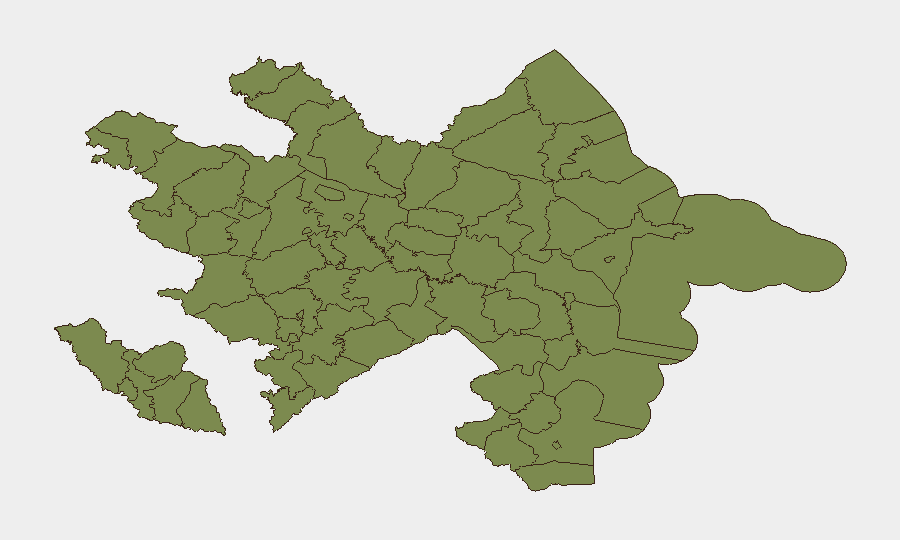
Situation Summary
Azerbaijan's national security environment remains broadly stable, with a composite threat score of 28 placing it outside the global top-tier risk tier. However, civil liberties and media-freedom tensions have escalated sharply in the past 72 hours, with multiple reports of police action against journalists and media outlets. Sub-national risk concentration in Imishli District (score 31.3) and Baku City (15.3) reflects both localized instability and the centralization of political/security activity in the capital. Ground Forces exercises underway nationwide indicate routine military operations rather than emergency mobilization.
Key Developments
- Baku City, 2026-07-28 — Police conducted investigations and blockades targeting media organizations; at least three separate violent repression incidents against journalists were reported, indicating a coordinated intensification of state pressure on press freedom.
- Baku, 2026-07-30 — Azerbaijani Land Forces executed large-scale training exercises nationwide as part of the 2026 military training plan, signaling routine operational tempo with no indications of emergency or heightened alert status.
- Caspian Sea, 2026-07-30 — A magnitude 3.2 earthquake was recorded; while minor, it warrants monitoring for any secondary effects on maritime infrastructure or regional travel corridors.
- Azerbaijan–Georgia Transit Route, 2026-07-30 — President Aliyev approved a new electricity supply and transit agreement with Georgia, reflecting ongoing regional infrastructure interdependence and logistics stability on this key corridor.
- Jebrail District, 2026-07-30 — Forty-six Azerbaijani families returned to the district, continuing post-conflict resettlement patterns in areas affected by the 2020 war and subsequent territorial changes.
- Baku (Detention & Legal System), 2026-07-30 — Civil-rights complaints by activist Mamed Mamedzade and resumption of the Meydan TV trial (following a judge change) highlight ongoing legal and accountability disputes; these are institutional tensions rather than acute security incidents.
Highest-Risk Areas
Imishli District dominates the sub-national risk profile (31.3), driven by unresolved post-conflict conditions and likely border sensitivities with Armenian-majority areas. Baku City (15.3) concentrates political power, security services, and media infrastructure, creating friction between state control and civil-society actors—evidenced by this week's journalist detentions and police blockades. Khankendi (3.3) and border districts (Sadarak, Sharur, Tovuz, Qakh) carry residual conflict risk and Armenian–Azerbaijani demographic sensitivities stemming from the 2020 war, though current scores remain low. All other tracked regions score below 1.5, indicating fragmented and localized risk rather than widespread instability.
How GeoBit Would Assist
Intel Sweep and X/Twitter OSINT capabilities would enable real-time monitoring of journalist detentions, police actions, and civil-unrest signals in Baku and media hubs. AOI Monitoring & Early Warning with persistent watch on Imishli District, border crossings (Sadarak, Tovuz, Qakh), and Baku detention facilities would provide 72-hour advance signals of escalation in state repression or cross-border incidents. Routing & Network Analysis would identify secure alternative transit routes should ground conditions in Imishli or Jebrail deteriorate, and Maritime & Aviation tracking would ensure continuity of Caspian and regional corridor assessments during seismic or infrastructure disruptions.
7-Day Outlook
Media-freedom restrictions are likely to persist at current intensity; no immediate de-escalation is evident. Ground Forces exercises will complete within the training cycle, with no operational anomalies expected. Sub-national risk in Imishli and border zones will remain elevated but stable absent external shocks (e.g., cross-border incidents, further Iran–Azerbaijan diplomatic friction). Corporate teams should maintain heightened awareness of journalist-safety incidents and police activity affecting employee movement and communications in Baku.
Highest-Risk Areas — Ranked
| # | State / Region | Risk |
|---|---|---|
| 1 | Imishli District | 31.3 |
| 2 | Baku City | 15.3 |
| 3 | Khankendi | 3.3 |
| 4 | Sadarak District | 1.3 |
| 5 | Qazakh District | 1.3 |
| 6 | Sharur District | 1.3 |
| 7 | Yevlakh District | 1.3 |
| 8 | Kangarli District | 1.3 |
| 9 | Nakhchivan Autonomous Republic | 1.3 |
| 10 | Aghstafa District | 1.3 |
| 11 | Tovuz District | 1.3 |
| 12 | Qakh District | 1.3 |
Sources
Previous Daily Briefs
A new Azerbaijan brief is written every day — each with its own risk map and downloadable CSV. Here's the last week; use the calendar to go further back.
📅 Browse every day by calendar →
Highlighted days have a brief. Tap a day for that day's map & analysis, or “csv” for that day's dataset ($5).
Atlas — our AI intelligence desk — emails them this snapshot personally. Nothing else, no list.