Situation Summary
Bangladesh faces a composite security environment marked by active civil unrest, intensified law-enforcement operations, and armed-group activity in remote regions. Over the past 48 hours, Dhaka has experienced large-scale police sweeps recovering explosives components alongside routine crime and narcotics busts, while the Chittagong Hill Tracts show escalating military counter-insurgency drives. Senior police leadership instability—driven by forced retirement of 33 top officers—compounds institutional risk and may disrupt operational continuity. Overall threat trajectory remains elevated and volatile, with particular concentration in Chittagong Division and the capital.
Key Developments
- Dhaka (multiple divisions) – 29–30 July: Dhaka Metropolitan Police conducted overlapping city-wide operations, arresting 442 individuals across 9 police zones, filing 29 cases, and recovering explosive/bomb-making components; a parallel 24-hour sweep detained 377 people and filed 41 narcotics and crime cases.[1][7]
- Bhatara, Dhaka – 29 July: A residential gas-line leak triggered a fatal explosion and fire, killing two civilians (ages 24 and 8) and critically injuring a third family member now hospitalized at the National Institute of Burn and Plastic Surgery.[11]
- Tongi, Gazipur – 29–30 July: Police arrested two suspected drug traffickers and seized approximately 10,500 yaba tablets and Tk 5.8 lakh in cash during a targeted raid, indicating sustained high-volume narcotics activity near the capital.[5]
- Chittagong Hill Tracts – past 24–48 hours: Bangladesh Army has scaled up operations against "mountain-based armed groups" with continuous patrols and drives aimed at disrupting militant activity in remote upland areas.[12]
- Kutupalong refugee camp, Cox's Bazar – within 48 hours: A large fire destroyed multiple shelters in the world's largest refugee settlement; firefighting operations ongoing and humanitarian impact under assessment.[6]
- Daulatpur border, Kushtia – 30–31 July window: Border Guard Bangladesh reported foiling an attempted cross-border infiltration allegedly involving Indian Border Security Force personnel pushing eight unidentified individuals across the Kushtia river boundary; the group was turned back.[11]
- National (Home Ministry) – 30 July: A Home Ministry circular ordered forced retirement of 33 senior police officials—14 DIGs and 18 additional DIGs—"in public interest," representing an abrupt and destabilizing leadership reshuffle with potential consequences for command structure and operational capacity.[3]
Highest-Risk Areas
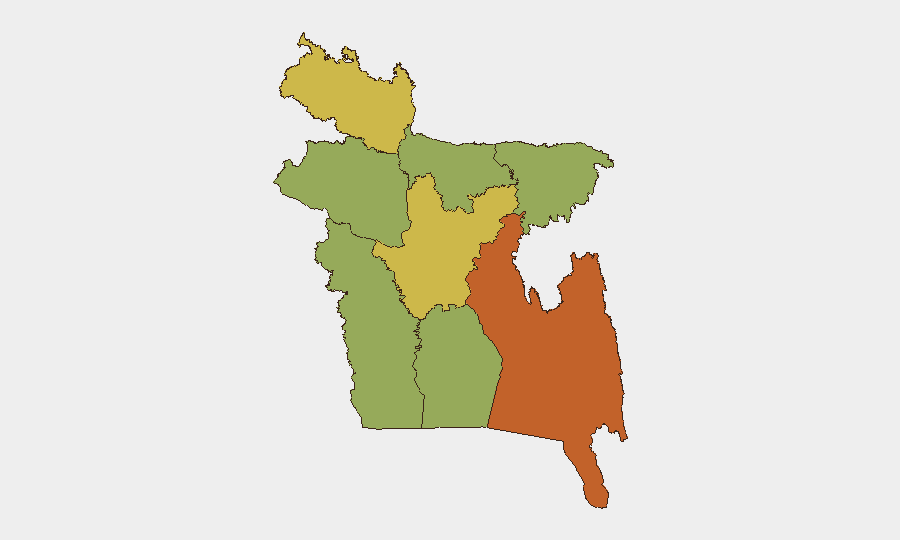
Chittagong Division (75.8 composite score) remains the primary risk hub, driven by armed-group activity and military counter-insurgency operations, particularly in the Chittagong Hill Tracts. Rangpur Division (67.4) and Dhaka Division (66.9) follow closely; Dhaka's risk is sustained by the capital's density, ongoing civil unrest signals, explosives-related recoveries, and administrative instability, while Rangpur reflects broader northern regional tensions. Khulna Division (59.4) shows elevated risk linked to recent small-arms combat and police engagement reports. The clustering of risk in the eastern and northeastern periphery alongside the capital underscores geographic concentration of militant, criminal, and institutional vulnerabilities.
How GeoBit Would Assist
Corporate security teams should deploy AOI (Area-of-Interest) Monitoring & Early Warning on Dhaka's high-volatility zones (Ramna, Mirpur, Uttara, Gulshan) and Chittagong Division to detect protest, military, or armed-group activity in real time. Intel Sweep, OSINT fusion, and multi-language social-media analysis (X, Telegram, YouTube) would track police leadership changes, armed-group communications, and civil unrest sentiment to anticipate operational disruptions. Routing & Network Analysis supports secure alternative transit planning around active police zones and border areas, while Conflict & Military force-structure monitoring provides early signals on CHT army deployments.
7-Day Outlook
Law-enforcement intensity in Dhaka is likely to remain high as police consolidate operations following the leadership reshuffle; further explosives-related arrests or security incidents are possible. Chittagong Division and CHT military activity will continue, with spillover risk to adjacent zones. Border tensions and refugee-camp humanitarian concerns will require ongoing monitoring; corporate teams should anticipate periodic disruption to transport and supply-chain flow in the capital and eastern regions.
Highest-Risk Areas — Ranked
| # | State / Region | Risk |
|---|---|---|
| 1 | Chittagong Division | 75.8 |
| 2 | Rangpur Division | 67.4 |
| 3 | Dhaka Division | 66.9 |
| 4 | Khulna Division | 59.4 |
| 5 | Barishal Division | 45.8 |
| 6 | Rajshahi Division | 45.8 |
| 7 | Mymensingh Division | 45.8 |
| 8 | Sylhet Division | 45.8 |
Sources
Previous Daily Briefs
A new Bangladesh brief is written every day — each with its own risk map and downloadable CSV. Here's the last week; use the calendar to go further back.
📅 Browse every day by calendar →
Highlighted days have a brief. Tap a day for that day's map & analysis, or “csv” for that day's dataset ($5).
Atlas — our AI intelligence desk — emails them this snapshot personally. Nothing else, no list.