Situation Summary
Bangladesh faces an elevated security posture driven by institutional instability, active militant operations, and urban crime surges across multiple divisions. The forced retirement of 33 senior police officials—including 14 DIGs cited for controversial roles in the 2018 election and July uprising response—signals notable command-structure churn at a moment of heightened threat activity. Dhaka Division remains the dominant risk driver (score 33.1), with Chittagong and Rangpur divisions recording significant militant and armed-group activity, while nationwide police alerts on vehicle security and a crude-bomb attack on a political gathering in Savar underscore both institutional vulnerability and the persistence of extremist threats.
Key Developments
- Nationwide police vehicle security alert (1–2 Aug). Police Operations Control Branch issued heightened alert on jeeps, trucks, and buses nationwide following bomb scares and recovery of suspicious objects; directive clarified as precautionary rather than intelligence-based, but reflects sustained concern over terrorist/extremist sabotage of security infrastructure.
- Senior police mass retirement (2 Aug). Government ordered forced retirement of 33 senior police officials under Section 45 of the Public Service Act, citing public-interest grounds; many linked to controversial roles in the 2018 election or the July uprising, indicating significant mid-level command instability.
- Savar crude-bomb attack on NCP political gathering (2 Aug). A crude explosive device detonated at a National Citizen Party event in Savar upazila on Dhaka's outskirts, injuring four people; incident reflects ongoing tensions surrounding the July protest movement and indicates sustained militant or radical capacity to target political gatherings.
- Dhaka citywide 24-hour crime crackdown (through 2 Aug). Metropolitan Police arrested 377 individuals in a single operation and filed 41 cases on drugs and other charges; concurrent operations in Jatrabari and Turag detained 19 alleged criminals, signaling intensified enforcement in the capital.
- Dhaka drug-trafficking seizure (2 Aug). Police raid in Tongi, Gazipur, recovered 10,500 yaba tablets and Tk 58 lakh (~USD 690,000) in cash, indicating substantial narcotics-financing infrastructure supplying greater Dhaka.
- Dhaka fatal gas-line explosion (Bhatara, 2 Aug). Residential gas leak caused severe explosion killing a 24-year-old and 8-year-old child; third family member remains critically injured, underscoring infrastructure safety and utility-management risks in dense urban areas.
- Bangladesh Army CHT operations escalation (last 48 hours). Army has intensified operations against armed groups in the Chittagong Hill Tracts, reflecting sustained militant presence and ongoing state-control challenges in the region.
- Border infiltration attempt thwarted (Kushtia, ~31 Jul). Border Guard Bangladesh intercepted alleged BSF attempt to push eight unidentified individuals across the river at Daulatpur; incident underscores ongoing India–Bangladesh border tensions and migration-control risks.
Highest-Risk Areas
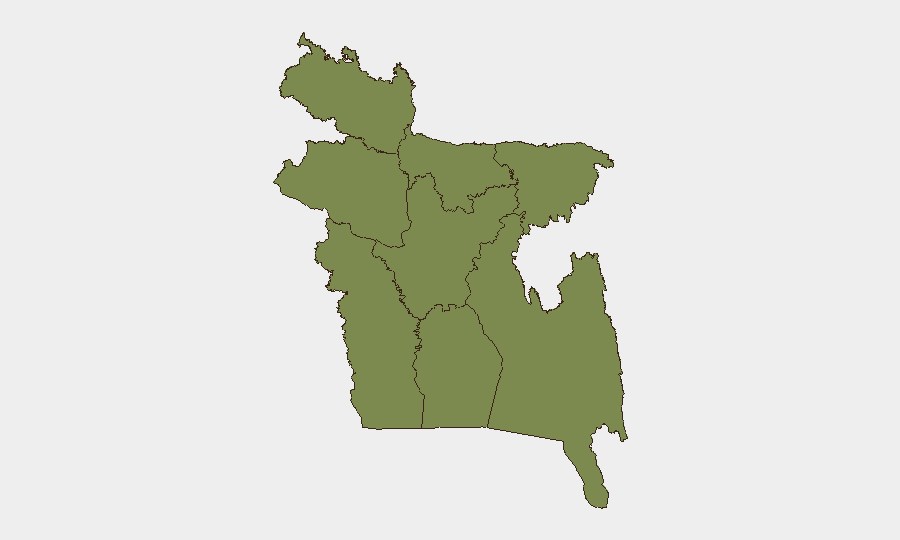
Dhaka Division dominates the threat landscape (risk 33.1), accounting for approximately 60 % of tracked national risk, with incidents spanning crude bombings, drug trafficking, organized robbery, infrastructure failures, and institutional disruption. Chittagong Division (18.9) and Rangpur Division (17.4) reflect sustained militant and armed-group activity, particularly in the Chittagong Hill Tracts where army operations target entrenched armed networks. Together, these three divisions account for the vast majority of measurable threat activity; remaining divisions (Khulna, Barishal, Sylhet) register minimal event density, suggesting either lower baseline instability or lower reporting visibility.
How GeoBit Would Assist
Corporate security teams would deploy Intel Sweep and multi-language OSINT fusion to monitor Telegram, Twitter, and Bengali-language channels for early signals of planned political violence or militant activity targeting foreign nationals or facilities. AOI Monitoring with persistent alerts on Dhaka Division, Savar upazila, and CHT regions would provide 24-hour threat notification tied to protest activity, security-force operations, or weapons movements. Network & Actor Analysis combined with regime-stability assessment would track institutional fractures (police command churn, factional tensions) that may amplify security gaps for foreign personnel during transitions.
7-Day Outlook
The combination of police leadership instability and persistent militant bombing capacity creates a near-term window of elevated uncertainty, particularly around political gatherings and security infrastructure. Continued army operations in the CHT and cross-border tensions suggest sustained low-level insurgent/militant activity, while urban crime enforcement intensity may temporarily suppress organized robbery and narcotics networks in Dhaka but is unlikely to eliminate underlying supply chains. Duty-of-care teams should expect sustained event reporting over the next 7 days and prepare contingency protocols for sudden institutional or command-level disruptions.
Highest-Risk Areas — Ranked
| # | State / Region | Risk |
|---|---|---|
| 1 | Dhaka Division | 33.1 |
| 2 | Chittagong Division | 18.9 |
| 3 | Rangpur Division | 17.4 |
| 4 | Rajshahi Division | 11.7 |
| 5 | Mymensingh Division | 11.7 |
| 6 | Khulna Division | 3.1 |
| 7 | Barishal Division | 3.1 |
| 8 | Sylhet Division | 3.1 |
Sources
Previous Daily Briefs
A new Bangladesh brief is written every day — each with its own risk map and downloadable CSV. Here's the last week; use the calendar to go further back.
📅 Browse every day by calendar →
Highlighted days have a brief. Tap a day for that day's map & analysis, or “csv” for that day's dataset ($5).
Atlas — our AI intelligence desk — emails them this snapshot personally. Nothing else, no list.