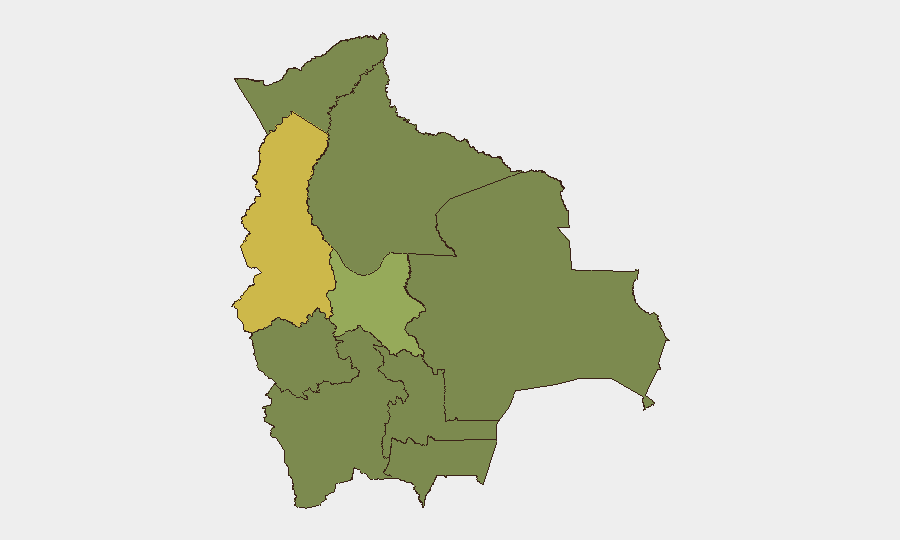
Situation Summary
Bolivia remains a moderate regional security concern (global rank #49) with composite threat score of 48 across 113 tracked events. La Paz and Cochabamba dominate the risk profile, driven by historical patterns of labor unrest, indigenous mobilization, and government instability rather than acute incidents in the immediate reporting window. Current trajectory reflects endemic political-economic fragility rather than sharp escalation, though currency and fiscal policy shifts create potential flashpoints for renewed protest activity.
Key Developments
Limited corroborated incidents identified in the 24–48 hour window. GeoBit's event signals reference a 2026-06-28 "Demand" event involving Bolivia and its government, but source material does not contain time-stamped, location-specific incident reporting sufficient to brief with confidence. A reported policy shift toward flexible exchange-rate adoption (ending the dollar peg) has circulated without clear date confirmation or visible security/protest linkage in current feeds. No cross-checked reports of active violence, road closures, or large-scale disruption in major cities (La Paz, Santa Cruz, Cochabamba) appear in available 24–48 hour sources. Recommended action: validate through direct contact with in-country security partners, local NGO incident trackers, or government security bulletins for real-time situational updates.
Highest-Risk Areas
La Paz (63.9) and Cochabamba (50.8) account for two-thirds of Bolivia's composite threat load. La Paz's elevated risk reflects its role as the de facto capital, seat of government, and hub for indigenous and labor organizations—making it the primary venue for political mobilization and civil unrest. Cochabamba's risk is rooted in its history as a center of mining labor activity, water-rights disputes, and regional autonomy tensions. Remaining departments (Potosí, Tarija, Pando, Beni, Oruro, Chuquisaca, Santa Cruz) cluster at lower but uniform risk levels (33.9), indicating diffuse baseline instability rather than localized hotspots. Santa Cruz, despite its economic importance, does not rank anomalously higher, suggesting current drivers are national political-economic rather than regional separatism.
How GeoBit Would Assist
Security teams should use Intel Sweep and multi-language OSINT (X/Twitter, local news, Telegram) to monitor La Paz and Cochabamba for labor, indigenous, and fiscal-policy protest signals in real time. AOI Monitoring & Early Warning with persistent geofencing around government buildings, key transport hubs, and mining regions would provide automated alerting of gatherings or disruption before they escalate to violence. Entity extraction and network analysis applied to government, union, and indigenous leadership communications would identify emerging coalition-building or mobilization timelines ahead of public announcement.
7-Day Outlook
No acute flashpoint is evident in the current 48-hour reporting, but the reported currency-policy shift creates structural risk for renewed labor and indigenous protest within the next 7–14 days if implementation is perceived as inflationary or welfare-reducing. Monitoring should intensify around any official announcement or legislative action on the exchange-rate regime. Road blockades and occupation of public spaces historically follow such announcements within 48–72 hours; duty-of-care teams should pre-position contingency travel routes and shelter-in-place protocols for La Paz and Cochabamba operations.
Highest-Risk Areas — Ranked
| # | State / Region | Risk |
|---|---|---|
| 1 | La Paz | 63.9 |
| 2 | Cochabamba | 50.8 |
| 3 | Potosí | 39.5 |
| 4 | Tarija | 33.9 |
| 5 | Pando | 33.9 |
| 6 | Beni | 33.9 |
| 7 | Oruro | 33.9 |
| 8 | Chuquisaca | 33.9 |
| 9 | Santa Cruz | 33.9 |
Sources
Previous Daily Briefs
A new Bolivia brief is written every day — each with its own risk map and downloadable CSV. Here's the last week; use the calendar to go further back.
📅 Browse every day by calendar →
Highlighted days have a brief. Tap a day for that day's map & analysis, or “csv” for that day's dataset ($5).