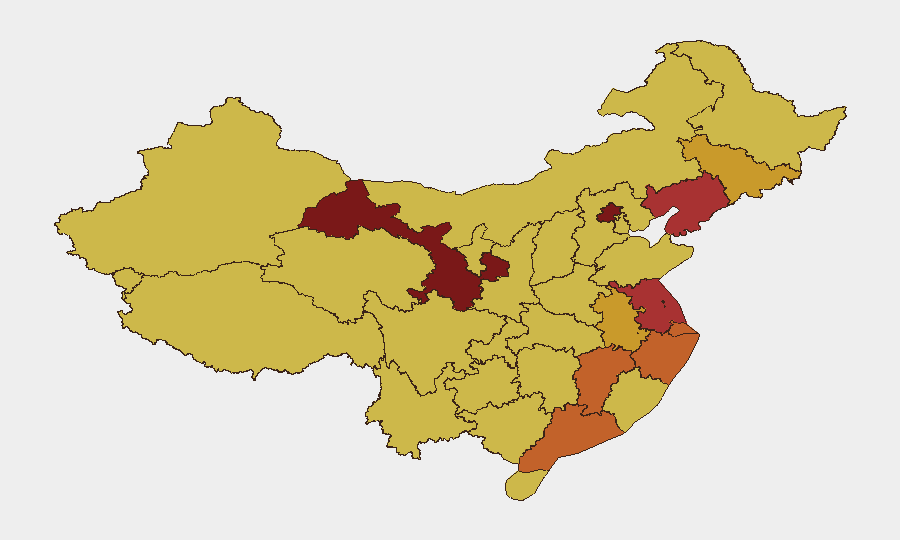
Situation Summary
China's composite threat score remains at #2 globally (100/100) with 878 tracked events, reflecting sustained tension across diplomatic, administrative, and military domains. Recent 24–48-hour activity signals include demonstrations, sanctions actions, investigations into foreign entities and individuals, military mobilization by external actors, and a significant aviation incident in Beijing with cascading security tightening across major financial hubs. The risk environment is characterized by heightened state scrutiny, infrastructure vulnerabilities, and reactive security postures in key economic zones.
Key Developments
- Beijing, Chaoyang District (2026-06-26): Small aircraft struck upper floors of CITIC Tower; debris scattered, emergency response deployed, structural damage assessment underway, casualty figures not yet confirmed.
- Shanghai, Lujiazui (2026-06-26): Finance district security tightened following Beijing aviation incident; events postponed or moved indoors, police patrols increased, bag inspections and access controls implemented at major skyscrapers.
- Guangzhou, Tianhe & Baiyun (2026-06-26): Coordinated police raids against drug-laced e-cigarette distribution; vape shops and warehouses targeted, seizures and detentions reported.
- National level (2026-06-26): Administrative sanctions imposed; public statements issued on multiple policy fronts; disapproval signaled toward Japan and unnamed industry sectors.
- Cross-border (2026-06-26): Military mobilization reported by New Zealand directed at China; relations with companies reduced by Beijing authorities.
- International investigations (2026-06-25): China-linked investigations initiated by European Union; separate student-related investigation underway.
Highest-Risk Areas
Beijing (100) and Gansu (90.8) lead the sub-national ranking, with Beijing's elevation driven by the aviation incident, central-government activity concentration, and diplomatic intensity. The next tier—Liaoning, Jiangsu, Zhejiang, Guangdong, Shanghai, Jiangxi, and Anhui (77–71 risk)—encompasses China's industrial, financial, and manufacturing heartland, where state oversight, border sensitivity, and corporate-sector scrutiny converge. Gansu's disproportionate risk reflects persistent sensitivities around governance and regional stability. Corporate and expatriate personnel in Beijing, Shanghai, and Guangdong should assume elevated operational friction, access restrictions, and investigative activity.
How GeoBit Would Assist
Security teams operating in China should deploy Intel Sweep and multi-language OSINT fusion to track evolving sanctions, administrative actions, and cross-border investigations in near-real time. AOI Monitoring & Early Warning focused on Beijing, Shanghai, Guangzhou, and other Tier-1 cities provides persistent watch on protest activity, police operations, and infrastructure incidents with immediate alerting to duty-of-care teams. Entity & Network Analysis combined with X/Twitter and Telegram OSINT surfaces emerging enforcement actions, visa/visa-denial patterns, and sector-specific regulatory shifts before they affect operations or personnel movement.
7-Day Outlook
Expect continued administrative action and policy statements from Beijing; the aviation incident is likely to prompt extended security protocols in major cities over the next 7–10 days. Diplomatic friction with Japan and ongoing investigations by external actors suggest China may expand sanctions or access restrictions on select foreign entities and individuals. Personnel should anticipate delays in visa processing, event clearances, and facility access in Beijing, Shanghai, and Guangdong through early July.
Highest-Risk Areas — Ranked
| # | State / Region | Risk |
|---|---|---|
| 1 | Beijing | 100 |
| 2 | Gansu | 90.8 |
| 3 | Liaoning | 77.4 |
| 4 | Jiangsu | 77.1 |
| 5 | Zhejiang | 74.9 |
| 6 | Guangdong Province | 73.4 |
| 7 | Shanghai | 73.4 |
| 8 | Jiangxi | 73.1 |
| 9 | Anhui | 71.5 |
| 10 | Jilin | 71.1 |
| 11 | Guangxi | 70.9 |
| 12 | Sichuan | 70.8 |
Sources
Previous Daily Briefs
A new China brief is written every day — each with its own risk map and downloadable CSV. Here's the last week; use the calendar to go further back.
📅 Browse every day by calendar →
Highlighted days have a brief. Tap a day for that day's map & analysis, or “csv” for that day's dataset ($5).