Situation Summary
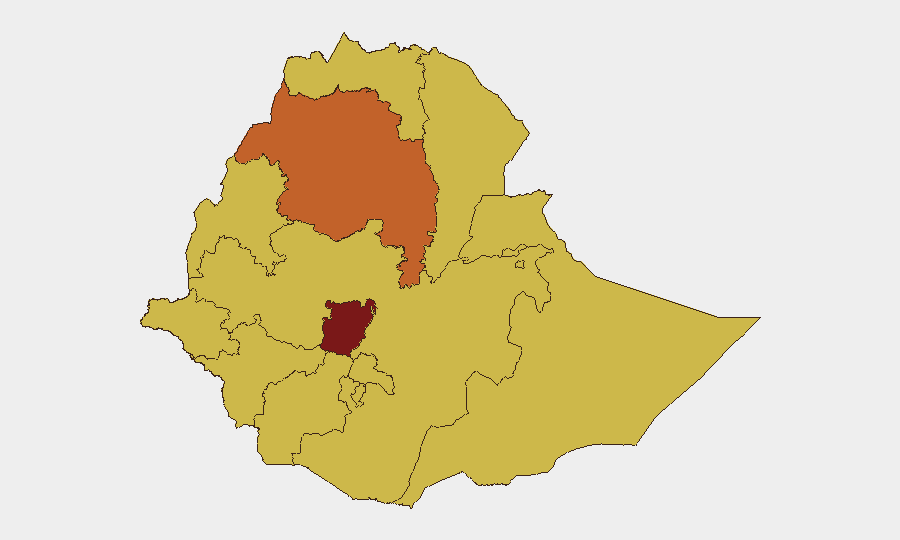
Ethiopia remains at composite threat rank #9 globally, driven principally by ongoing civil-war dynamics and fragile post-conflict stability. The Tigray Region continues to be the epicenter of security concern following the intensification of forced-recruitment campaigns since late April 2026. Parliamentary debate on 2026-07-07 confirms that national security—particularly in northern Ethiopia—remains a live policy priority, even as the Prime Minister publicly frames dialogue as the primary peace mechanism. Central Ethiopia Regional State carries the highest sub-national risk score (100), indicating that conflict pressures extend well beyond Tigray into the broader northern and central corridor.
Key Developments
- Tigray Region, 2026-07-07: Human Rights Watch documented a systematic forced-recruitment campaign targeting civilians as young as 15, including street roundups, nighttime home searches, and detentions at workplaces and mining sites. Multiple international media outlets corroborated the report.
- Tigray Region, 2026-07-07: HRW assessed that the recruitment intensification since late April 2026 risks undermining fragile peace efforts and generating a climate of fear across the region, undercutting stability gains.
- Addis Ababa (House of People's Representatives), 2026-07-07: Prime Minister Abiy Ahmed stated that community and interfaith conflicts have declined significantly and reaffirmed dialogue-based approaches; simultaneously, lawmakers pressed the government on security in northern Ethiopia, inflation, and infrastructure delays, reflecting persistent public and legislative concern.
- Addis Ababa, 2026-07-07: Parliamentary questioning on the Tigray peace process and northern security situation underscores that political consensus on conflict resolution remains contested at the national level.
- Addis Ababa, 2026-07-07: High-level African Union–Russian Federation consultations occurred in the capital, reflecting diplomatic activity on regional security matters, though no specific violent incident or policy shift was reported.
- Nationwide event signal pattern (2026-07-06 to 2026-07-08): Concurrent public statements, demonstrations, and territory-occupation reports across multiple event categories suggest sustained activist/civil-society pressure and government messaging activity, consistent with an ongoing political crisis rather than a discrete attack.
Highest-Risk Areas
Central Ethiopia Regional State, Amhara Region, and Tigray form the critical risk corridor, with Tigray (risk 70) and Amhara (74.5) serving as active theaters for recruitment, potential violence, and humanitarian friction. The forced-recruitment campaign in Tigray—now documented as systematic and intensified—directly explains elevated risk scores in the north. Critically, all twelve major regions and Addis Ababa itself carry risk scores of 70–100, indicating that instability is geographically distributed rather than localized; this suggests that conflict pressures, economic strain, and intercommunal tensions are present across the country, limiting safe operational corridors. Central Ethiopia Regional State's exceptional risk score (100) warrants specific attention from teams with assets or personnel in that zone.
How GeoBit Would Assist
Organizations operating in Ethiopia should employ AOI Monitoring & Early Warning to track Tigray, Central Ethiopia Regional State, and Amhara with persistent alerting on recruitment, detention, and movement activity. OSINT fusion and multi-language search capabilities allow continuous monitoring of parliamentary proceedings, NGO reporting, and regional media for early signals of policy shifts or localized escalation. Routing & Network Analysis and GIS & Spatial Analysis support alternative journey planning and safe-zone mapping for personnel movement and asset positioning.
7-Day Outlook
Forced-recruitment pressures in Tigray are likely to persist absent a marked diplomatic breakthrough; parliamentary scrutiny will continue, signaling that peace consensus remains fragile. Risk of secondary violence—communal clashes, security-force friction, or protest escalation—remains elevated across the northern and central regions through mid-July 2026, particularly if recruitment intensifies further or humanitarian access is restricted.
Highest-Risk Areas — Ranked
| # | State / Region | Risk |
|---|---|---|
| 1 | Central Ethiopia Regional State | 100 |
| 2 | Amhara Region | 74.5 |
| 3 | Tigray | 70 |
| 4 | Afar Region | 70 |
| 5 | Benishangul-Gumuz Region | 70 |
| 6 | Somali Region | 70 |
| 7 | Gambela Region | 70 |
| 8 | South West Ethiopia Peoples | 70 |
| 9 | Addis Ababa | 70 |
| 10 | South Ethiopia Regional State | 70 |
| 11 | Oromia Region | 70 |
| 12 | Sidama | 70 |
Sources
Previous Daily Briefs
A new Ethiopia brief is written every day — each with its own risk map and downloadable CSV. Here's the last week; use the calendar to go further back.
📅 Browse every day by calendar →
Highlighted days have a brief. Tap a day for that day's map & analysis, or “csv” for that day's dataset ($5).
Atlas — our AI intelligence desk — emails them this snapshot personally. Nothing else, no list.