Situation Summary
France remains at composite threat level 44 globally, with 224 tracked events, reflecting a multifaceted security environment shaped by terrorism concerns, civil-order volatility, and elevated state-level tensions. A stolen-vehicle incident involving military-grade firearms near a Paris-area synagogue, coupled with heatwave-driven public-event cancellations and a disclosed breach of government encrypted communications, has raised operational and governance risk across the country over the past 48 hours. Ile-de-France dominates sub-national risk (60.5), driven by concentration of critical infrastructure, large crowds, and active threat signals. The security posture is strained but stable; near-term escalation depends on investigation outcomes and political/event-management decisions.
Key Developments
- Sarcelles (Val-d'Oise), Saturday 12 July, evening: Police evacuated approximately 300 residents from Rue Henri-Dunant after locating a stolen vehicle containing a military-grade long firearm and handgun near the Great Synagogue, restaurants, and cinema. Bomb disposal found no explosives; anti-terror prosecutors opened investigation into suspected terrorist criminal organization. No suspects or motive identified as of 14 July.
- Nationwide heatwave response, weekend 11–12 July: Orange alert issued in Haute-Loire; Eiffel Tower and Louvre closed early (4 pm) over weekend; many towns cancelled Bastille Day fireworks due to wildfire risk, affecting large public gatherings and travel.
- Government communications breach, disclosed recent days: French government confirmed breach of Tchap encrypted messaging platform affecting 73,000+ public-sector employees, raising exposure risk for official communications and potential cascading security/infrastructure impacts.
- Paris (Les Halles), Friday 10 July, night: Municipal police vehicle attacked near Les Halles during post-World Cup celebrations; incident under investigation, reflecting sporadic civil-unrest risk around football events.
- Police firearms presumption bill, recent parliamentary vote: National Assembly voted to establish presumption of legitimate self-defense for police firearm use, shifting burden of proof to victims/families. Legal analysts warn this may increase perceptions of police impunity, fueling distrust and protest risk.
- Multiple state-level tensions, 14 July: Public statements and military signals involving France, Ukraine, Iran, Spain, and Russia recorded on 14 July; unconventional violence event flagged in Paris context.
Highest-Risk Areas
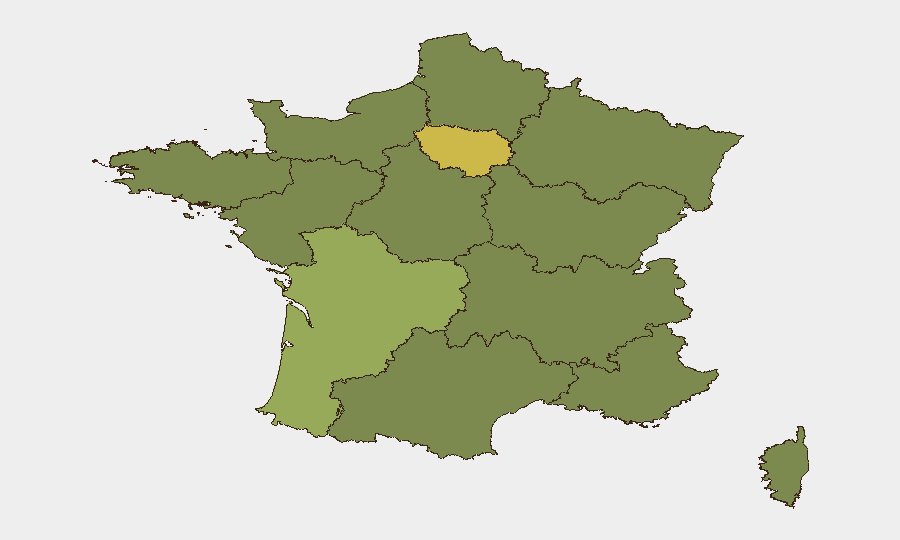
Ile-de-France (60.5) is the dominant risk driver, reflecting Paris's role as capital, transportation hub, and target concentration for both terrorism and large-event disorder. Nouvelle-Aquitaine (48.7) ranks second, suggesting secondary urban and border-adjacent vulnerabilities. The next tier—Pays de la Loire, Auvergne-Rhône-Alpes, Corsica, and Normandy (34–31 range)—reflects distributed civil-unrest, infrastructure, and cross-border or separatist-linked activity. Ile-de-France's risk is substantially higher than peers, warranting heightened asset and personnel monitoring in and around Paris metropolitan and critical-infrastructure zones.
How GeoBit Would Assist
Intel Sweep, OSINT fusion, and Telegram/X monitoring would track emerging actor statements, recruitment signals, and tactical chatter related to the Sarcelles investigation and any linked networks. AOI monitoring with alerting on high-risk zones (Paris central, Ile-de-France transport nodes, synagogues, major events) would provide early warning of protest, gathering, or security-force escalation. Entity extraction and network analysis would map relationships among state and non-state actors signaling on 14 July, clarifying intent and escalation likelihood.
7-Day Outlook
Investigation findings on the Sarcelles incident will be the primary near-term driver of threat trajectory; any arrest or motive disclosure could trigger secondary civil unrest or copycat activity. Heatwave-driven event cancellations reduce short-term crowd-disorder risk but extend uncertainty around Bastille Day observances and summer-holiday travel. State-level tensions (France–Ukraine, France–Spain) are unlikely to translate to direct kinetic escalation in metropolitan France but may increase cyber, disinformation, or proxy activity targeting government and critical infrastructure.
Highest-Risk Areas — Ranked
| # | State / Region | Risk |
|---|---|---|
| 1 | Ile-de-France | 60.5 |
| 2 | Nouvelle-Aquitaine | 48.7 |
| 3 | Pays de la Loire | 34.3 |
| 4 | Auvergne-Rhône-Alpes | 31.9 |
| 5 | Corsica | 30.8 |
| 6 | Normandy | 30.7 |
| 7 | Occitania | 30.6 |
| 8 | Brittany | 30.4 |
| 9 | Hauts-de-France | 30.4 |
| 10 | Centre-Val de Loire | 30.4 |
| 11 | Grand Est | 30.4 |
| 12 | Bourgogne – Franche-Comté | 30.4 |
Sources
Previous Daily Briefs
A new France brief is written every day — each with its own risk map and downloadable CSV. Here's the last week; use the calendar to go further back.
📅 Browse every day by calendar →
Highlighted days have a brief. Tap a day for that day's map & analysis, or “csv” for that day's dataset ($5).
Atlas — our AI intelligence desk — emails them this snapshot personally. Nothing else, no list.