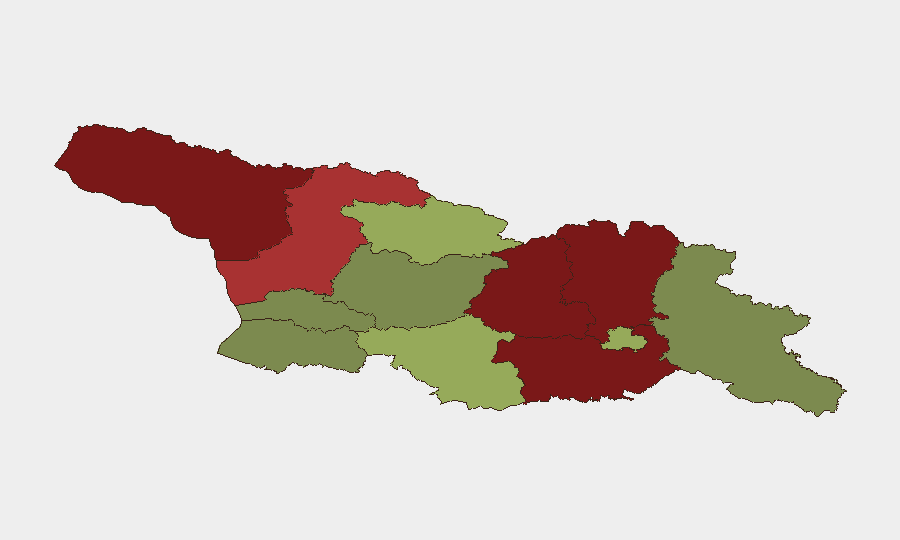
Situation Summary
Georgia remains a low-threat country overall (composite score 2, no tracked events globally), but sub-national risk is highly concentrated in separatist-controlled and border regions. Recent weeks have seen notable infrastructure-security concerns—including a July 24–25 sabotage investigation into nationwide power outages—and transnational crime activity in the capital, but no verified incidents within the last 24–48 hours. The security environment is stable outside conflict-affected areas, though critical infrastructure and border-region monitoring remain operationally important.
Key Developments
No verified security or travel-risk incidents have been reliably dated to July 31–August 1, 2026. Open-source news and social content contain references to earlier July events (power outages on July 24–25, firearms arrests on July 29, and an alleged uranium-purchase detention in late July) and historical risk assessments, but none meet the 24–48-hour window with confirmed timestamps.
*Note to duty-of-care teams:* Recent activity outside the immediate 24–48-hour window includes:
- Power-grid sabotage investigation (July 24–25, nationwide): State Security Service opened a criminal probe into emergency outages treated as possible deliberate infrastructure interference.
- Transnational firearms and narcotics arrest (July 29, Tbilisi): Three foreign nationals detained during an illicit arms transaction; weapons, ammunition, and suspected drugs seized.
Absence of current alerts should not be misinterpreted as absence of risk in high-risk zones (see below).
Highest-Risk Areas
The Autonomous Republic of Abkhazia (risk 95) and the South Ossetia-adjacent regions of Shida Kartli (88) and Lower Kartli (85) dominate sub-national threat levels, reflecting unresolved territorial disputes, limited Georgian state control, and proximity to Russian military presence. Mtskheta-Mtianeti (82) and Samegrelo-Upper Svaneti (78) carry elevated risk from similar geopolitical drivers. By contrast, western coastal regions (Guria, Adjara) and central lowlands (Imereti, Kakheti) present substantially lower risk. Tbilisi, despite recent transnational crime arrests, ranks at 45—moderate by comparison—indicating that capital-city incidents remain isolated relative to conflict-zone volatility.
How GeoBit Would Assist
Corporate teams with personnel or assets in Georgia should leverage AOI Monitoring & Early Warning on Abkhazia, Shida Kartli, and Lower Kartli to detect border movements, military activity, or access-route changes with persistent alerting. Intel Sweep and multi-language OSINT (X/Twitter, Telegram, local media, radio SIGINT) provide 24/7 detection of civil unrest, security-force activity, or infrastructure failures before they affect operations. Routing & Network Analysis enables real-time alternative-route planning for staff or supply chains if primary corridors become impassable due to military activity or unannounced checkpoints.
7-Day Outlook
No significant escalation is expected in the near term; however, the recent sabotage investigation into power infrastructure suggests ongoing state-security attention to critical systems. Separatist-zone volatility remains the primary driver of sub-national risk and will likely persist as a background concern. Teams should maintain standard monitoring of border regions and continue capability-based contingency planning for supply-chain or personnel movement disruptions.
Highest-Risk Areas — Ranked
| # | State / Region | Risk |
|---|---|---|
| 1 | Autonomous Republic of Abkhazia | 95 |
| 2 | Shida Kartli | 88 |
| 3 | Lower Kartli | 85 |
| 4 | Mtskheta-Mtianeti | 82 |
| 5 | Samegrelo-Upper Svaneti | 78 |
| 6 | Samtskhe-Javakheti | 48 |
| 7 | Tbilisi | 45 |
| 8 | Racha-Lechkhumi and Kvemo Svaneti | 42 |
| 9 | Kakheti | 38 |
| 10 | Autonomous Republic of Adjara | 35 |
| 11 | Imereti | 32 |
| 12 | Guria | 28 |
Sources
Previous Daily Briefs
A new Georgia brief is written every day — each with its own risk map and downloadable CSV. Here's the last week; use the calendar to go further back.
📅 Browse every day by calendar →
Highlighted days have a brief. Tap a day for that day's map & analysis, or “csv” for that day's dataset ($5).
Atlas — our AI intelligence desk — emails them this snapshot personally. Nothing else, no list.